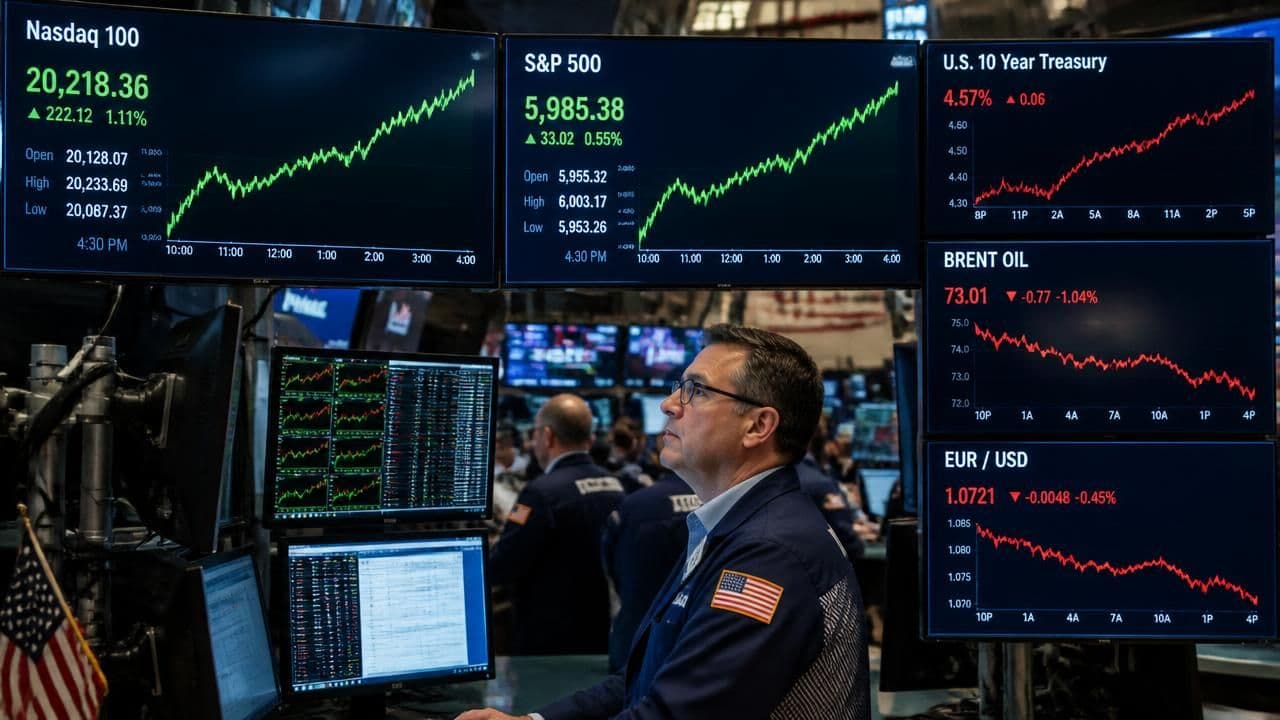
Asian bond markets opened lower on Thursday, tracking a pullback in U.S. Treasuries after a brief rally lost steam. The dollar also came under renewed pressure as investors grew skeptical that Washington's latest effort to contain long-term borrowing costs through debt buybacks would provide anything more than a temporary reprieve.
The moves underscore a growing sense of unease in global fixed income markets, where concerns over fiscal deficits, persistent inflation, and an unprecedented wave of government debt supply continue to clash with central bank efforts to stabilize yields.
Asian Bonds Retreat as Treasury Rally Fades
Japan's 10-year government bond yield rose by 3 basis points to 0.92%, while Australia's 10-year yield climbed 5 basis points to 4.35%. South Korea's benchmark yield added 4 basis points, and Singapore's 10-year yield edged up 2 basis points. Across the region, sovereign debt prices fell as demand for safe-haven assets waned.
The pullback followed a fleeting rally in U.S. Treasuries overnight, where yields initially dropped after the Treasury Department announced plans to buy back up to $30 billion in long-dated debt over the next quarter. The buyback, part of a broader effort to smooth out market functioning and reduce volatility in the long end, briefly pushed the 10-year Treasury yield down to 4.45% before it rebounded to 4.52%.
"The market sees this as a band-aid, not a cure," said Priya Natarajan, head of fixed income strategy at Meridian Global Advisors in Singapore. "The fundamental problem is that the U.S. is issuing an enormous amount of debt to fund fiscal deficits, and buybacks don't reduce the net supply — they just change the maturity profile."
Dollar Slips as Buyback Skepticism Grows
The dollar index, which measures the currency against six major peers, slipped 0.2% to 104.3, extending its decline from earlier this week. The yen strengthened to 154.8 per dollar, while the euro inched up to $1.0875. Asian currencies also gained modestly, with the Korean won rising 0.3% and the Thai baht gaining 0.2%.
Traders interpreted the dollar's weakness as a signal that investors are not convinced the buyback program will succeed in keeping a lid on yields. If long-term U.S. yields continue to climb, the interest rate differential would typically favor the dollar, but the market seems to be looking ahead to eventual Federal Reserve rate cuts.
"The buyback announcement was a bit of a surprise, but it's a drop in the bucket relative to the Treasury's borrowing needs," said Marcus Chen, a foreign exchange strategist at Bank of Asia in Hong Kong. "The dollar is more focused on the Fed's path and the upcoming inflation data."
The Buyback Program: A Temporary Fix?
The U.S. Treasury's buyback program, first announced in January, is designed to repurchase outstanding securities in the secondary market. The stated goals are to improve liquidity, reduce volatility, and manage the government's cash position. The latest operation, which began this week, targets long-dated bonds with maturities of 10 years or more.
"This is not quantitative easing. It's a liability management tool. But it's also a signal that the Treasury is worried about the steepness of the yield curve and the cost of borrowing."
That assessment came from Lisa Montgomery, a former Federal Reserve economist now at the Brookings Institution, in a note to clients. She added that buybacks could temporarily support prices, but they do nothing to address the underlying supply forces.
Data from the U.S. Treasury shows that the federal government is on track to issue over $1.8 trillion in net new debt this fiscal year, up from $1.3 trillion last year. The Congressional Budget Office projects that average annual deficits will remain above $1.5 trillion through 2034, keeping upward pressure on yields.
Historical Context and Investor Concerns
This is not the first time the Treasury has used buybacks. In the early 2000s, the department repurchased bonds to reduce government debt when budget surpluses were running high. But the current environment is different: the government is running large deficits, and the buybacks are being funded by issuing short-term bills, which effectively steepens the curve.
Some analysts draw parallels to Operation Twist, a Fed program in 2011 and 2012 that sold short-dated securities and bought long-dated ones to push down long-term yields. But the Treasury's buyback is smaller and less direct.
"The market is questioning whether this is a precursor to yield curve control," said Natarajan. "In Japan, the central bank had to step in aggressively to cap yields, and even then it faced distortions. The U.S. is unlikely to go that route, but the buyback could be the first step."
Investors are also watching the Federal Reserve's balance sheet runoff, or quantitative tightening, which is reducing the Fed's holdings of Treasuries by up to $60 billion per month. That adds to the net supply that the private sector must absorb.
Implications for Global Markets and Central Banks
The build-up in U.S. yields has ripple effects across Asia. Higher yields attract capital from emerging markets, putting pressure on local currencies and forcing central banks to hike rates or intervene. But many Asian central banks are already grappling with slowing growth and inflation that is gradually returning to target.
In the near term, strategists expect the dollar to remain rangebound, with risks tilted to the downside if U.S. inflation data due next week comes in softer than expected. For bond traders, the key will be the auction cycle next month, when the Treasury sells a fresh batch of coupon-bearing debt.
- Japan's Ministry of Finance has signaled that it is watching currency movements closely and may intervene if the yen weakens beyond 155 per dollar.
- Australia's central bank is expected to hold rates steady in June, but a surge in global yields could force a hawkish tilt.
- China's bond market has remained relatively insulated, with the 10-year yield stable at 2.3%, as the People's Bank of China maintains its easing bias.
The bottom line, according to analysts, is that the global bond market is entering a period of heightened sensitivity to supply and policy signals. The Treasury buyback may provide a floor under prices for now, but it is unlikely to reverse the trend of rising long-term yields that has defined the post-pandemic era.
"We are in a new regime where fiscal dominance is reasserting itself," said Montgomery. "Central banks and Treasuries are trying to manage the yield curve without stoking inflation. That is a very delicate balance, and the margin for error is thin."
For investors, the advice is to stay nimble. "Don't fight the trend, but don't assume that any one policy move will change the course," said Chen. "The next few months will be volatile."