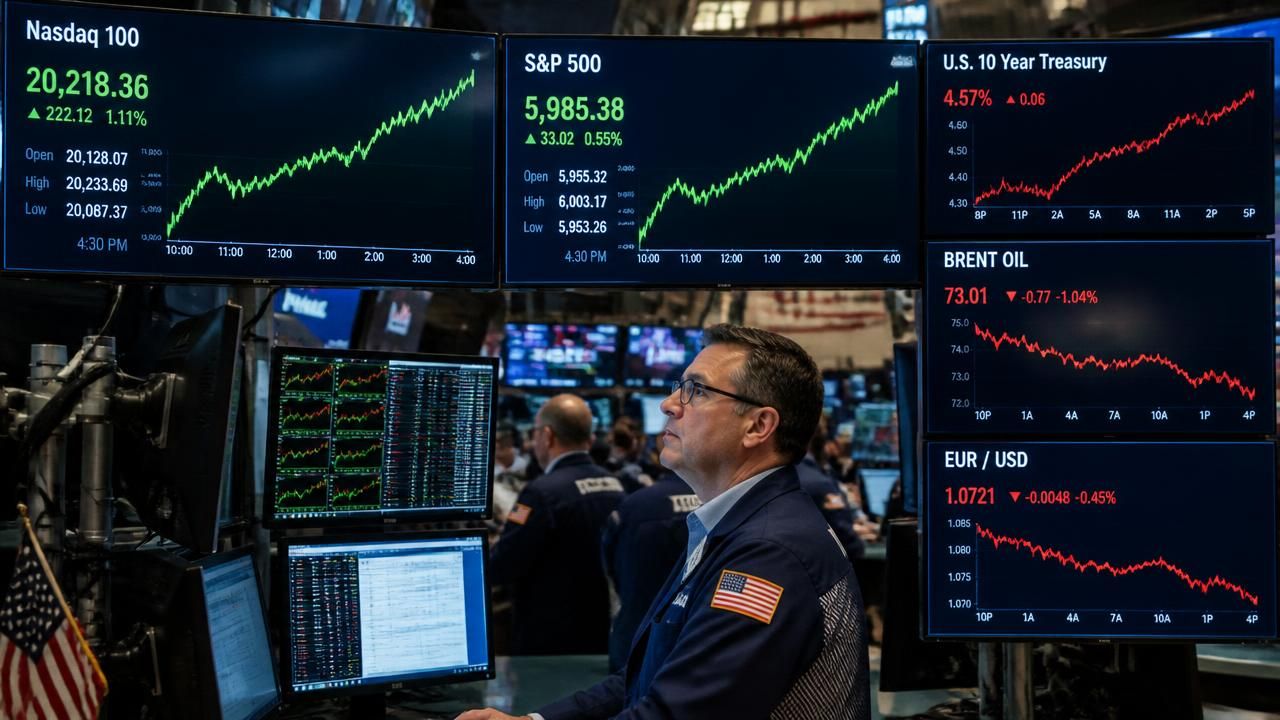
The S&P 500 finished Monday within striking distance of an all-time high, powered by a rally in the giant technology companies that dominate U.S. equity benchmarks, while the Nasdaq 100 climbed to a fresh record. The advance came against a backdrop that would ordinarily unsettle investors: still-elevated oil prices, long-dated Treasury yields at multi-decade highs, renewed inflation anxiety and political upheaval in Europe.
According to Bloomberg's markets wrap, the tech-led move was strong enough to overshadow those concerns rather than resolve them — a distinction that separates a durable breakout from a narrow, momentum-driven squeeze. MarketWatch framed the same session differently, attributing the rally to falling oil prices, while MSN's coverage pointed to an "AI rally" and cautioned that Wall Street futures had paused as traders turned their attention to Middle East tensions.
The Tech Engine Room
The Nasdaq 100's record close was the session's headline achievement, and it fits a pattern that has defined the past two years: capital concentrating in a shrinking group of mega-cap technology and artificial intelligence names whose earnings have proven unusually resilient to higher borrowing costs. The S&P 500's approach to its prior peak reflects the same gravitational pull, since the index's largest constituents are precisely the companies driving the gains.
Zooming out, the move extends a striking run of market resilience. Equities have absorbed rising rates, high energy costs and renewed inflation concerns while continuing to advance — a combination that has repeatedly confounded strategists who expected tighter financial conditions to force a valuation reset.
“A rally in giant technology companies drove stocks higher in the Monday session, overshadowing concerns about still-elevated oil prices and bond yields.” — Bloomberg Markets Wrap
Rates, Oil and a Weak Euro
The crosscurrents are not trivial. Longer-dated Treasury yields reached multi-decade highs, a signal that investors are demanding more compensation for duration risk amid sticky inflation and heavy government borrowing. Higher long-end yields raise the discount rate applied to future corporate earnings — precisely the cash flows that make growth stocks most sensitive to rate moves.
At the same time, political upheaval in Europe and fiscal worries on the continent drove the euro to its weakest level since May 2025. A softer euro is a double-edged sword: it flatters European exporters' competitiveness but imports inflation and complicates the European Central Bank's path, while a stronger dollar can weigh on U.S. multinationals' overseas earnings.
Two headlines, one session
The divergence between Bloomberg and MarketWatch is instructive. Bloomberg characterized oil as "still-elevated," a persistent headwind the market overcame; MarketWatch described falling crude as the fuel for the rally itself. The two framings are not mutually exclusive — oil can remain historically expensive while easing from a recent high, and a softer crude print can simultaneously relieve inflation pressure and lift risk appetite. What the difference reveals is editorial emphasis: one outlet foregrounded the market's ability to shrug off bad news, the other the specific catalyst of the day.
Context From the Desk
On Bloomberg Businessweek Daily, hosts Carol Massar and Norah Mulinda turned to Carol Schleif, chief market strategist at BMO Wealth Management, for perspective on the broader market backdrop — a reminder that the question occupying strategists is less whether tech can rally and more how long the rally can outrun the cost of capital.
The historical parallel most frequently invoked is the late-1990s, when technology leadership similarly powered indices to records even as bond yields rose. That episode ended badly, but not before an extended period in which skepticism was costly. Bulls counter that today's leaders are highly profitable, cash-rich and less dependent on debt financing than their dot-com predecessors — an argument that has held up through multiple rate scares.
Asia Braces for the Spillover
The rally is now a global story. Singapore-based The Edge reported that Asian stocks were set to rise following the tech-driven push that carried the S&P to a record, with regional technology exporters typically the first to price in Wall Street's overnight leadership. That transmission channel works both ways: Asian chipmakers and hardware suppliers sit directly in the AI supply chain that U.S. investors are rewarding.
Notably, several syndicated versions of the same wire story arrived in degraded form — Yahoo Finance returned a rate-limit notice, MSN served a bare stub, and The Edge's page returned an error. The pattern is a familiar one in modern financial media, where a single original report propagates across dozens of portals faster than any of them can verify or enrich it.
What to Watch
- The long end of the curve. If multi-decade-high yields keep climbing, the discount-rate math eventually competes with earnings momentum.
- Crude prices. Middle East tensions remain the wild card MSN's coverage flagged; an oil spike would test the market's composure far more than a drift lower.
- Europe's politics and the euro. Fiscal instability there feeds directly into currency markets and, by extension, U.S. corporate earnings translations.
- Breadth. A record built narrowly on a handful of AI winners is more fragile than one confirmed by broader participation.
For now, the tape's message is unambiguous: investors are choosing to be paid for optimism rather than paid to wait.