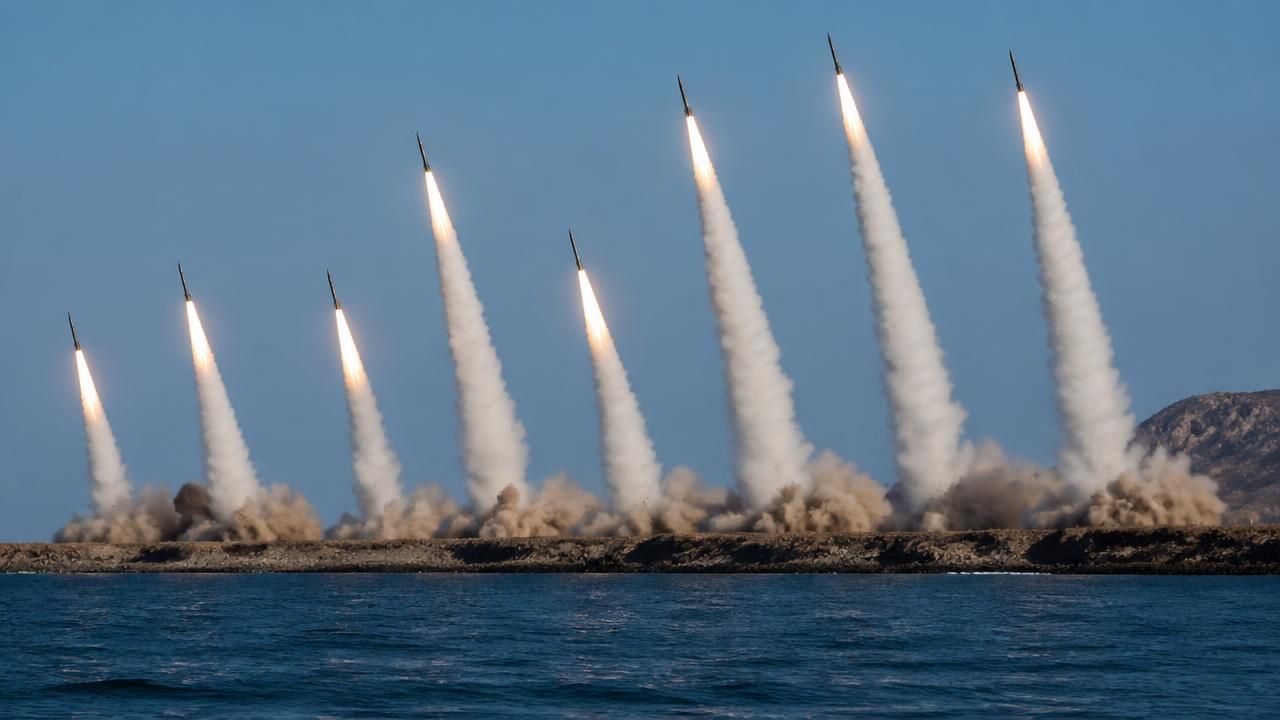
North Korea fired approximately 10 short-range ballistic missiles toward the sea on Thursday, South Korea's Joint Chiefs of Staff and Japan's Defense Ministry confirmed. The launch, detected in the early morning hours, was initially reported as an unidentified projectile by Seoul and later identified as a suspected ballistic missile by Tokyo. The projectiles splashed down in the Sea of Japan, also known as the East Sea, marking one of North Korea's largest single-day missile salvos in recent months.
- Approximately 10 short-range ballistic missiles were fired from North Korea's eastern coast.
- The missiles landed in the Sea of Japan, with no immediate reports of damage or casualties.
- The launch came one day after the U.S. scaled back military drills with South Korea.
- North Korea dismissed the U.S. overture, saying it “changes nothing.”
- Both Japan and South Korea tracked the projectiles and issued maritime safety warnings.
Details of the Barrage
The missiles were launched from North Korea's eastern coastal region, according to Japan's Coast Guard, which issued a maritime safety advisory for vessels in the area. South Korean military officials said the missiles flew a relatively short distance, indicating they were short-range ballistic missiles (SRBMs) designed to strike targets in the region. The scale of the launch — 10 missiles in quick succession — demonstrates a capability to saturate missile defenses and sends a clear message of military readiness.
A Diplomatic Overture Rebuffed
President Donald Trump had expressed hope for a meeting with North Korean leader Kim Jong Un later this year, and the decision to trim the allies' annual drills was widely seen as an attempt to create conditions for dialogue. However, North Korea quickly dismissed the gesture. In a statement carried by state media, the North Korean Foreign Ministry said the U.S. move “changes nothing,” echoing a pattern of rejecting Washington's offers unless accompanied by tangible security guarantees.
“Changes nothing.” — North Korean Foreign Ministry
This is not the first time North Korea has used missile launches to signal displeasure. Since the breakdown of the 2019 Hanoi summit between Trump and Kim, Pyongyang has repeatedly test-fired short-range missiles while keeping intercontinental ballistic missiles (ICBMs) and nuclear tests in reserve. The strategy, analysts say, is to apply pressure without crossing a red line that would trigger severe international consequences.
International Reactions and Regional Security
Japan's Chief Cabinet Secretary condemned the launches as a threat to regional peace, while South Korea's National Security Council convened an emergency meeting to assess the situation. The United States did not immediately issue a formal response, but the launches put the White House in an awkward position, undercutting the administration's narrative of diplomatic progress.
The news coverage reflects differing priorities across outlets. The New York Post and The Guardian led with the sheer number of missiles, while Japanese media focused on the ballistic missile trajectory and Tokyo's response. Meanwhile, sources like Castanet.net framed the story as North Korea “dismissing an overture” from Trump, highlighting the diplomatic dimension. These varying angles illustrate the complex interplay between military provocation and political signaling.
Historical Context and Next Steps
The Korean Peninsula remains technically in a state of war, as the 1950-53 conflict ended with an armistice, not a peace treaty. The U.S.-South Korea alliance has maintained a significant military footprint, and North Korea has long demanded the withdrawal of American forces and an end to joint exercises as a precondition for denuclearization.
Past summits in Singapore (2018) and Hanoi (2019) produced little concrete progress. While Kim declared a moratorium on ICBM and nuclear tests, that self-imposed ban has been frayed by continued SRBM launches, which are not covered by the moratorium. The United Nations has imposed sanctions on North Korea, but enforcement remains uneven.
What Analysts Are Saying
Observers note that North Korea's tactical approach is carefully calibrated. By firing short-range missiles, the regime avoids violating its declared moratorium on long-range testing, thereby limiting international condemnation while still demonstrating military capability. The launches also serve a domestic purpose, reinforcing Kim's image as a strong leader who stands up to foreign pressure.
Some regional security experts describe a cyclical pattern: diplomatic initiatives are met with provocations, followed by a pause, and then a return to talks once both sides recalibrate. Thursday's barrage suggests that cycle is now in a provocative phase, with Pyongyang demanding more substantive concessions, such as sanctions relief or a formal end-of-war declaration.
Implications for Diplomacy
The missile barrage complicates efforts to resume denuclearization talks. The U.S. decision to scale back exercises was intended as a goodwill gesture, but North Korea's response indicates that more substantial offers will be required to bring Pyongyang back to the table. The incident also underscores the fragility of peace on the Korean Peninsula and the challenges facing any administration seeking to strike a deal with a regime that has consistently defied diplomatic efforts.
For now, the missiles serve as a stark reminder that North Korea's arsenal continues to advance, and that the window for successful diplomacy may be narrowing. The world watches closely as both sides weigh their next moves.