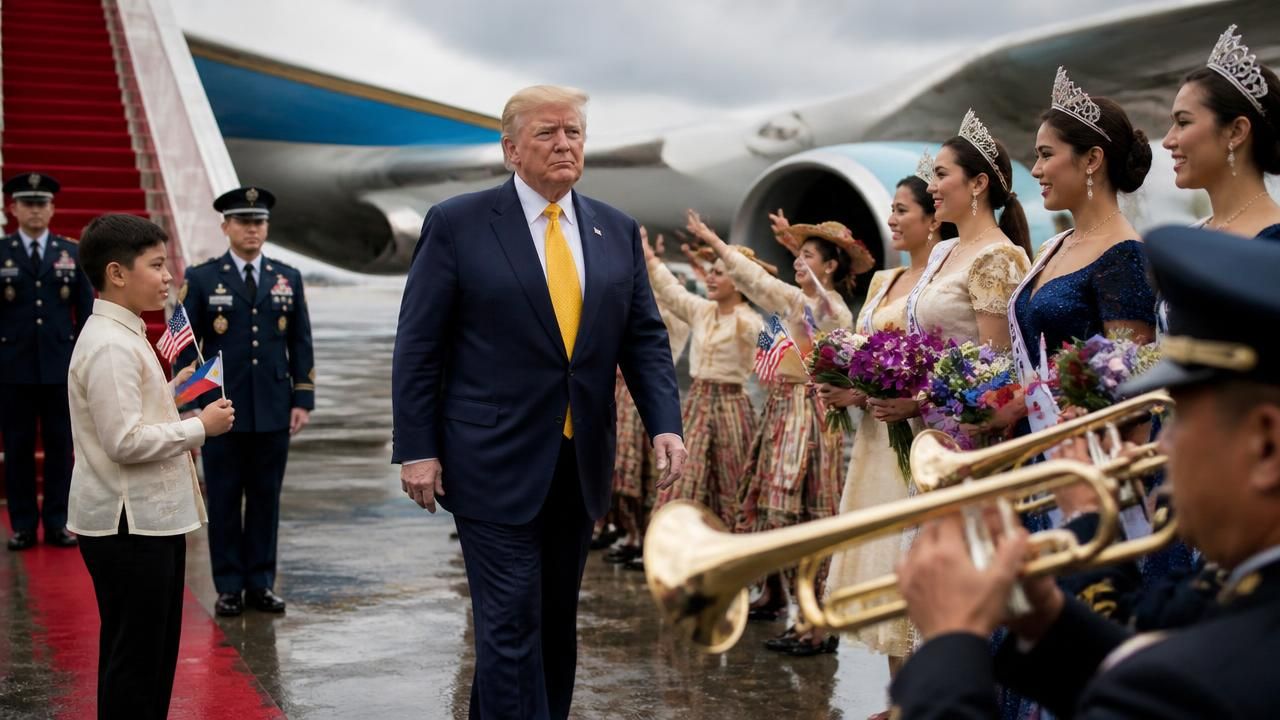
MANILA — President Donald Trump touched down at Villamor Air Base on Tuesday to a reception of beauty queens, a children's honor guard and a brass rendition of “YMCA,” then departed without signing the agreement that had brought him to the Philippine capital: a US-backed plan to carve out a 4,000-acre artificial intelligence hub on Philippine soil.
The unsigned pact, reported by ucanews.com, caps a visit that dramatized the collision between Washington's accelerating push to control the physical supply chain of artificial intelligence and the domestic politics of the countries expected to host it.
A red-carpet arrival — and a casket outside the gates
According to local outlet Rappler, the arrival choreography was unmistakably Trumpian. Five beauty queens greeted the president as he stepped onto the tarmac; a child handed him small American and Philippine flags; dancers in traditional bell-sleeved blouses and wide-brimmed hats performed as the Village People's “YMCA” — a staple of Trump rallies — played over the airport sound system.
Beyond the airport perimeter, the scene inverted. Hundreds of demonstrators packed the streets carrying signs reading “Trump out,” and at least one prop casket was carried through the crowd. Other banners read “Reject Pax Silica,” the name Washington has given to its US-led international initiative to secure semiconductor capacity and the critical minerals that feed it.
“Trump out.” — “Reject Pax Silica.” Placards carried by protesters outside Villamor Air Base, Manila.
The contrast was not lost on Philippine commentators: a visit staged as a celebration of alliance, shadowed by the most visible anti-American street turnout in Manila in years.
What Pax Silica actually is
The name is deliberate — a play on Pax Romana, the Roman peace enforced by military and commercial dominance, fused with the silicon at the heart of the AI economy. In practice, Pax Silica is an attempt to build a friendly-nation corridor for the two chokepoints of the AI age: advanced chip fabrication and assembly, and the rare earths, gallium, germanium and other critical minerals that go into them.
For the Philippines, the prize is a 4,000-acre — roughly 1,600-hectare — development zone that would anchor testing, packaging and data-center capacity. The country has for decades been a major center for semiconductor assembly and test, the labor-intensive back end of the chip supply chain that US policymakers now regard as a strategic vulnerability. The hub would, in theory, upgrade that position into something closer to an AI industrial base.
The risks are equally large. Land assembly at that scale in a densely populated archipelago raises questions of displacement and due process that the plan'sframers have not publicly answered.
A coalition of 120 groups — and a cabinet at odds
Opposition has consolidated faster than the deal itself. MSN reported that more than 120 organizations — characterized in coverage as far-left groups, though the coalition's stated objections range from land rights to sovereignty to environmental impact — have publicly campaigned against the project. The protests on Tuesday were the movement's most visible expression to date.
More consequential for the White House, according to the same reporting, is that the project has opened a split inside Trump's own cabinet. Competing factions — those prioritizing the speed of AI supply-chain decoupling from China versus those focused on the diplomatic and reputational cost of a deal negotiated against street protests in a treaty ally — have reportedly pulled the agreement in different directions. The White House has not publicly detailed the internal disagreement.
The hesitation helps explain the outcome of the trip. Trump arrived, performed the ceremonial elements of the visit, and left without his signature on the document.
Why Washington wants this — and why Manila is wary
The strategic logic behind Pax Silica is straightforward. AI capacity is now measured not only in model quality but in access to fabs, advanced packaging and mineral refining — and China controls a dominant share of the latter. Building allied nodes in Southeast Asia reduces single-point-of-failure risk across the entire stack.
The politics are harder. For the Philippine government, hosting a flagship US AI installation means jobs, infrastructure and leverage in a region where Washington and Beijing are both competing for alignment. It also means absorbing the domestic cost of a visibly American project personally associated with a polarizing US president.
That asymmetry — strategic value for Washington, political liability for Manila — is the reason a 4,000-acre hub became a signing-ceremony question rather than a technical one.
What happens now
- The pact remains unsigned, leaving the hub's financing, land title and construction timeline unresolved.
- The 120-group coalition has signaled it will continue mobilizing, and its “Reject Pax Silica” framing has already moved from fringe signage into mainstream Philippine coverage.
- The intra-cabinet dispute in Washington remains the largest single variable; without a unified US position, Manila has little incentive to absorb the political cost of signing first.
For now, the most concrete artifact of the visit is a juxtaposition: beauty queens and a dance troupe on one side of the airport fence, a prop casket and a rejection slogan on the other, and an agreement still sitting unsigned in someone's briefcase.