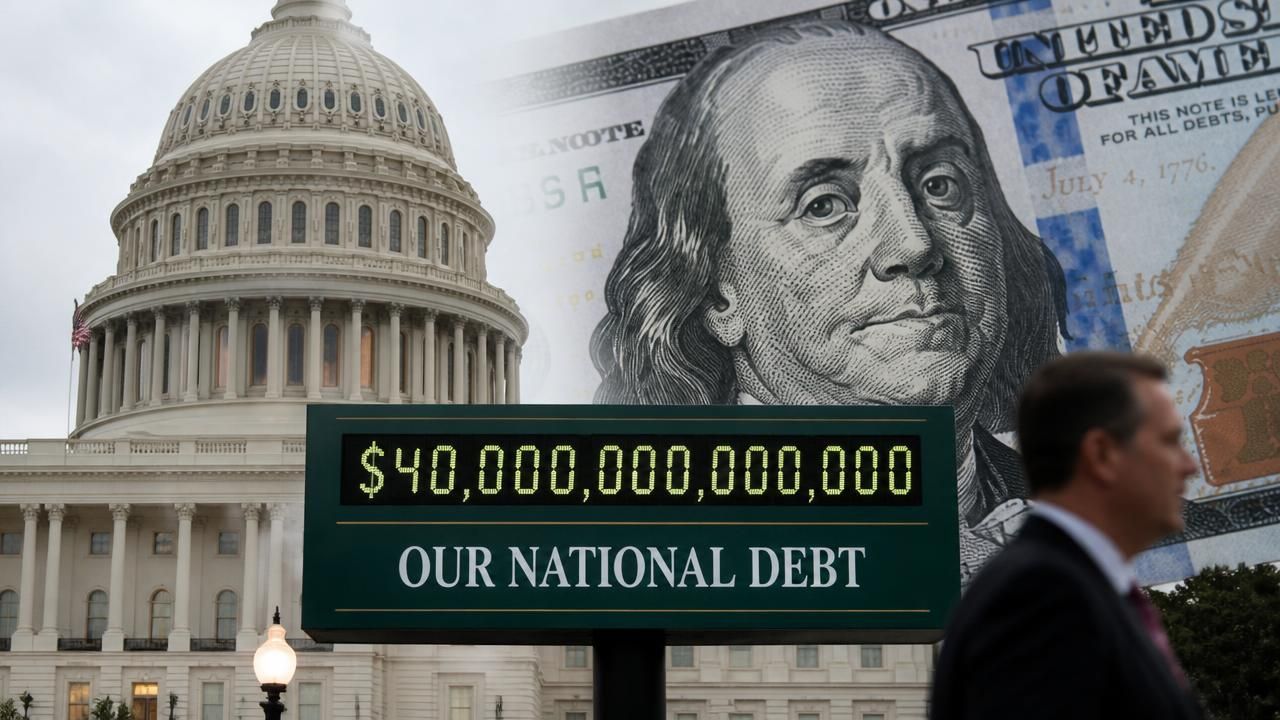
The United States national debt has surged past a staggering $40 trillion for the first time in history, a milestone that underscores the federal government's rapid borrowing pace and raises fresh alarms among investors, economists, and political leaders. The new figure, reported by the Treasury Department, marks a dramatic acceleration from previous milestones and has reignited debate over the long-term fiscal sustainability of the world's largest economy.
A Record-Shattering Milestone
The $40 trillion threshold, initially reported by NPR and confirmed by multiple outlets, reflects the total amount of money the federal government owes to creditors, including foreign governments, domestic institutions, and the public. The debt has grown by roughly $1 trillion every 100 days over the past year, a pace that would have been inconceivable even a decade ago.
According to historical data, the last time the national debt relative to the size of the economy reached such extremes was during World War II. That record, long considered an outlier of wartime spending, has now been broken in peacetime. The comparison has prompted grave warnings: "The U.S. debt tops a record-shattering $40 trillion. Yes, with a T," reported NPR, highlighting the psychological heft of the number.
Investors Demand Higher Interest Rates
One immediate consequence of the mounting debt is that nervous bond investors are demanding higher yields to hold U.S. Treasury securities. This, in turn, pushes up borrowing costs for the rest of the economy—affecting mortgages, auto loans, corporate bonds, and ultimately consumer spending.
"As the government adds red ink at a rapid rate, investors are seeking compensation for the risk of inflation and potential default," an NPR analysis noted. The rising yields on 10-year and 30-year Treasuries have already fed into higher interest rates across the economy, putting additional strain on households and businesses already grappling with elevated prices.
Elon Musk's Warning
Adding a high-profile voice to the debate, billionaire entrepreneur Elon Musk—who has often catalogued government waste—commented on the debt's trajectory. An article from MSN's headline declared: "America's debt just shattered a WWII record. Elon Musk says only one thing can save us." Though the full text of the article is not available, Musk's remarks have typically centered on the urgent need for deep spending cuts. In recent months, he has used his social media platform X to call for a government efficiency commission, arguing that without drastic reductions in federal expenditures, the nation faces an economic catastrophe.
"The debt is growing faster than the economy can support. Only massive cuts to wasteful spending can save us from a debt spiral," Musk has repeatedly warned.
Historical Context and Rising Red Ink
The $40 trillion figure is the latest in a series of sobering milestones. The debt crossed $30 trillion in early 2022, then $35 trillion in late 2024, and now $40 trillion in 2025—a mere few months later. The trajectory is driven by a combination of mandatory spending programs (Social Security, Medicare, Medicaid), the rising cost of interest payments, defense outlays, and repeated bipartisan tax cuts that have not been matched by spending reductions.
According to the nonpartisan Congressional Budget Office (CBO), under current law, the debt held by the public is projected to exceed 150% of GDP by 2035, a level unseen in American history. Interest costs alone are now more than the nation spends on defense or Medicare, and they continue to rise alongside interest rates.
How Did We Get Here?
- Mandatory spending: Social Security and Medicare outlays are expanding as baby boomers retire.
- Revenue gaps: Lower corporate and individual tax rates have reduced government income.
- Emergency measures: The pandemic response, infrastructure bill, and other stimulus measures added trillions to the ledger.
- Interest-rate surge: The Federal Reserve's inflation-fighting rate hikes made new debt more expensive.
Economic and Political Implications
Investors, economists, and policy analysts are increasingly worried that the United States is on an unsustainable path. "We are effectively sterilizing economic growth by devoting an ever-larger share of the budget to interest payments," said Maya MacGuineas, president of the Committee for a Responsible Federal Budget. "This is not just a fiscal issue—it's an economic emergency."
On the political front, the debt has become a flashpoint. Conservative lawmakers have pushed for sharp spending cuts in discretionary programs, while liberal advocates argue that investment in social safety nets is necessary. The Biden administration has proposed tax increases on the wealthy to offset deficits, but Congress remains gridlocked.
Global Perspectives
The $40 trillion debt also has international dimensions. Foreign holders own about a quarter of U.S. treasury securities, and central banks around the world watch U.S. fiscal developments closely. The risk of a sudden loss of confidence could lead to global financial instability, as the dollar's reserve status is underpinned by confidence in U.S. fiscal credibility. Countries like China and Japan hold trillions in U.S. debt, and any move to diversify carries geopolitical ramifications.
What Comes Next?
While no immediate crisis is at hand, the continued erosion of trust in U.S. fiscal management could slowly undermine the nation's economic power. The Treasury Department has not provided a timeline for when the debt might reach $45 trillion, but projections suggest it could occur as soon as 2027 if current trends persist.
For now, the news of the $40 trillion milestone serves as a stark warning. As NPR emphasized, the number is "record-shattering"—and the consequences are being felt in interest rates, borrowing costs, and the psychology of investors who are increasingly asking: At what point is the bill too big to be paid?
Amid this environment, Elon Musk's words may serve as either a cautionary tale or a call to action. Only time will tell whether the country's leaders take the necessary steps to rein in the red ink before it is too late.