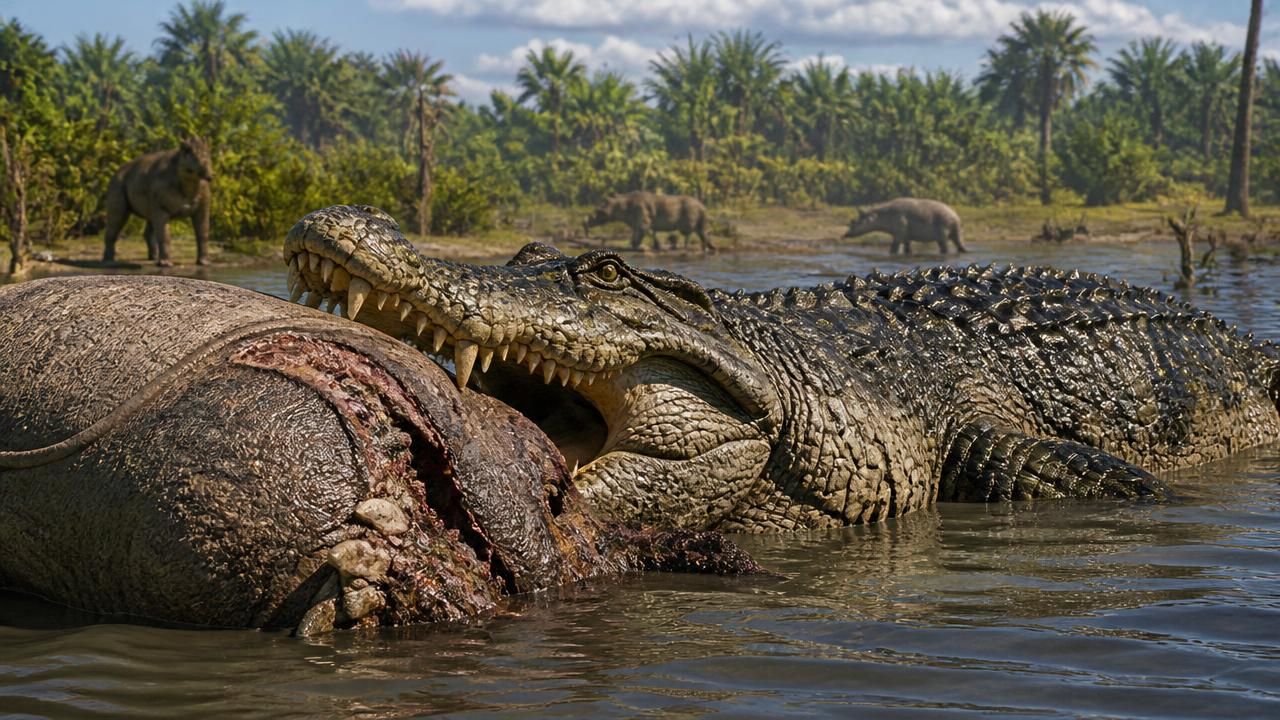
New fossil evidence is rewriting the story of South America’s Miocene epoch, revealing that giant crocodylians—not mammals—were the undisputed apex predators of this ancient tropical ecosystem. A study analyzing fossil bite marks has identified the enormous Purussaurus neivensis as a dominant force, one that likely controlled populations of even the largest herbivores. The findings, reported by ScienceDaily and MSN, offer a fresh glimpse into a prehistoric food chain where reptiles reigned supreme.
The Purussaurus neivensis: A Colossal Predator
At around seven meters (23 feet) long, Purussaurus neivensis was a titan among crocodylians. This creature lived during the Miocene epoch, roughly 23 to 5 million years ago, in what is now South America. The region was teeming with giant prey—massive herbivores and other megafauna—but the new research suggests that the true rulers were these ancient reptiles, not the mammalian predators that often dominate discussions of ancient food webs.
According to the study, fossilized bite marks on the bones of Miocene animals point directly to crocodylians as the primary predators. The marks match the dental patterns of Purussaurus, indicating that this giant likely ambushed prey from the water, much like modern crocodiles, but on a far more imposing scale.
Evidence from Bite Marks
The analysis of bite marks provides a tangible link between predator and prey. As the researchers note, these marks are not merely scratches—they are a record of ancient interactions, preserved for millions of years. The sheer size and depth of the puncture wounds left by Purussaurus suggest a bite force capable of crushing bone, enabling it to take down even the most formidable herbivores of its time.
"Crocodylians, particularly the enormous Purussaurus neivensis, were more important predators than mammals in this ancient tropical ecosystem," the study authors concluded.
This insight challenges previous assumptions that mammalian carnivores held the top positions in Miocene South America. Instead, the evidence indicates a reptilian-dominated hierarchy, with Purussaurus acting as both an apex predator and a keystone species that shaped the entire ecosystem.
The Role of Crocodylians in the Ecosystem
The ecological impact of such a predator cannot be overstated. By preying on giant herbivores, Purussaurus would have helped regulate their populations, preventing overgrazing and maintaining the balance of the environment. Its presence may have also influenced the behavior and evolution of other species, driving adaptations for defense or avoidance.
Interestingly, this mirrors modern crocodylian ecosystems, where alligators and crocodiles serve as both predators and ecosystem engineers. Yet in the Miocene, the scale was drastically different. A seven-meter crocodylian would have dwarfed most contemporary predators, making it a truly formidable force in an already dangerous world.
Broader Implications
The study adds to a growing body of research that highlights the importance of crocodylians in ancient ecosystems. It also raises questions about the co-evolution of predators and prey, particularly how giant herbivores adapted to the threat of a reptilian super-predator. Future studies may uncover further evidence of these interactions, using advanced imaging techniques to analyze bite marks in greater detail.
Other Prehistoric Predator Discoveries
The findings come amid a wave of new research on ancient predators. In a separate study reported by ScienceDaily, scientists have proposed that Tyrannosaurus rex’s famously tiny arms may have evolved for a surprisingly brutal reason. While the exact purpose remains debated, the new hypothesis suggests these appendages were not vestigial but rather served a violent function, possibly related to mating or close-quarters combat. This research adds another layer to our understanding of how even seemingly odd features can have adaptive significance.
Meanwhile, marine paleontologists have unveiled Tylosaurus rex, a giant sea predator that terrorized ancient oceans. This creature, a member of the mosasaur family, was among the largest marine reptiles of its time, boasting a powerful jaws and a streamlined body built for hunting. The discovery underscores the diversity of apex predators across different environments, from freshwater rivers to the open seas.
Conclusion
The reign of Purussaurus neivensis in Miocene South America is a testament to the dynamic and often surprising nature of life’s history. As fossil evidence continues to emerge, it becomes increasingly clear that the ancient world was shaped by a complex web of interactions, with predators—whether reptilian or mammalian, terrestrial or aquatic—playing pivotal roles. These findings not only illuminate the past but also remind us of the fragility and resilience of ecosystems, a lesson that remains relevant today.