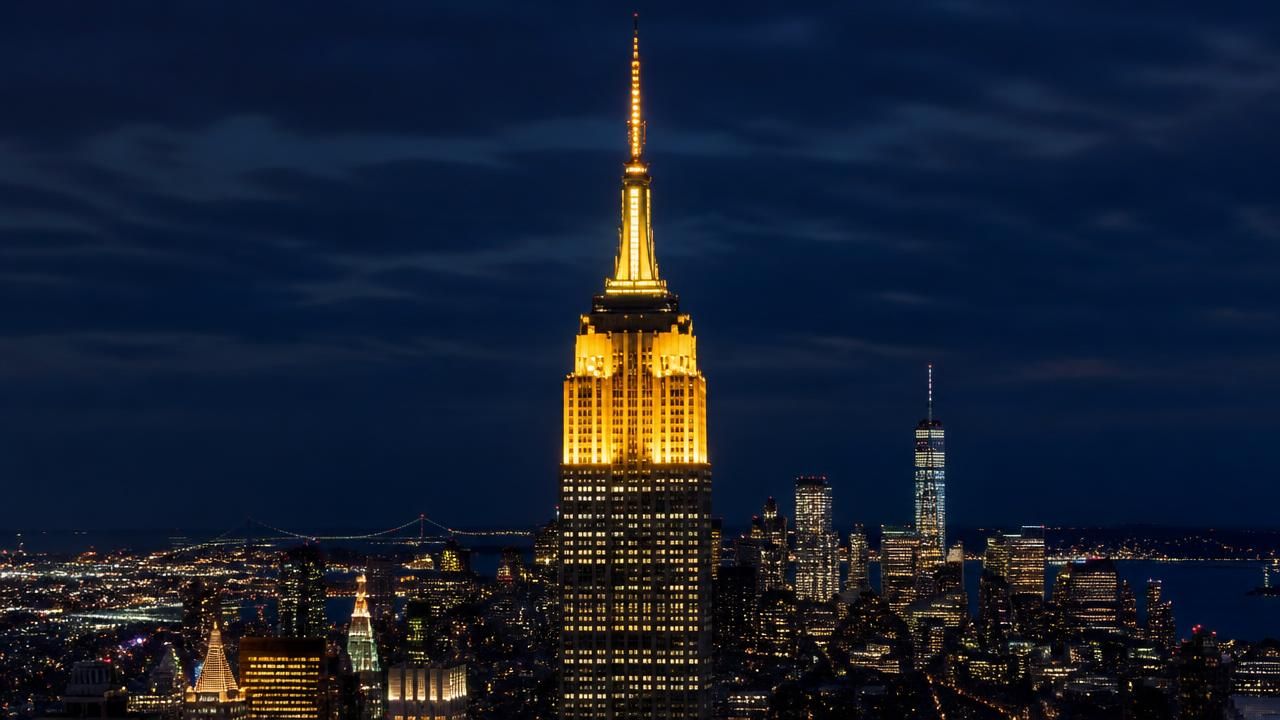
New York's Empire State Building glowed gold on Tuesday night, Nov. 17, 2026, but the illumination was aimed not at the city below it but at a point roughly 26 billion kilometers away — the location of NASA's Voyager 1 spacecraft, which on that day became the first human-made object to reach a distance of one light-day from Earth.
NASA said the gold lighting was chosen deliberately: it echoes the gold-plated copper phonograph record bolted to Voyager 1's flank, the famous Golden Record, which carries sounds and images chosen to portray the diversity of life and culture on Earth. The agency published a photograph of the landmark by NASA photographer Bill Ingalls, showing the building's upper tiers bathed in the same hue as the spacecraft's cargo.
What one light-day actually means
A light-day is the distance light travels in 24 hours — about 25.9 billion kilometers, or 16.1 billion miles, or roughly 173 times the distance from Earth to the Sun. Voyager 1 is moving at about 17 kilometers per second relative to the Sun, gaining roughly 3.6 astronomical units each year, so the light-day threshold is a function of time rather than any change in the spacecraft's behavior.
The practical consequence is communication lag. Radio commands from NASA's Deep Space Network now take a full day to reach the probe, and a reply takes another day to return. Engineers must therefore work with a spacecraft they cannot steer in real time, relying on pre-loaded sequences and waiting 48 hours for a round trip. That constraint has shaped every operation since the probe entered interstellar space in August 2012, when it crossed the heliopause and became the first spacecraft to leave the Sun's bubble of charged particles.
A 1977 machine still calling home
Voyager 1 was launched on Sept. 5, 1977, weeks after its twin, Voyager 2, and has long outlived its four-year primary mission. Its power comes from radioisotope thermoelectric generators, which lose roughly four watts of output each year as their plutonium-238 decays. To keep the probe alive, NASA has progressively shut down heaters and instruments — a piecemeal retreat that engineers have described as managing a slow, irreversible decline.
The Golden Record was assembled by a committee chaired by Carl Sagan, with Ann Druyan as creative director, and includes 115 images, greetings in 55 languages, a selection of natural sounds, and 90 minutes of music spanning Bach, Beethoven, Chuck Berry and Bulgarian folk singing. Each cover carries a diagram showing how to play the record and a map of pulsars indicating where in the galaxy the Sun sits — a message designed to be readable by a civilization that may never exist.
"The launch of this bottle into the cosmic ocean says something very hopeful about life on this planet," Sagan said at the time of the record's creation.
How the milestone was framed
Coverage of the event varied sharply by outlet. NASA's own release was essentially an image-led dispatch — a caption, a credit line, and a description of the lighting — treating the milestone as a visual celebration rather than a technical briefing. Aggregators such as MSN carried the story in short headline form, emphasizing the building and the color rather than the physics, while regional outlets including KTBS led with the "historic milestone" framing, positioning the anniversary as a human-interest moment.
The divergence reflects a broader pattern in science communication: institutional sources supply the imagery and the occasion, while the explanatory burden — what a light-day is, why it matters, why a 49-year-old machine is still talking — falls to secondary coverage that often compresses it to a sentence or omits it entirely. Readers who encountered the story only through aggregation headlines would know the building turned gold; they would not necessarily know why gold, or what distance had been crossed.
Why the milestone resonates
The Empire State Building's lighting program has marked everything from holidays to sporting championships, but space milestones are comparatively rare. Lighting the tower gold places Voyager 1 in a tradition of public commemoration that includes the Apollo missions and the Mars landings — moments when a distant engineering achievement is translated into something a pedestrian on Fifth Avenue can see and ask about.
There is also a quieter significance. At one light-day out, Voyager 1 has become a benchmark for the scale of the solar system's outer reaches and a reminder of how slowly the frontier recedes. Voyager 2 follows behind, and both spacecraft are expected to fall silent sometime in the 2030s as their power budgets run out. When they do, they will continue drifting — carrying the gold records, and no longer transmitting.
- Distance at milestone: ~25.9 billion km (one light-day)
- Launch: Sept. 5, 1977, from Cape Canaveral
- Interstellar space since: Aug. 25, 2012
- Current signal delay: ~24 hours each way
- Power source: Radioisotope thermoelectric generators, decaying ~4 watts/year
For now, the spacecraft is still answering. Engineers will keep sending commands into a 24-hour silence and waiting a day for the reply — a conversation conducted at the speed of light, with a machine that has been traveling for nearly half a century.