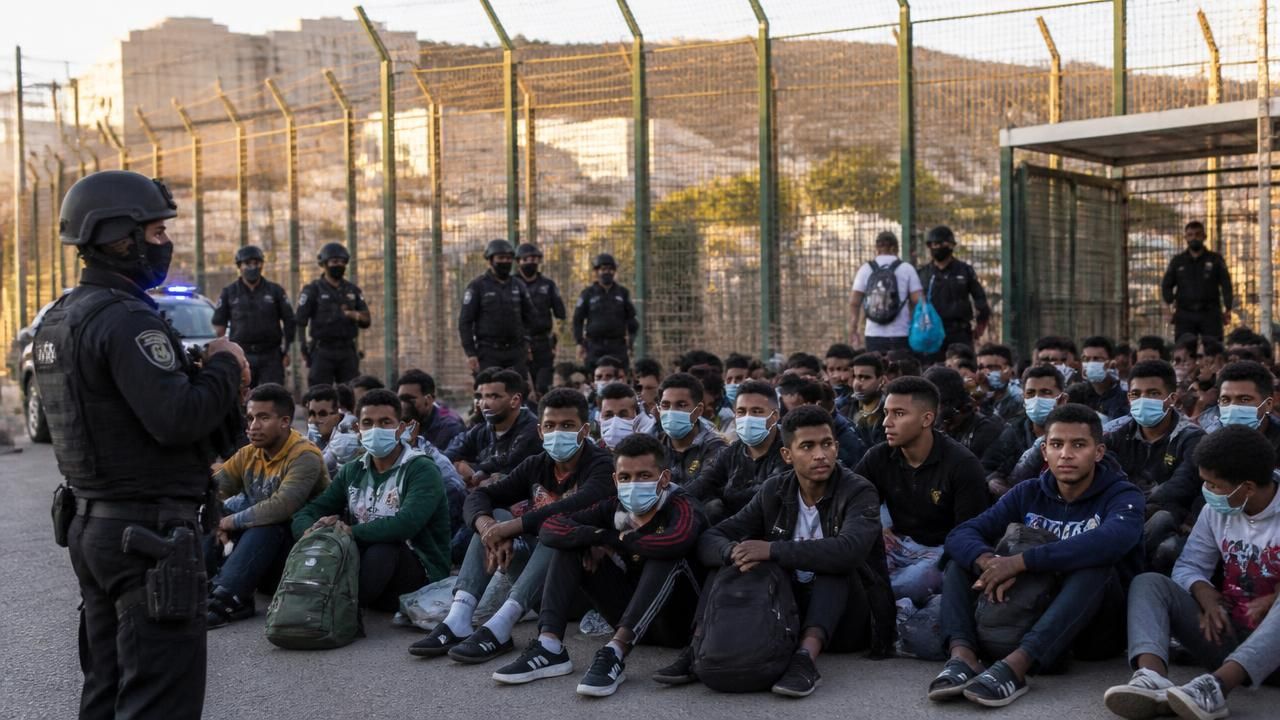
In a dramatic reversal of policy, Spain's socialist-led government has announced it will allow 500 unaccompanied migrant children currently stranded in the North African enclave of Ceuta to be transferred to the mainland. The decision, confirmed by Madrid on Wednesday, marks a significant retreat from an earlier pledge to return anyone who entered the territory illegally, and comes amid mounting international pressure and a deepening humanitarian situation on the ground.
The announcement follows an extraordinary surge in migration that saw—according to some estimates—as many as 70,000 people cross into Ceuta, a Spanish exclave on Morocco's Mediterranean coast, on a single day. While most of those who entered have since been returned to Morocco under a joint security operation, several hundred minors remain in overcrowded reception facilities, where rights groups have warned of dire conditions.
A legal and humanitarian obligation
Under Spanish law, the state has a clear duty of care to unaccompanied foreign minors until they reach the age of 18. The government's initial hardline stance—vowing to deport all irregular arrivals—was widely criticized by child-rights organizations, which argued that the law prohibits the summary return of minors without due process. By relocating the children to mainland Spain, the administration is now belatedly honoring that legal commitment, but it is also acknowledging that the crisis cannot be solved through deterrence alone.
"This is not a concession to traffickers; it is an act of legal and humanitarian responsibility," said a senior Spanish official speaking on condition of anonymity. "These children are among the most vulnerable people on earth, and our obligations under national and EU law are unambiguous." However, the U-turn has also exposed deep divisions within the ruling coalition, with hardline elements warning that it could encourage further migration.
"This is not a concession to traffickers; it is an act of legal and humanitarian responsibility. These children are among the most vulnerable people on earth, and our obligations under national and EU law are unambiguous."
Dismay and disagreement over casualties
As the political and legal battles unfold, a separate dispute has erupted over the human cost of the crisis. French media reported on Tuesday that at least 72 people died during the mass crossing, citing Spanish official sources. But Moroccan authorities have strongly contested that figure, insisting that the actual death toll is far lower and accusing Spanish officials of inflating numbers to deflect criticism of their own border management. The disagreement has clouded an already tense diplomatic relationship between Madrid and Rabat.
In Ceuta itself, hundreds of migrants staged a protest in the city's main square over the weekend, demanding asylum and an end to their legal limbo. Videos circulated on social media showed young men holding banners reading "We are not criminals" and "Open the doors to Europe." Local residents, meanwhile, have expressed a mix of sympathy and frustration, with many shops and streets having been disrupted by the sheer scale of the influx.
Sánchez's political headache
For Prime Minister Pedro Sánchez, the crisis has become a defining challenge. Once hailed as a champion of migrants for his decision to accept the rescue ship Aquarius in 2018, Sánchez now faces accusations of mishandling the situation from both the left and the right. The far-right Vox party has called for a permanent fence and a suspension of Schengen rules, while human rights groups have condemned the government's initial pushback policy as a violation of international law.
Adding to the embarrassment, Spanish media revealed that Sánchez flew off on holiday as the crisis reached its peak, with thousands still camping in makeshift shelters. The prime minister's office defended his absence, saying he remained "in permanent contact" with his ministers, but the optics have further eroded his standing. In a country deeply polarized over migration, the Ceuta affair has thrust the issue to the top of the political agenda, complicating Sánchez's efforts to build a progressive alliance in parliament.
Broader implications for Europe and the UK
The Ceuta crisis is not just a Spanish problem. Speculation is now rife that the 500 minors, once on the Spanish mainland, could eventually attempt to travel onward to other European countries or even the United Kingdom, where family ties and asylum networks often draw migrants. The British government has already expressed concerns about a rise in small-boat crossings if the Mediterranean route remains open through Spain.
European Union officials have sought to downplay the risk, pointing to the bloc's Dublin Regulation, which normally requires asylum seekers to be processed in the first member state they enter. But the system is widely known to be dysfunctional, and several northern EU states have quietly warned Madrid that they will not accept a wave of secondary movements. The European Commission has so far avoided direct intervention, despite the fact that the EU has a joint border-management framework with Morocco. Spain's decision to ignore Brussels's cautious stance and proceed with the relocation suggests that national pressure has trumped European coordination.
The shadow of Melilla
The events in Ceuta evoke painful memories of Melilla, Spain's other enclave on the African coast, which has long been described as "Europe's dirty secret." Over the years, thousands of desperate migrants have attempted to scale the double fences that separate Melilla from Morocco, often met with violent pushbacks by Moroccan security forces. In 2014, the death of at least 15 migrants during a mass attempt shocked the world and led to years of litigation. Yet little has changed: the fences have been raised, but the desperation outside them has not diminished.
Analysts say that the underlying cause of both crises is the lack of legal pathways for migration from Africa to Europe. "The EU has spent billions on border enforcement and deportations, but almost nothing on creating safe and dignified routes for those fleeing conflict and poverty," said Catriona Murdoch, a migration policy expert at the University of Edinburgh. "As long as that imbalance persists, we will continue to see tragedies like Ceuta and Melilla."
What happens next?
The immediate priority for the Spanish government is to arrange the transfer of the 500 minors to reception centers on the mainland, where they will receive legal guardianship, education, and health care. But the longer-term questions remain unresolved. How will Spain manage a record year of arrivals? Can it rebuild trust with Morocco, which has periodically used migration as a political lever? And will the public—already weary of political instability—tolerate a more compassionate approach?
For now, the children of Ceuta are at least moving toward a more secure future. But the crisis has exposed a fundamental contradiction in Europe's migration policy: a continent that prides itself on human rights, yet repeatedly responds to human suffering at its borders with fences, deterrence, and blame. As Spain embarks on this modest act of solidarity, the world watches to see whether it marks a genuine change of heart or merely a temporary concession to reality.