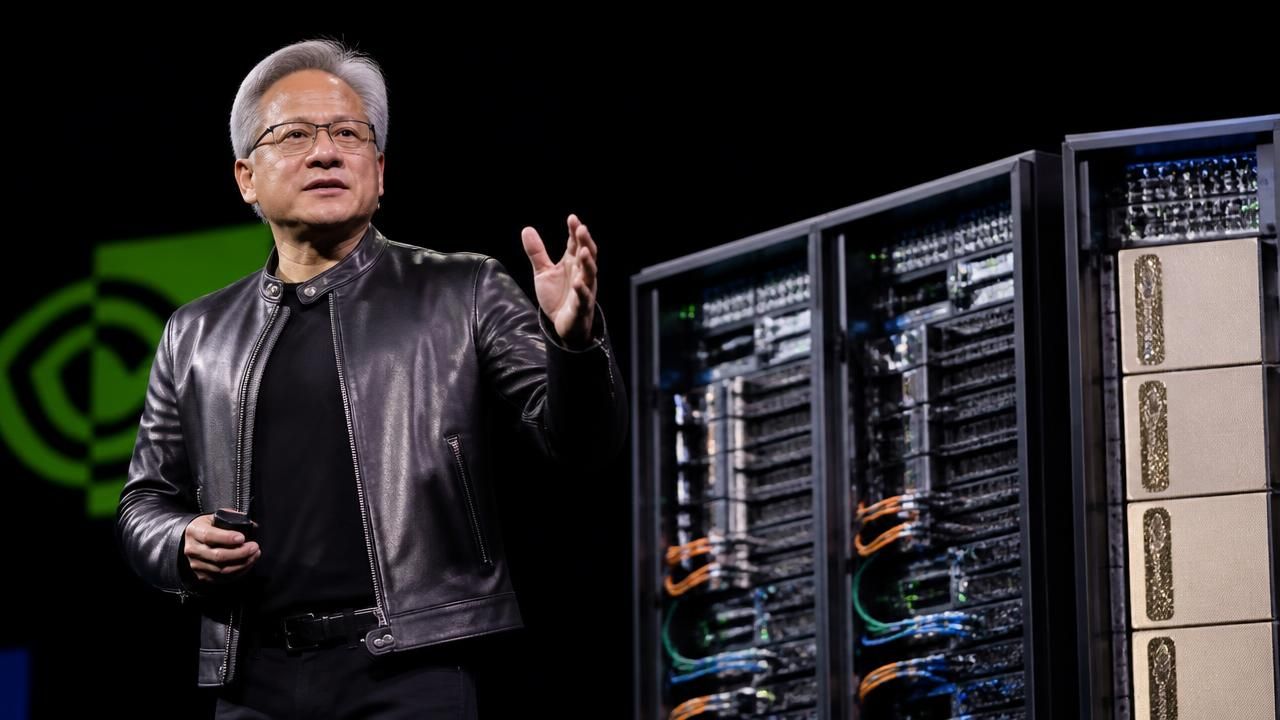
Nvidia has announced a sweeping partnership with six of the world's largest financial institutions to mobilize more than $500 billion in financing for AI compute infrastructure, a move that CEO Jensen Huang says will transform computer chips into a new asset class. The initiative, unveiled this week, brings together Apollo, BlackRock, Blackstone, Brookfield, Goldman Sachs, and KKR in what is being described as the first-ever large-scale effort to treat AI computing power as an investable, revenue-generating asset class.
“This is really the first time that technology chips have become an investable asset class,” Huang told CNBC. “These are revenue-generating assets now. They're productive, they're long-lived, they're fungible, they're flexible.” The partnerships, formalized through memoranda of understanding, will create dedicated financing platforms to fund the construction and operation of AI data centers and related infrastructure, marking a significant escalation in Nvidia's strategy to dominate the AI compute ecosystem.
Compute as an Asset: A New Financial Frontier
The core idea is to treat high-performance GPUs and AI factories like traditional infrastructure assets such as pipelines, toll roads, or data centers. Investors would own or finance compute capacity, which then generates returns through long-term leases or usage fees paid by AI companies, cloud providers, and enterprises. Nvidia itself will not be the borrower or the owner; rather, it will orchestrate deals, provide the technology, and collect licensing and hardware revenue while financial partners take on the capital burden.
The scale is staggering. According to Nvidia, the six firms will work to “establish AI compute infrastructure financing platforms” that together can mobilize over $500 billion in third-party capital. This is on top of Nvidia's existing partnerships with cloud providers and infrastructure operators like CoreWeave, which recently secured a $2 billion investment from Nvidia to expand its AI compute capacity by up to 5 gigawatts. GMI Cloud, Sharon AI, and IREN have also announced strategic compute collaborations with Nvidia, while OpenAI and Nvidia recently unveiled a partnership to deploy 10 gigawatts of Nvidia systems, and a separate plan to build a massive 8-gigawatt data center in Ohio with OpenAI.
Goldman Sachs is said to be courting investors for the initiative, and the push extends beyond Nvidia. OpenAI has made computing deals that now exceed $1 trillion, with a five-year business plan to meet those spending pledges, according to the Financial Times. The 'Stargate' project, backed by OpenAI, Oracle, and SoftBank, is already underway to build a national network of AI data centers, and Nvidia's new financing mechanism is positioned as a central pillar in that architecture.
Optimistic Outlook: A Bridge to the AI Future
Proponents argue that this financing model is exactly what the AI industry needs to scale from experimentation to widespread deployment. AI training and inference require enormous upfront capital expenditures, and few companies—even hyperscalers—can fund the buildout alone. By turning compute into an asset class, Nvidia aims to unlock institutional capital that has been waiting on the sidelines, much like real estate investment trusts (REITs) did for property decades ago.
“This is a brilliant platform strategy,” noted one analysis from AOL, “if it works, Nvidia doesn't just sell chips—it creates a self-reinforcing ecosystem where investors, developers, and enterprises are all aligned.” The involvement of heavyweight financial institutions lends credibility, and their appetite for stable, long-duration assets could provide the patient capital that AI infrastructure requires. For startups and neoclouds, this could lower the barrier to accessing scarce GPUs, which are still in high demand despite a recent stabilization in supply chains.
The announcement also arrives amid a surge in AI-related spending. Meta has committed billions to Nvidia chips, and EY has partnered with Dell and Nvidia to deliver enterprise AI. Nvidia's fiscal 2026 results, though not yet fully released, are expected to show continued growth driven by data center demand.
Skeptical Voices: Echoes of a Bubble?
Not everyone is convinced. The Verge responded with characteristic irreverence, mocking the idea that “compute is now an asset class” and drawing a satirical comparison to Napoleon-era financial schemes. More substantively, Bloomberg published a guide to the “circular deals underpinning the AI boom,” pointing out that much of the AI financing activity involves companies lending money to each other, with the same assets used as collateral again and again. In this case, Nvidia is both the chip vendor and the orchestrator of financing—potentially creating conflicts of interest and masking systemic risk.
“How is this different from the securitized debt instruments that caused the 2008 financial crisis?” asked one market analyst. Critics note that the supposed 'asset class' is entirely dependent on the continued growth of AI demand. If AI revenues fail to materialize at the pace expected, those revenue-generating assets could become worthless almost overnight. Nvidia has already reportedly slashed its data center guarantee to OpenAI by more than half amidst investor concerns, a sign that the company itself is being more cautious about the financing burden.
“This is the very beginning, like what it was when private equity first began to invest in power plants and pipelines,” Huang said, but skeptics wonder whether AI compute has the same stable, utility-like demand characteristics. “Power plants generate electricity people need,” a fund manager told The Next Web. “AI compute generates tokens people may or may not want.”
The Circular Nature of AI Deals
Several sources, including Built In, have pointed to the circular nature of these financing arrangements. Nvidia invests in and guarantees loans for companies like CoreWeave, which then buy Nvidia chips. OpenAI signs massive compute leases backed by Microsoft, Oracle, and now Nvidia, while Microsoft turns around and invests in OpenAI. The new financing platforms could institutionalize this circularity, with investors unknowingly exposed to correlated risks.
Still, institutional investors are eager to participate. BlackRock and Apollo have been increasingly active in infrastructure and private credit, and both have indicated that AI compute fits their risk-return profile. Brookfield, which has a massive infrastructure fund, sees data centers as “the new oil.” The MOU framework will likely evolve into bespoke funding vehicles, possibly with credit enhancements from Nvidia or the hyperscalers.
Global Implications: A New Geopolitical Battleground
The financing push is also geopolitical. Nvidia's partnerships are not just about Wall Street; they are about exporting the AI ecosystem on American terms. The 'Stargate of China' plan has emerged, aimed at challenging U.S. dominance, and Nvidia's ability to mobilize capital at scale could cement a U.S.-centric AI infrastructure network. Indonesia, India, and the UK are all seeing Nvidia-backed data center projects, from a 170,000-GPU data center in Indonesia to Nebius's expansion in the UK.
For governments, this is a double-edged sword. On the one hand, AI infrastructure is critical for economic competitiveness. On the other, the concentration of financing power in a handful of giant financial firms raises concerns about market power and national security. The Biden administration's recent AI executive order and export controls have already complicated Nvidia's business, and this new financing model could create new channels for technology transfer that regulators may scrutinize.
What This Means for Startups and the Wider Industry
If the plan comes to fruition, the AI compute landscape will look very different. Startups that today struggle to secure GPU allocation may be able to lease compute capacity with financing attached, rather than buying chips. 'AI neoclouds'—smaller, specialized cloud providers—could arise, funded by these platforms. But they will be competing against hyperscalers like AWS, which is already optimizing AI workloads on its own chips, and Google's TPU strategy, which is seen as a rising threat to Nvidia's dominance.
“This is a defining moment for the AI industry,” said Nvidia's Jensen Huang. But as with all defining moments, the future is uncertain. The $500 billion bet could be the foundation of a transformative technological revolution, or it could be the most elaborate financial engineering ever constructed around a single company's products. For now, the markets are watching—and the stakes could not be higher.