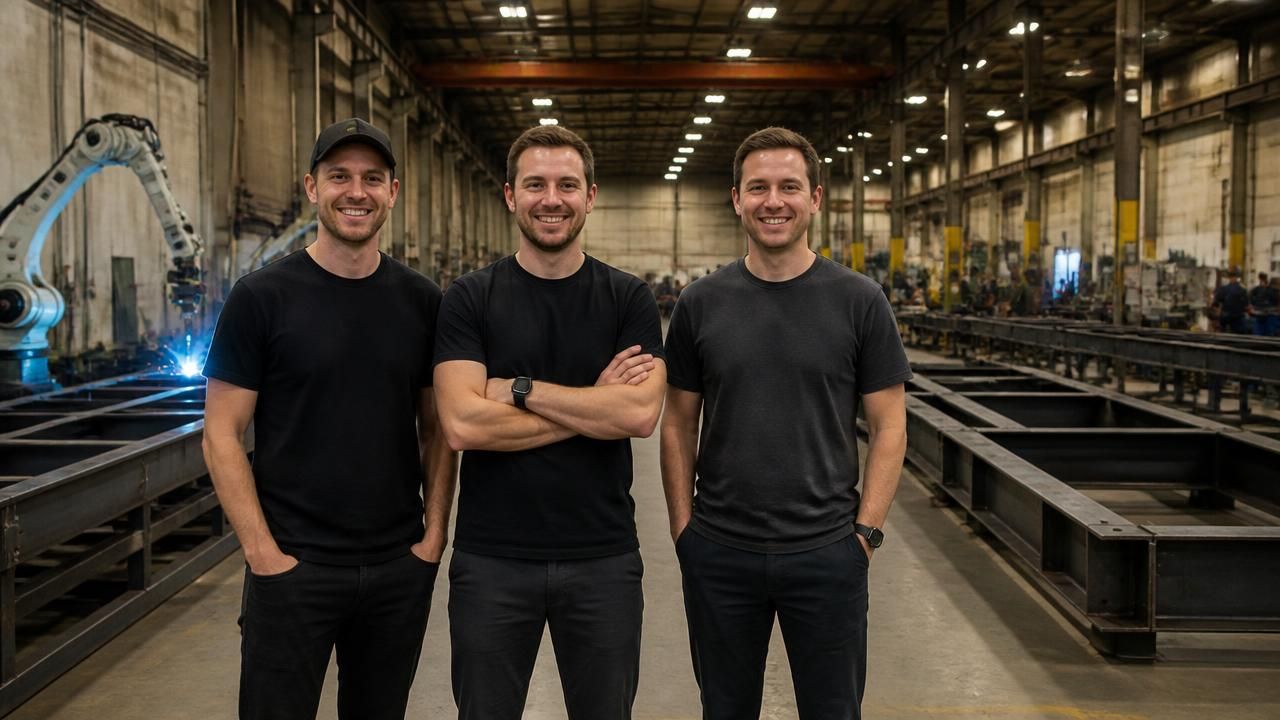
Three former SpaceX engineers have traded rocket science for a new mission: reinventing the steel fabrication industry with AI-driven robotics. The startup, named 1872, officially opened its Factory One facility in Cincinnati, Ohio, on July 22, marking a bold step toward automating the production of steel components for critical infrastructure. Backed by a $15 million seed round, the company aims to have a prototype factory operating at scale by 2027.
The founders—who helped build rocket engines at SpaceX—are now focused on something far more terrestrial but no less ambitious: manufacturing steel skids. These rectangular steel frames serve as movable foundations for modular buildings, and 1872 plans to supply customers developing AI data centers and small modular nuclear reactors. The choice of Cincinnati is intentional, placing the factory in the heart of America’s industrial rust belt, where skilled welding labor is both abundant and aging.
From Rocket Engines to Robotic Welders
The pivot from aerospace to steel may seem drastic, but the underlying engineering challenges are strikingly similar. Building rocket engines requires precision, repeatability, and extreme reliability—qualities that are equally vital in manufacturing infrastructure components. The trio is applying lessons learned at SpaceX to automate what has traditionally been a manual, labor-intensive process.
At the core of 1872’s approach is a hybrid of AI-driven software and off-the-shelf industrial robots. The system learns to weld and assemble steel skids with minimal human intervention, but the founders are pragmatic about autonomy. CEO Dan Summers told Ars Technica, “We're building towards autonomy, but we're not necessarily building in a dogmatic fashion towards full autonomy. We may achieve 80 percent autonomous operations, and we may decide that it makes sense to stop there because there's just diminishing returns to go to full 100 percent.” This philosophy reflects a practical understanding that some tasks may always require a human touch.
Targeting the Infrastructure Boom
The initial market focus is on steel skids for AI data centers and small modular nuclear reactors (SMRs). These industries are experiencing explosive growth, and both require modular, scalable construction methods. AI data centers, in particular, need to be deployed quickly and efficiently, often in remote locations. Steel skids provide a pre-fabricated, movable base that can be assembled on-site with minimal labor. Similarly, SMRs are designed for factory fabrication, and steel skids are essential for their modular architecture.
By automating steel fabrication, 1872 aims to reduce costs and lead times dramatically. The company’s robotic factory can potentially operate 24/7, producing components with consistent quality and precision. This is especially critical as the U.S. faces a shortage of skilled welders; the average age of a welder is over 50, and younger workers are not entering the trade in sufficient numbers.
Local Impact and Economic Revitalization
The choice of Cincinnati has not gone unnoticed by local media. Cleveland.com highlighted the factory’s potential to revitalize the region’s manufacturing sector, bringing high-tech jobs to a state that has seen decades of industrial decline. The ribbon-cutting ceremony was attended by local officials and business leaders, who see 1872 as a beacon of the “factory of the future.” The company’s $15 million seed round, reported by Bizjournals, is among the largest early-stage investments in the region this year, signaling strong investor confidence in the team’s vision.
Perspectives from Different Outlets
Coverage of the launch has varied widely, reflecting the breadth of the story’s implications. Ars Technica focused on the technical nuances of the AI and robotics systems, emphasizing the founders’ engineering pedigree and their pragmatic approach to autonomy. Bizjournals framed the story in business terms, highlighting the funding, the facility, and the market opportunity. Cleveland.com provided local color, emphasizing the economic impact on the region. Meanwhile, Maclean’s posed a whimsical question in its headline—“A Moon Hotel? Why Not?”—which, while ostensibly about space tourism, gestures toward the broader potential of this technology. Given the founders’ SpaceX background, it’s not a stretch to imagine that automated steel fabrication could one day support construction in extreme environments, from lunar bases to orbital habitats. While 1872 is initially focused on earthly applications, the long-term possibilities are as expansive as space itself.
The Road to 2027
Over the next five years, 1872 will work toward its prototype factory goal. The company plans to refine its AI algorithms, optimize robot workflows, and develop a robust supply chain for raw materials. The factory in Cincinnati is expected to serve as a proving ground, demonstrating the viability of the technology before scaling to additional locations.
Summers and his co-founders are also mindful of the broader implications of their work. “We’re not just building a factory; we’re building a new paradigm for how infrastructure is made,” Summers said in a statement. “If we can show that robots can produce steel components faster, cheaper, and more safely than traditional methods, the potential is enormous—not just for our company, but for the entire construction industry.”
A Cautionary Note
Despite the optimism, challenges remain. Automating complex welding tasks is difficult, and achieving even 80% autonomy will require overcoming significant technical hurdles. The company will also need to navigate regulatory requirements and build trust with customers in safety-critical industries like nuclear power. Yet the founders’ track record at SpaceX, where they helped develop manufacturing processes for the most advanced rockets in history, gives them credibility that few startups can match.
As the world races to build the infrastructure of the future—AI data centers, advanced nuclear reactors, and perhaps even structures on other planets—1872 aims to be the quiet enabler behind the scenes. The factory in Cincinnati is just the starting point. If successful, it could help usher in a new era of automated manufacturing, one where human ingenuity and robotic precision work hand in hand.