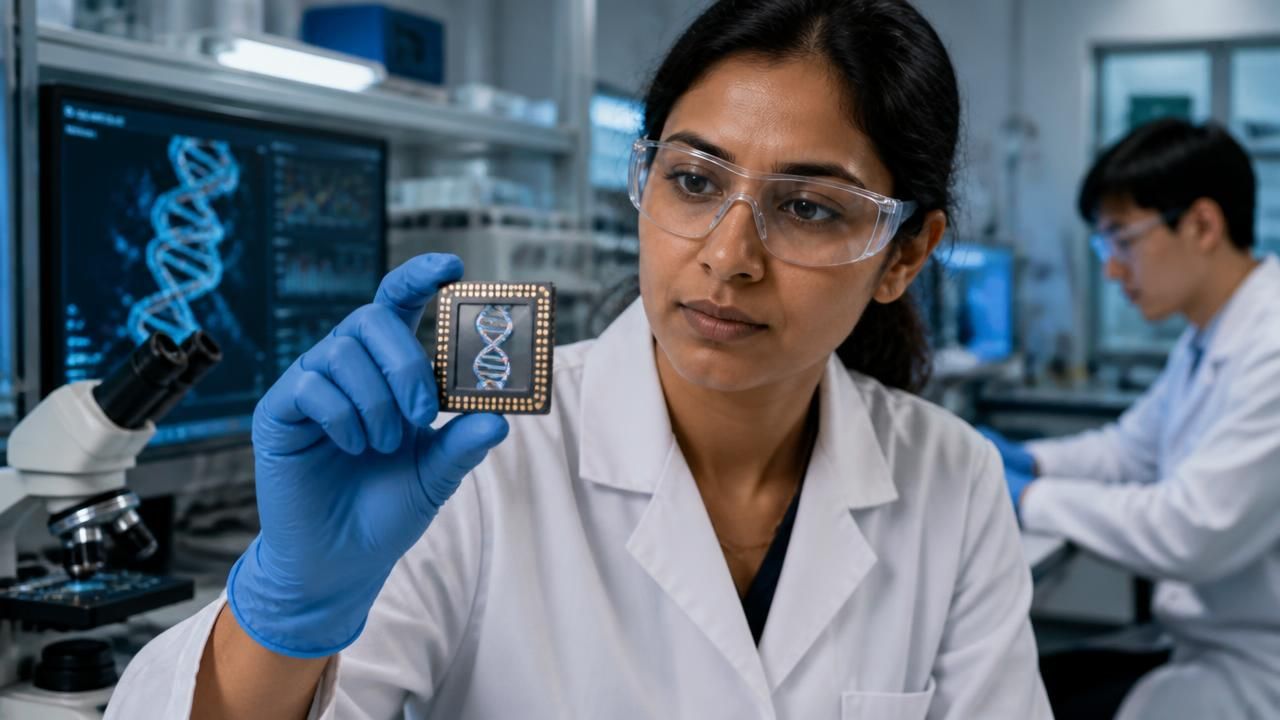
A team of scientists has unveiled a novel memory device that fuses synthetic DNA with a semiconductor, achieving a dramatic 100-fold reduction in power consumption compared to conventional memory chips. The bio-hybrid design, which stores and processes information in the same physical location, could point the way toward a new generation of ultra-efficient computers and artificial intelligence systems.
Turning DNA into a Computational Medium
Deoxyribonucleic acid, better known as DNA, is nature's own information storage system. Its four nucleobases—adenine, guanine, cytosine, and thymine—form a molecular alphabet that can encode vast amounts of data at an atomic scale. A single gram of DNA can theoretically hold hundreds of exabytes of information, making it one of the densest storage media known to science. But until now, harnessing DNA for practical computing has required slow, wet-lab processes and chemical manipulations that are far removed from the semiconductor industry.
The new device changes that by integrating synthetic DNA with a solid-state semiconductor. The DNA acts as the memory medium while the semiconductor provides the interface to read, write, and perform logic operations. The result is an in-memory computing architecture, where data does not need to be shuttled back and forth between separate storage and processing units. This eliminates the so-called von Neumann bottleneck, a fundamental limitation in classical computers.
A 100-Fold Leap in Efficiency
The researchers report that the hybrid device requires just one-hundredth of the power of existing memory technologies—including flash and DRAM—during operation. In data-intensive workloads typical of AI training and inference, this kind of efficiency gain is transformative.
"Integrating DNA with semiconductor technology opens a new pathway toward computing systems that are far more energy efficient, especially for AI," said the research team.
Power consumption is a growing concern in computing. Data centers already account for roughly 1-2% of global electricity usage, according to the International Energy Agency, and that figure is expected to climb as AI models become larger and more complex. Training a single large language model can emit as much carbon as several cars over their lifetimes. The promise of a 100x power reduction in memory—the component that often dominates energy use—has far-reaching implications for both the environment and the economics of computing.
How the DNA-Semiconductor Device Works
While the full technical details are expected to be published in a peer-reviewed journal, the team has outlined the core mechanism. Synthetic DNA strands are deposited onto a semiconductor substrate. Electric signals are used to trigger changes in the DNA—such as hybridization or structural switching—that represent bits of data. The semiconductor reads these states directly, and due to the molecular-scale dimensions of DNA, the energy required per operation is minuscule.
The device is also rewritable, meaning data can be erased and rewritten multiple times, a key requirement for practical memory. Moreover, because storage and computation occur in the same place, the device can perform parallel operations on data, greatly accelerating tasks like pattern recognition and matrix multiplication—the bread-and-butter of AI algorithms.
Key Features of the Memory Device
- Ultra-low power consumption: 100x less than conventional memory.
- In-memory computing: no separation between storage and processing.
- Rewritable synthetic DNA media.
- Semiconductor-compatible interface for scalable manufacturing.
- Potential for massive data density and parallel processing.
From DNA Computing to Practical Hardware
The idea of using DNA for computation dates back to 1994, when computer scientist Leonard Adleman solved a seven-city traveling salesman problem using DNA molecules. That famous experiment proved the concept of molecular computing, but subsequent efforts were confined to test tubes and were too slow and fragile for practical use. The new hybrid approach changes the calculus by marrying DNA's information density with the reliable, high-speed architecture of semiconductors.
Still, significant challenges remain. The team must demonstrate long-term stability, improve manufacturing consistency, and scale the technology to competitive capacities. "This is a promising proof of concept, but it is still years away from commercialization," one industry analyst noted. "The key question is whether DNA memory can be mass-produced at a cost and durability comparable to silicon."
Implications for AI and Next-Generation Computing
For artificial intelligence, the benefits are particularly pronounced. AI systems rely heavily on memory bandwidth to shuttle weights and activations between storage and neural processing units. By performing calculations directly in memory, the DNA-semiconductor device could speed up inference while drastically lowering energy budgets. This might enable edge AI applications—smartphones, wearables, and IoT sensors—that run sophisticated models without draining batteries.
Beyond AI, the technology could be used in massive data archiving, with DNA providing long-term, dense storage. Combined with the low-power processing capability, such a memory device could serve as a read/write archive for everything from scientific datasets to digital media.
The work represents a convergence of biotechnology and semiconductor manufacturing, fields that were once considered worlds apart. It also underscores a broader trend toward bio-hybrid electronics, where biological molecules are repurposed for computing tasks. As the demand for computing power continues to grow exponentially, solutions like this may become essential to keep the digital economy sustainable.
The researchers say their next steps include optimizing the DNA molecules to improve speed and reliability, and exploring integration with existing chip manufacturing processes. If those efforts succeed, the DNA-based memory could rapidly move from the laboratory to the data center.
In the near term, the device is a powerful demonstration that nature's oldest data storage system still has lessons to teach us about the future of computing.