Global equity markets rallied this week, propelled by a fresh wave of optimism around artificial intelligence after Anthropic PBC delivered stellar revenue growth, reinforcing the belief that massive AI infrastructure spending will be sustained. The S&P 500 powered through a historic weekly run, while the Nasdaq climbed more than 1% as technology shares broadly advanced. Yet beneath the surface, a more complex picture is emerging: investors are grappling with warnings of froth in the AI trade, a rotation from software to hardware, and a delicate geopolitical backdrop centred on US-Iran relations.
Anthropic Powers the AI Trade
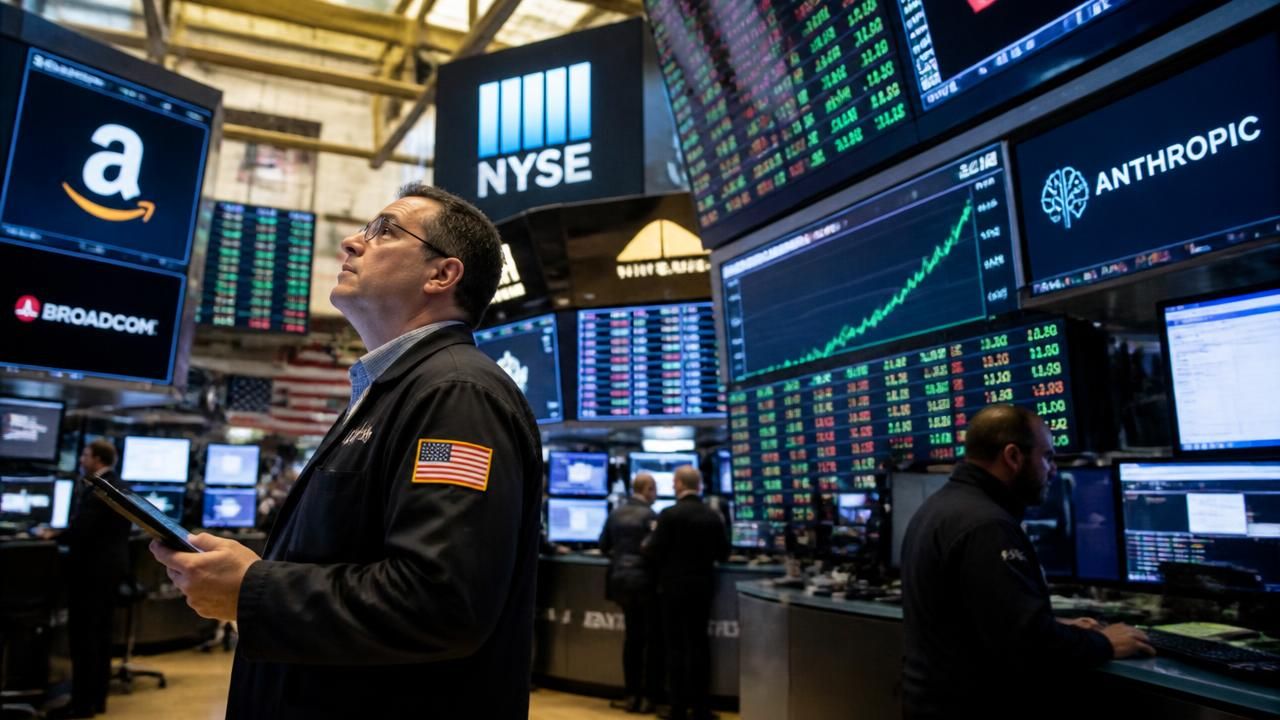
Anthropic, the AI startup backed by Amazon and Google, has become a bellwether for the sector. Its robust revenue growth has eased fears that AI spending is outrunning real-world adoption. According to Bloomberg, the news lifted stock futures on Wall Street and in Europe, with technology shares leading gains. The dollar touched a three-month low, reflecting increased risk appetite and expectations that the Federal Reserve may loosen monetary policy. The Economic Times reported that US stocks ended higher as semiconductors surged, even as Mideast war fears persisted.
Amazon was a notable gainer after its cloud division, which partners with Anthropic, was seen as a prime beneficiary of the company's expansion. Broadcom also surged following reports of deals with Google and Anthropic, as Investopedia highlighted, with investors betting that demand for custom AI chips will remain powerful. Taiwan Semiconductor, a key chip supplier, rose over 4% to a record high, according to market reports. Meanwhile, shares of Thomson Reuters—viewed as vulnerable to AI disruption—soared 11% as investors positioned for AI-related productivity gains.
'The market is saying that the AI trade is not just a story anymore—it's a revenue story,' said one strategist. But not everyone is convinced.
The Skeptic's View: An Achilles' Heel?
Steve Eisman, the investor famous for betting against subprime mortgages in the film 'The Big Short,' has sounded a contrarian alarm. He argued that Anthropic and OpenAI, despite their early success, could be the 'Achilles' heel' of the AI trade. Eisman's concern hinges on the heavy concentration of AI spending into a small number of unlisted companies with high valuations and uncertain long-term profitability. If those companies stumble, the ripple effects could be severe for the tech giants investing heavily in them.
Other commentators have echoed this unease. Microsoft reportedly is developing in-house AI models that could reduce its reliance on Anthropic and OpenAI, a move that might reshape the competitive dynamics. Meanwhile, the Wall Street Journal has noted that the race between OpenAI and Anthropic to go public matters greatly: their IPOs would expose the true economics of the AI boom to public markets.
Geopolitics and Macroeconomics Intersect
The AI rally has been complicated by geopolitical crosscurrents. Oil prices have whipsawed on reports of attacks on ships near the Strait of Hormuz and, then, on signs that Washington and Tehran are close to an arrangement. Pakistan said the US and Iran are nearing some kind of deal, and President Trump stated the war with Iran is 'about to end.' These comments have helped lift futures, with the S&P 500 extending its historic run. Yet a Pentagon debate over military AI use pressured Amazon, as investors weighed the ethical and regulatory risks of AI deployment.
On the macro front, markets are awaiting a slew of inflation and employment data. The ADP employment change came in below expectations, trimming futures losses earlier this week. The focus is now on the non-farm payrolls report and producer price index (PPI), which could influence the Fed's next moves.
A Rotation Within AI: Software Out, Infrastructure In
One of the most striking trends is the shift in AI stock performance. Palantir, a software company once heralded as a key AI play, has plummeted, while infrastructure providers like Nebius have soared. This 'sell software, buy infrastructure' rotation reflects a maturing AI cycle: as the technology becomes more mainstream, the value is shifting from application-layer software to the physical enablers—chips, data centres, power, and memory.
The viral success of 'OpenClaw' has raised concerns about exhausting computing power, further fuelling demand for AI infrastructure. Several market observers note that investors are increasingly looking at power companies, memory manufacturers, and other 'picks and shovels' plays. A 24-year-old investor, Leopold, who is shorting Nvidia with $9 billion, has reportedly doubled down on power, memory, and Anthropic—highlighting the complex, multi-sided bets in the market.
Looking Ahead
As the week draws to a close, all three major US equity futures point to a firm open, with investor attention squarely on jobs data. The massive run-up in AI-related equities, while justified by strong earnings at companies like Anthropic, has left markets vulnerable to sudden disappointments. The IPO race between OpenAI and Anthropic will be a landmark event for the sector, potentially unlocking a new phase of investment and scrutiny.
In the long run, governments are also preparing for AI's broader impact. The UK government's 'AI Scenarios 2030' report, published this week, asks policymakers to plan for a future where AI is deeply embedded across the economy. That report underscores that the AI trade is not merely a short-term market phenomenon—it is a structural transformation. For now, the market is glad to ride the wave, but the cross-currents of geopolitics, inflation, and corporate concentration mean the journey is unlikely to be smooth.