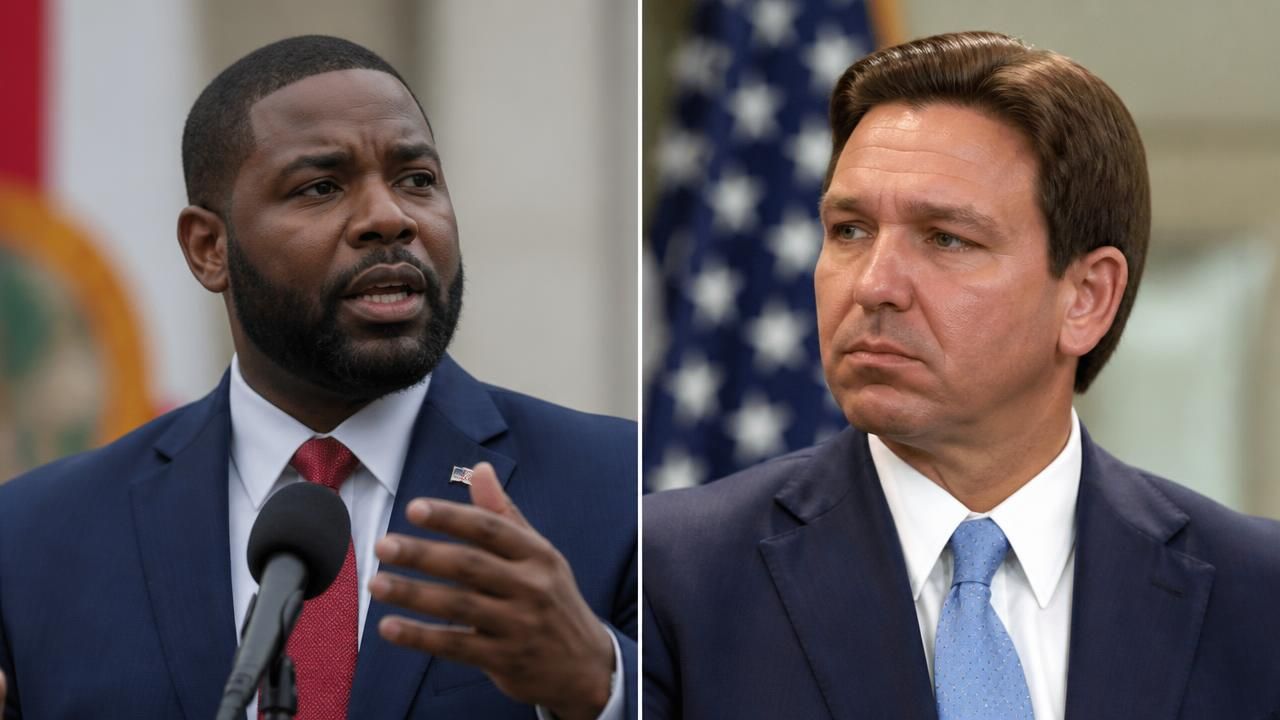
The race to succeed Florida Gov. Ron DeSantis has become an unexpectedly explosive family feud, pitting former President Donald Trump's political machine against the sitting governor's still-potent legacy. With less than six months until the Aug. 18 Republican primary, a crowded field is forming, and the battle lines are drawn not just between candidates, but between two powerful wings of the GOP: Trump loyalists and DeSantis disciples.
Rep. Byron Donalds, a Trump-endorsed congressman from Naples, has emerged as the front-runner, commanding a wide polling lead. But his path to the governor's mansion is complicated by a conspicuous absence: DeSantis has refused to endorse him. That silence, once seen as a minor snub, has turned into a defining storyline of the 2026 election season, prompting speculation about bad blood, ideological divides, and even a brewing "civil war" within the Florida GOP.
Donalds Pledges Affordability, Promises to Build on DeSantis's Record
Announcing his campaign on Fox News before pivoting to a statewide tour, Donalds has leaned heavily into the endorsement of Trump, who remains enormously popular with the GOP base. But Donalds is also eager to claim the mantle of his ostensible rival, DeSantis, telling Bloomberg Television that he intends to "build on Governor DeSantis's record" while making affordability the centerpiece of his campaign.
"Affordability will be central to my campaign," Donalds said, outlining proposals to tackle property taxes, insurance premiums, housing costs, and health-care expenses. "We've made Florida a beacon of freedom, but working families are being crushed by the cost of living."
Donalds also defended Trump's approach to Iran, even as rising gasoline prices threaten to undercut economic optimism. "The President is standing up for American interests," he said. "I expect to earn Governor DeSantis's support if I advance to the general election."
Yet Donalds has also shown flashes of independence. In a notable departure from DeSantis's skepticism of tech overreach, Donalds has embraced artificial intelligence as a force for "creative destruction," breaking with the governor's more cautious, "magical" framing of the technology.
DeSantis's Silence Roils the GOP Establishment
The governor's refusal to back Donalds has stunned many insiders. After eight years in office—marked by headline-grabbing fights over COVID-19 restrictions, immigration, and cultural issues—DeSantis was widely expected to hand-pick his successor. Instead, his mute stance has fed a narrative of discord.
According to a USA Today analysis, DeSantis's rebuff of Donalds is less about policy than about personal and political grievances. The two men have never been close, and Trump's early, aggressive embrace of Donalds may have complicated any rapprochement. As one Tallahassee insider put it, the lack of endorsement "shows growing cracks within Florida's GOP."
"There's a lot of pent-up frustration," said a former DeSantis aide. "The governor built a movement, and now he's watching it be co-opted by Trump's wing. The silence speaks volumes."
DeSantis's own political operation has not stood still. In his final months, he has been advancing an aggressive policy agenda, including the controversial $1.2-million-per-day "Alligator Alcatraz" project, an immigration detention facility that has drawn national scrutiny. Critics see it as a legacy-branding exercise; supporters see it as bold governance. Meanwhile, his administration has moved to rename an airport after Trump and approved a Miami-Dade site for the former president's library—gestures that some interpret as overtures, others as abdication.
Renner and Fishback Enter the Fray
The turbulence has created openings for other candidates. Paul Renner, the former state House Speaker, formally entered the race on Feb. 17, 2026, positioning himself as a bridge between the warring factions.
"The civil war between Trump Republicans and DeSantis Republicans is real," Renner said. "I'm the only candidate who can unite the party and win in November."
Renner's strategy is to appeal to both camps by praising DeSantis's record while acknowledging Trump's leadership. But he faces an uphill climb against Donalds's name recognition and Trump's endorsement.
Another entrant, investor James Fishback, has taken a more combative tack, calling Donalds "compromised" and positioning himself as the true conservative outsider. Fishback, a political newcomer, has deep pockets and a willingness to attack the front-runner from the right.
Then there is Jay Collins, a decorated military veteran who has ties to DeSantis's inner circle. Collins's campaign ads emphasize his service and his relationship with the governor, vowing to keep the "DeSantis movement alive" if elected.
A National Battlefield for 2028 and Beyond
The Florida governor's race is no longer just a state affair; it is a proxy war for the future of the national Republican Party. With Trump still weighing another White House bid and DeSantis harboring his own ambitions, the outcome in Florida could reshape the GOP's power structure.
Political analysts note that DeSantis and Trump share a playbook built on "boundary-busting and defiance," making their current distance all the more poignant. But the feud is also practical: Trump has moved to cement his influence by backing candidates like Donalds, while DeSantis seems determined to preserve his own lane.
The race is also a test of whether Trump's endorsement is still the gold standard in Republican primaries. In 2026, with polls showing Donalds well ahead, it clearly matters—but so does the quiet resistance from the DeSantis camp. If Donalds stumbles, Renner or Collins could emerge as a compromise candidate.
Meanwhile, the symbolism of a Trump presidential library in Miami—a site smaller than those of Carter, Clinton, or Reagan—has sparked its own debates about legacy and scale. The Florida Cabinet's approval of the Miami-Dade location was overshadowed by the governor's race, yet it reinforces the gravitational pull of the former president on state politics.
What's at Stake
Whoever emerges from the Aug. 18 primary will enter a general election against a yet-to-be-determined Democrat, but the bigger story is the GOP's internal struggle. For voters, the coming months will offer a choice between continuity with Trump's disruptive style, a return to DeSantis's brand of cultural conservatism, or an entirely new generation of leadership.
As DeSantis's time in office winds down, his legacy is taking hits from multiple sides. Recent policy reversals and budget disputes have dented his approval ratings, and even some conservatives are questioning whether his aggressive governance went too far. But his influence remains formidable, and his decision to stay silent until the last moment suggests he is not ready to cede the stage.
For now, the race is Donalds's to lose. Yet with a field that includes a former House speaker, a self-funding investor, and a military veteran with deep roots in Florida, the only certainty is uncertainty. The Aug. 18 primary will be more than a political event—it will be a verdict on the soul of the Sunshine State's Republican Party.