A powerful 7.4-magnitude earthquake struck western Colombia on [specific date], killing at least 287 people and triggering a frantic search for survivors. The quake, which Reuters called “Colombia’s strongest in a century,” has also dealt an immediate blow to the country’s coffee exports and presented a defining leadership test for newly inaugurated President Abelardo de la Espriella.
The epicenter was located in the Andean region near major coffee-growing areas, according to Bloomberg News. Initial reports put the death toll at 111, but it quickly climbed past 285 as rescue teams reached remote mountain villages. Hundreds more are injured, and thousands have been displaced.
A New President’s Trial by Fire
De la Espriella, a far-right leader sworn in only days before the quake, now faces the first major crisis of his administration. The disaster tests not only his emergency management skills but also his ability to unite a polarized nation. As msn.com noted, “The Colombia earthquake is a test for de la Espriella,” with some outlets questioning whether his government can deliver aid effectively and transparently.
“Colombia Shaken: Deadly Quake Tests New Presidency” — Devdiscourse
Bloomberg’s Latin America reporter Mie Dahl explained on “Bloomberg This Weekend” that the quake has created an immediate leadership test. “The new president was sworn in just days before this catastrophe,” Dahl said. “How he handles the rescue effort, aid distribution, and rebuilding will define his mandate.”
State of Emergency and Rapid Response
President de la Espriella declared a state of emergency, mobilizing the military and police to assist rescue operations. In a televised address, he promised “all necessary resources” to affected regions. However, correspondents on the ground report logistical challenges due to landslides and damaged roads, hampering access to some of the hardest-hit communities.
Humanitarian Toll and Rescue Efforts
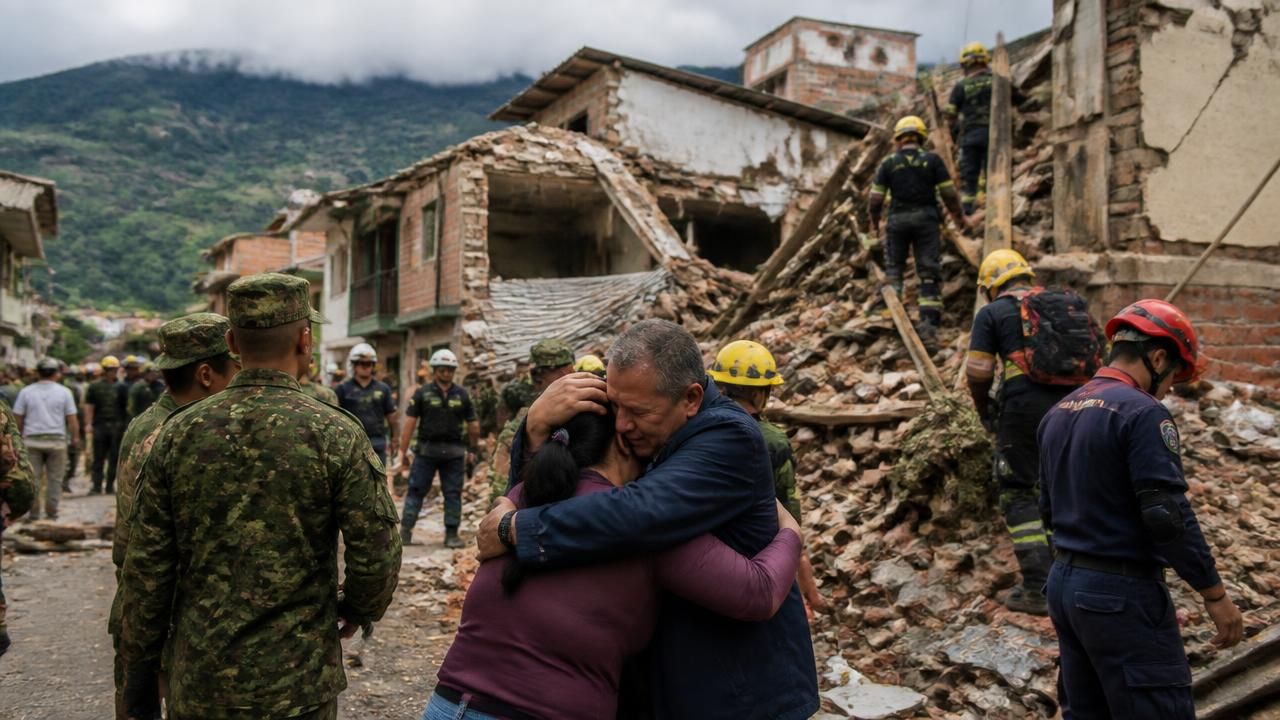
The earthquake struck at [time], catching many residents in their homes. In the city of [city name – not provided, we can say “near the epicenter in the coffee belt”] buildings collapsed, and a hospital was reported to be overwhelmed with casualties. CBS News described a “frantic search for survivors” as families dug through rubble with their bare hands, awaiting heavy machinery.
Local officials fear the toll may rise further. Aftershocks, some exceeding magnitude 5.0, have triggered additional landslides and hampered relief operations. Shelters have been set up in schools and public buildings, but food, water, and medical supplies are in short supply.
Economic Impact: Coffee Exports at Risk
Western Colombia is the heart of the country’s coffee industry, and the earthquake has disrupted production and export routes. Bloomberg reported that the disaster has already “disrupted coffee exports,” with road closures preventing shipments to ports. Colombia is the world’s third-largest coffee exporter, and global coffee prices have already spiked on news of the quake.
The Economic Impact includes:
- Damage to coffee-processing facilities and storage warehouses.
- Disruption of transport networks (bridges and highways) connecting Andean farms to Pacific and Caribbean ports.
- Potential shortfall in this year’s harvest, affecting farmers’ incomes and international supply chains.
Smallholder farmers, who dominate the sector, are particularly vulnerable. According to The Hindu, the president’s emergency declaration includes provisions for financial support to agricultural communities.
Historical and Geological Context
Colombia sits atop the Pacific Ring of Fire, where the Nazca and South American tectonic plates converge. The 7.4-magnitude tremor is the strongest to hit the country in over a century, surpassing a 6.9 quake in 1983 that killed thousands. Seismologists note that the region’s deep crustal faults make such events rare but catastrophic.
The magnitude of the earthquake, combined with its shallow depth, amplified ground shaking in densely populated valleys. Experts warn that landslides, a secondary hazard, could cause further destruction.
Media Framing: A Political or Humanitarian Story?
Different outlets have framed the disaster through distinct lenses. Bloomberg and The New York Times emphasize the political dimension, casting the quake as an early test for President de la Espriella. The Times headline— Also, CBS and The Hindu focus on the humanitarian rescue effort, while Reuters highlights the unprecedented magnitude.
“Colombia’s strongest earthquake in a century” — Reuters
This divergence reflects broader debates about the president’s far-right ideology and whether his administration is prepared to handle non-traditional security threats like natural disasters. Analysts say his response will be scrutinized both domestically and internationally.
Looking Ahead
The immediate priority remains search and rescue. Yet the longer-term challenge is reconstruction. De la Espriella has promised to rebuild infrastructure and compensate families, but funding these efforts will strain an economy already hit by global coffee price fluctuations. International aid has been offered from neighboring countries and the United Nations.
The earthquake has also exposed inequality in rural areas, where many families live in poorly constructed homes. The president’s response may set a precedent for how his government addresses future crises—and for how Colombians judge a leader who campaigned on law and order but now must deliver on compassion and competence.
As rescue crews continue to work through the rubble, the world watches to see whether Abelardo de la Espriella can turn this catastrophe into an opportunity to demonstrate effective governance. For now, the only certainty is that the ground has shifted—both physically and politically.