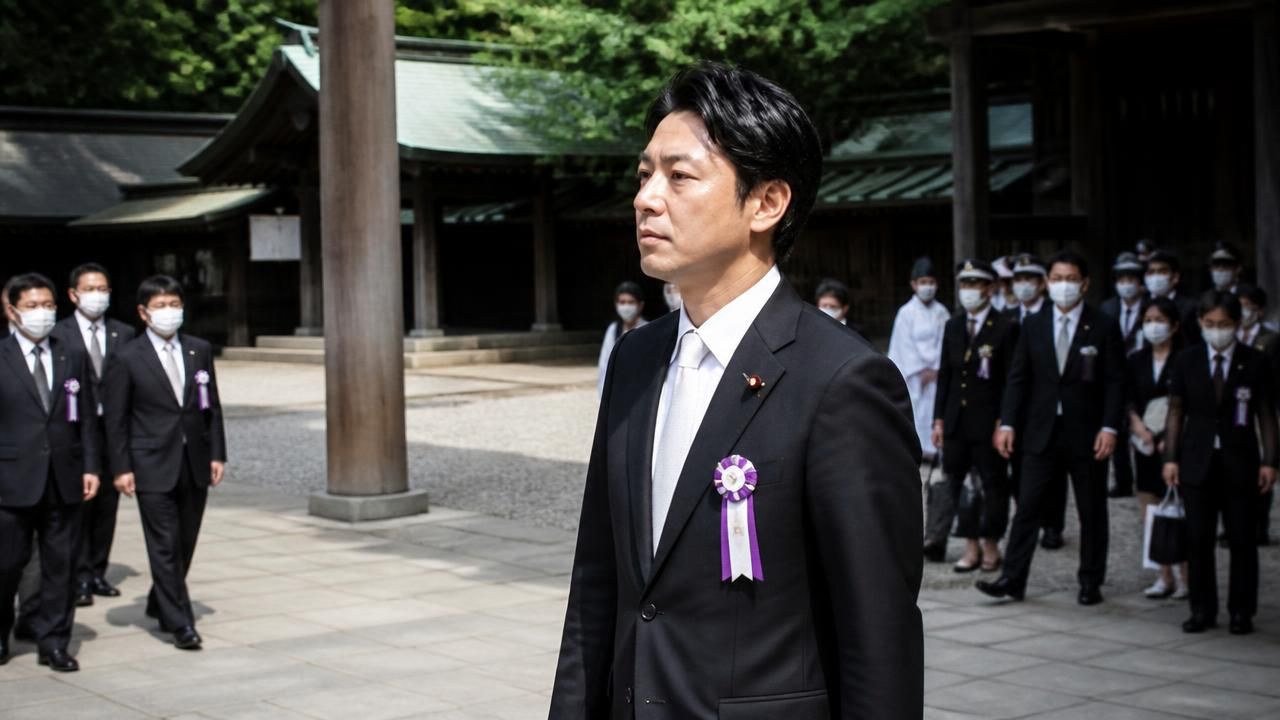
China has formally protested to Japan after Prime Minister Sanae Takaichi sent a ritual offering to the controversial Yasukuni Shrine and Defense Minister Shinjiro Koizumi paid a personal visit on the anniversary of Japan's World War II surrender, heightening tensions between the two neighboring powers.
The protest was lodged on August 15 by China's Ministry of Foreign Affairs, which summoned a senior Japanese diplomat to convey Beijing's strong dissatisfaction and opposition. The Chinese government described the actions as a "provocative move that disrespects the victims of Japanese militarism" and a "serious violation of the political consensus between China and Japan."
The Yasukuni Shrine Controversy
Yasukuni Shrine is a Shinto religious site in central Tokyo that honors approximately 2.5 million Japanese war dead, including 14 Class-A convicted war criminals from World War II. Since the 1980s, visits or offerings by Japanese leaders have regularly sparked diplomatic crises with China and South Korea, who see the shrine as a symbol of Japan's wartime aggression.
Takaichi, who assumed office as Japan's first female prime minister, sent a "masakaki" tree offering to the shrine on the anniversary of Japan's surrender on August 15, a traditional gesture performed by many conservative politicians. Defense Minister Koizumi went further, visiting the shrine in person and paying his respects, an act that drew immediate ire from Beijing.
China's Formal Protest
China's Foreign Ministry spokesperson issued a statement saying: "The Yasukuni Shrine is a spiritual tool and symbol of the Japanese militarists' aggressive war. The Japanese leaders' actions whitewash the history of aggression and hurt the feelings of people in China and other victimized countries."
"China urges Japan to reflect on its history of aggression and to take concrete actions to earn the trust of its Asian neighbors," the statement read.
The ministry confirmed that a "stern representation" was made to the Japanese embassy in Beijing. According to Chinese state media, the protest included a warning that such actions "will seriously affect the improvement of China-Japan relations."
Historical Context
The Aug. 15 anniversary marks the day in 1945 when Emperor Hirohito announced Japan's acceptance of the Potsdam Declaration, effectively ending World War II. For Japan, the day is often framed as a time to remember the war dead, but for China and South Korea, it is a painful reminder of Japan's militaristic past and wartime atrocities, including the Nanjing Massacre and the use of "comfort women."
This is not the first time Takaichi has drawn China's ire. During her political career, she has been a regular visitor to Yasukuni and has advocated for a more hawkish stance toward Beijing. Her cabinet, which includes several outspoken nationalists, has pledged to revise the postwar constitution and strengthen Japan's military — moves that China views with deep suspicion.
Japanese officials defended the actions. Chief Cabinet Secretary Hiroshi Toyama told reporters that the visits were "private acts of prayer" and that Japan respects China's feelings but cannot accept interference in its domestic religious customs.
Regional Reactions and International Pressure
South Korea also expressed regret over the Yasukuni actions, with the foreign ministry describing them as "regrettable" and "undermining the spirit of reconciliation." "We emphasize that the Japanese leadership must have the right attitude toward history," a spokesperson said.
The controversy comes at a delicate time for the region. China-Japan relations have seen tentative steps toward improvement in recent months, with discussions on economic cooperation and people-to-people exchanges. However, security issues, including territorial disputes over the Senkaku/Diaoyu islands and Japan's expanded military role in the Indo-Pacific, continue to strain ties.
Expert Perspectives
International relations experts say the Yasukuni issue is a recurring obstacle. Dr. Asuka Ito, a professor of political science at the University of Tokyo, noted: "Yasukuni is a lightning rod for diplomatic confrontation. China and South Korea cannot tolerate high-level visits because they see it as an endorsement of historical revisionism. Japan's leaders, especially those on the conservative right, use the shrine to shore up domestic support and assert a national identity that pushes back against perceived apologies."
Dr. Zhang Hao, a Beijing-based scholar on Japanese affairs, commented: "Beijing's protest is predictable policy. But there is a deeper concern: the direction of Japan's security policy under Takaichi. The shrine visits are a symbol, but the real issue is Japan's preparations for 'counterstrike capabilities' and its alignment with U.S. strategy against China."
Implications for Bilateral Relations
The immediate fallout is likely to include a freeze in planned high-level diplomatic engagements. Chinese foreign ministry officials hinted that forthcoming visits and talks could be postponed or canceled if Japan does not address China's concerns.
Economic ties, however, may remain resilient. Bilateral trade between China and Japan exceeded $370 billion in 2023, and both countries have deep supply-chain integration. "Governments may trade accusations, but businesses continue to cooperate," said economist Yuki Tanaka. "The political noise affects the surface, but the deep economic currents remain largely unaffected."
Yet the political trust deficit is widening. Analysts expect China to cite the Yasukuni incident in its diplomatic messaging, warning regional nations about Japan's "militaristic revival." This could complicate Japan's efforts to build alliances in Southeast Asia and with Pacific island nations.
Looking Ahead
The Yasukuni shrine issue is unlikely to be resolved anytime soon. For Japan, it is a matter of domestic politics and national identity. For China, it is a test of Japan's sincerity in recognizing past wrongdoings. As long as the historical legacy remains unsettled, the shrine will continue to be a symbol of discord between two of Asia's largest powers.
Both nations have pragmatic reasons to manage the dispute. Japan needs stable ties with China for economic recovery, and China faces its own domestic and global challenges. But the emotional weight of history, amplified by nationalistic politics, makes every Aug. 15 a potential flashpoint.
In the coming weeks, the focus will shift to whether Japan's ambassador meets with Chinese officials and whether any concrete steps are taken to mitigate the damage. For now, China's protest stands as a stern warning that Tokyo's actions on the Yasukuni anniversary will not go unanswered.