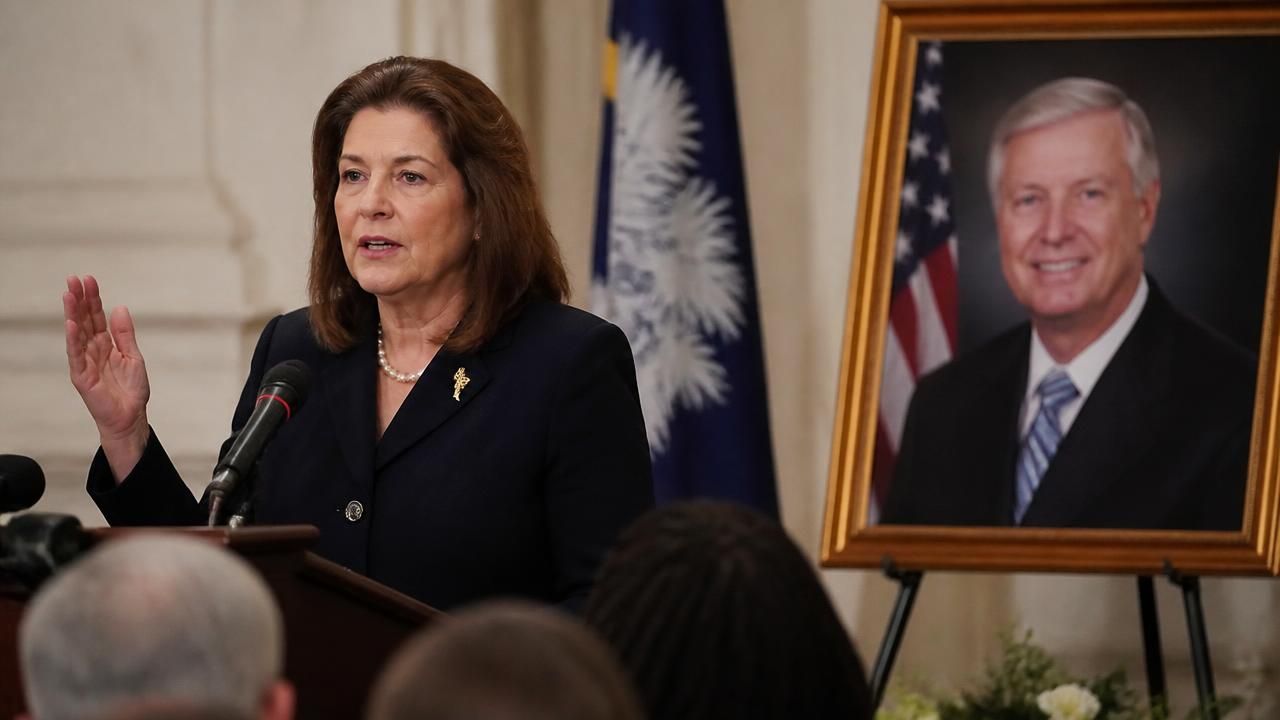
South Carolina Republicans head to the polls on Tuesday for a special primary that will determine the party's nominee for the late Sen. Lindsey Graham's seat — a contest that has become a proxy for a simmering power struggle between former President Donald Trump and the state's GOP establishment. With early voting and absentee ballots already tallied, Sen. Darline Graham, the senator's sister who was appointed to fill the vacancy, holds a commanding double-digit lead over a field of 10 challengers, according to multiple polls.
The election comes exactly one month after Graham's death, which sent shockwaves through the Senate and upended assumptions about the 2026 midterm map. The winner of Tuesday's primary will advance to the November special election, where the state's Republican lean makes the GOP primary effectively the decisive contest. But the race is not simply an inheritance battle; it has laid bare divisions over loyalty to Trump, the party's legislative priorities, and the future of South Carolina's influence in Washington.
A Crowded Field to Carry a Legacy
Darline Graham, a little-known businesswoman before her appointment, has sought to position herself as the natural steward of her brother's political legacy. She campaigned on continuing his hawkish foreign policy stance, his push for military investment in the state, and his knack for courting establishment donors. Yet her opponents argue that the seat should not be passed down like a family heirloom.
According to the South Carolina Daily Gazette, a dozen candidates initially filed, but the field narrowed to ten after qualification checks. Among them are state legislators, a former congressional aide, and a construction company owner who has branded himself as the "true conservative" in the race. The candidate backed by Trump — whom Politico described as a "wild card choice" — has privately rankled senior state GOP figures, who worry that his controversial social media posts and thin political resume could imperil the party's hold on the seat in a general election.
"There’s a power struggle brewing in South Carolina, and Trump might not win," Politico reported in a headline that captured the stakes.
That assessment appears validated by recent polling: Darline Graham leads with 38 percent support, while the Trump-backed candidate languishes in the mid-teens, according to a survey shared with MSN. "Republican primary voters in South Carolina want a senator in the mold of Lindsey Graham — but they aren't sure that's his sister," noted The Post and Courier in a voter survey analysis.
Trump's Endorsement and a Party at Crossroads
Trump's involvement has added a volatile dimension. He has publicly praised Darline Graham's loyalty to her brother but stopped short of a full endorsement, instead throwing his weight behind a little-known challenger who has echoed his false claims of election fraud and called for sweeping cuts to federal agencies. That choice has split the state's GOP coalition. Some county party chairs have warned that nominating a political novice could hand the seat to a Democrat in an otherwise safe Republican state — especially if the Democratic nominee, who has raised a record $4.2 million, successfully nationalizes the race.
The internal friction mirrors a broader regional trend. In recent months, Trump has sought to purge incumbent Republicans who voted to certify the 2020 election or who supported infrastructure spending, and South Carolina has become a test case. "The former president wants to prove he can still dictate nominations in the Deep South," said a Republican strategist familiar with the race. "But voters here are more pragmatic than national pundits assume."
Darline Graham has tried to thread the needle, accepting Trump's praise without seeking his formal endorsement. "She is running as Lindsey's sister, not Trump's ally," observed the Charleston-based political blog FITSNews. That strategy appears to be working among the state's older, suburban voters, who remember Graham's decades of constituent service.
The Redistricting Wrangle
Complicating Tuesday's vote is an explosive redistricting fight that has unfolded in the state legislature and federal courts. Just days before the primary, the Republican-controlled South Carolina House passed a new congressional map engineered to crack the historically Black district represented by Democrat James Clyburn, the powerful former House majority whip. The move, first reported by The New York Times, immediately drew a legal challenge from civil rights groups, who argue it violates the Voting Rights Act. Trump publicly demanded that the legislature go further and pack more Democratic voters into a single district, but state GOP leaders defiantly rejected his pressure — a rare public break that made national headlines.
"Republicans in South Carolina defy Trump to reject voting map changes," read a BBC headline.
The dispute has delayed the state's congressional primaries, originally scheduled for June. A House panel approved a two-month postponement, and Gov. Henry McMaster called a special session to expedite the new map. The Senate primary, however, is governed by a separate timeline set by the South Carolina Election Commission, and proceeded as scheduled. This staggered election calendar has confused voters, with many receiving conflicting information about when and where they can cast ballots. "It's a mess," said Scott Muller, the Republican chairman of Greenville County. "But we're doing everything we can to make sure every valid vote is counted."
The Supreme Court could ultimately decide the map's fate. In a related case, Politico noted that the Court may "leave alone the Voting Rights Act just long enough to keep the GOP from House control in 2026," signaling that the conservative majority is wary of dismantling a provision that has historically protected minority voting strength. A ruling against the new map could force a second redrawing later this year, further churning the state's political waters.
What Voters Say at the Polls
For many South Carolinians, Tuesday's primary is less about Trump or redistricting than about continuing Graham's outsize role in the state's civic life. At a polling place in Greenville, where the primary coincided with the first day of school, parents juggled voting with dropping off children. "Lindsey would have wanted us to be here early," said Mary Beth Turner, 58, a retired teacher. "I'm voting for Darline because she knows the job. Trump's guy doesn't have a clue."
High school students in the Midlands also got their first taste of civic engagement, grilling candidates at a forum sponsored by the local civics club. "How will you keep our military bases open?" one student asked. "What will you do about college costs?" asked another. The candidates' answers, recorded by WYFF, drew sharp contrasts on federal spending and veterans' benefits. For Darline Graham, the forum was a chance to evoke her brother's humble beginnings. "Lindsey always said the best ideas come from the people who live here," she told the audience.
Voter turnout is expected to be moderate — around 18 percent, according to early voting data tracked by the South Carolina Election Commission. But with runoff elections likely in several other statewide races, the broader primary season is far from over. If no Senate candidate clears 50 percent on Tuesday, the top two finishers will meet in a runoff on August 25, which would extend the uncertainty into late summer.
What Comes Next
The immediate aftermath of the primary will set the stage for a November contest that could tip the balance of the Senate, where Republicans currently hold a fragile 52-48 majority. Lindsey Graham's death had already transformed the political calculus; a Democratic pickup in a state Trump won by 11 points would be a seismic upset, but Democrats see opportunity if the GOP nominates a polarizing outsider. "We're not taking anything for granted," said state Democratic Party chairwoman Christale Spain. "South Carolina is changing."
For now, all eyes are on the returns. Polls close at 7 p.m. ET. As the results roll in, the question is whether Darline Graham can seal her brother's legacy — or whether the fracture lines exposed by his death will reshape South Carolina's Republican Party for years to come.