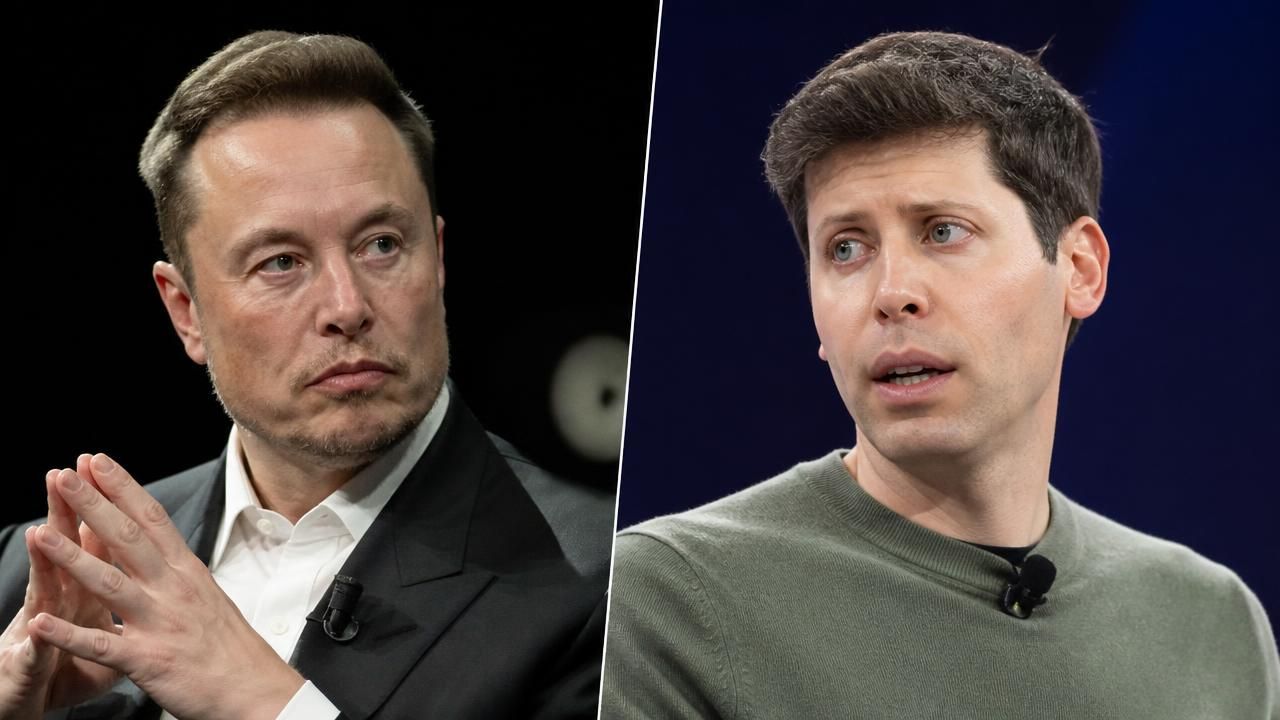
The feud between Elon Musk and Sam Altman has escalated into open warfare, with the two tech titans trading personal insults on X over Apple's new lawsuit against OpenAI. But beneath the schoolyard bickering lies a deeper ideological rift — one that historians and critics say reveals Silicon Valley's dangerous tendency to misread the science fiction that shapes its vision of the future.
The drama erupted this week after Apple filed a lawsuit against OpenAI, the company Altman leads as CEO. Musk, who co-founded OpenAI in 2015 before leaving and launching his own rival xAI, seized the moment to attack his former ally. In a series of posts on X, Musk accused Altman of having taken 'scamming to a whole new level' and declared that 'OpenAI is a lie.' Altman fired back with equal venom, taunting Musk: 'You're the one selling investors on space datacenters.'
From Allies to Adversaries
The bitter exchange is the latest chapter in a long-running rivalry that has intensified as the race for artificial intelligence supremacy heats up. Musk and Altman once shared a common mission: to ensure AI benefits humanity. But they have since diverged dramatically, with Musk warning that unchecked AI could wipe out civilization and Altman pushing forward with commercial deployment of OpenAI's technologies, including ChatGPT and GPT-4.
Apple's lawsuit adds a new legal dimension to their conflict. While the exact allegations remain sealed, reports suggest Apple is challenging OpenAI's business practices and claims about its AI systems' capabilities. The lawsuit has given Musk ammunition to portray Altman as a charlatan, a narrative Musk has promoted since leaving OpenAI's board in 2018.
'OpenAI is a lie,' Musk posted, reiterating his long-standing criticism that the company has abandoned its original non-profit, open-source ethos in favor of profit and secrecy.
Altman, for his part, has dismissed Musk's attacks as sour grapes from a competitor who is trying to catch up. His retort about 'space datacenters' appears to reference Musk's ambitious plans to deploy AI infrastructure in orbit — a project Altman has mocked as impractical and gimmicky.
Open-Sourcing Grok: A Strategic Move
In a surprising twist, Musk announced that xAI will open-source its Grok chatbot, a move widely seen as a direct challenge to OpenAI's proprietary model. 'We are releasing Grok's code to the world,' Musk wrote, framing it as a blow against the closed, profit-driven approach he says OpenAI has adopted. The announcement came just hours after his exchange with Altman, suggesting it was a calculated escalation.
The Science Fiction Problem
The feud, however, is more than a personal squabble. It reflects a broader intellectual crisis in Silicon Valley, where tech leaders have repeatedly misappropriated science fiction as a blueprint for the future. In recent essays, outlets like Wired and Aeon have pointed out that Musk, Altman, and their peers often misread classic works such as Isaac Asimov's Foundation series or Douglas Adams's The Hitchhiker's Guide to the Galaxy.
Historian Jill Lepore, in a widely cited critique, argues that this misreading poses a threat to democracy itself. 'Silicon Valley's founding myths are drawn from pulp science fiction, but they ignore the cautionary tales embedded in those stories,' Lepore said in a recent interview. 'They see the technology and miss the warnings.'
The Guardian's Eduardo Porter echoed this sentiment, noting that tech overlords are planning for 'conscious AI to conquer the cosmos' — a vision lifted wholesale from sci-fi tropes, but without the ethical reflection those stories demand.
'Our tech overlords are planning for conscious AI to conquer the cosmos. What could go wrong?' — Eduardo Porter, The Guardian
A Clash of Worldviews
The Musk-Altman divide exemplifies this problem. Musk repeatedly invokes The Terminator and other dystopian narratives, warning that AI could 'kill us all.' He has even cited the novels of Iain M. Banks as a model for a future where AI is benevolent — but added that we must first survive the transition. Altman, by contrast, speaks of AI as an inevitable, transformative force, echoing the optimistic techno-utopianism of Star Trek or Asimov's roboticist tales.
Yet both may be guilty of what Lepore calls 'science fiction myopia' — cherry-picking the exciting parts of speculative fiction while ignoring the complex social and political commentary embedded in the texts. This myopia has real-world consequences: it drives investment decisions, shapes public policy, and influences how billions of dollars are spent on AI research.
Expert Warnings
The stakes are further underscored by warnings from within the industry. Google DeepMind's chief AI officer recently cautioned that the odds of AI causing catastrophic harm are far too high to ignore, urging a more measured and evidence-based approach to AI development. This aligns with Musk's apocalyptic rhetoric, but also with Lepore's critique that tech leaders are operating on myth rather than analysis.
As the legal battle between Apple and OpenAI unfolds and the Musk-Altman feud shows no sign of abating, it is worth asking whether these titans are truly building a future grounded in reality — or merely acting out a script written by science fiction authors who were, in many cases, satirizing the very hubris they now embody.
What's Next?
For now, the public sparring continues. Musk's open-source pledge will put pressure on OpenAI to justify its closed approach, while Apple's lawsuit could force the company to open its books. Altman remains defiant, insisting that OpenAI's mission is to deliver 'AI that benefits all of humanity,' even if that means navigating a minefield of legal and ethical challenges.
- Apple's lawsuit against OpenAI is pending in federal court.
- xAI's Grok source code is expected to be released within weeks.
- Industry experts are calling for greater transparency in AI development.
The Musk-Altman rivalry is a spectacle that captivates the tech world, but it also illustrates a deeper truth: the future of AI is being shaped not just by algorithms and business models, but by the stories we tell ourselves about what AI should be. As Lepore warns, if those stories are misread, the consequences could be dire — not just for Silicon Valley, but for democracy itself.