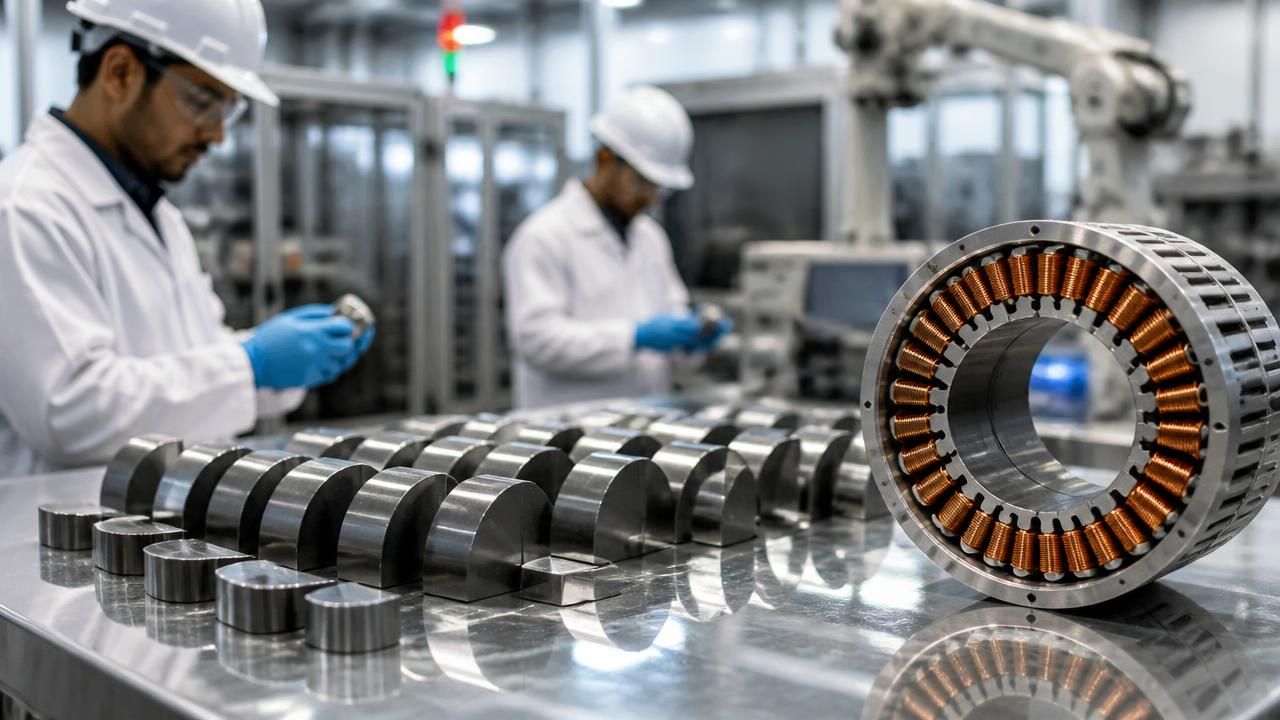
For decades, China has held a near-monopoly on the production of rare earth magnets – tiny but powerful components essential to electric vehicles, wind turbines, smartphones, and defense systems. Now, a wave of new projects across India, the United States, Europe, and Canada is challenging that dominance, driven by geopolitical tensions, supply security fears, and a surge in demand for clean energy technologies.
The urgency is palpable. Chinese export controls, tightening since last year, have jolted buyers into paying premium prices for non-Chinese supply, according to a Reuters report. Rare earth magnet users are now scrambling for alternatives as Beijing leverages its market power. The Wall Street Journal chronicles how China methodically took over the industry through decades of state support, low-cost production, and strategic acquisitions. Breaking that grip will require billions in investment and years of effort – but the race is on.
India's Bold Push for Self-Reliance
India is emerging as a major contender. Engineering giant Larsen & Toubro (L&T) plans to manufacture rare earth magnets in the country, according to Bloomberg, riding the government's push to cut import dependence. New Delhi is also preparing incentives for rare earth magnet manufacturing, Reuters reports, aiming to kickstart domestic output. State-owned IREL is championing a "rare earth corridor" in Tamil Nadu, which it says can become a magnet for investments. The Indian Rare Earths Limited envisions a hub that covers the entire value chain—from mining to magnet making.
Private firms are moving too. Lohum is building what it calls India's first rare earth magnet plant in Uttar Pradesh, a move to cut dependence on China. Rocklink India is setting up an integrated battery and rare earth recycling facility in UP, while Noveon Magnetics—a Texas-based recycler that recently raised $75 million—offers a circular economy model. Indian startups are also innovating around the problem: Vimag Labs and Gati Drives are developing electric motors that work without rare earth magnets entirely, reducing the need for imports and eliminating toxic materials. This dual-track approach—building supply chains while leapfrogging to magnet-free technology—is a hallmark of India's strategy.
Geopolitical Maneuvering
India is also securing raw materials abroad. The Moscow Times reports that Russia has offered India access to a major rare earth deposit in Siberia, while Reuters says India is exploring a rare earth deal with Myanmar rebels after Chinese curbs disrupted supply. These moves reflect a broader geopolitical scramble as nations seek to align with reliable partners.
The United States: From Oklahoma to the Pentagon
In the United States, efforts are accelerating at both the federal and state levels. The Pentagon says it will keep investing in U.S. critical minerals projects, a key pillar of national security strategy. Oklahoma has emerged as an unlikely epicenter: USA Rare Earth is building a plant there, and Reuters asks: "What is America’s answer to China’s rare earths dominance? Oklahoma!" The company is also considering a French magnet plant, signaling a transatlantic expansion.
South Korea's POSCO and U.S.-based ReElement Technologies are jointly exploring an integrated rare earth and magnet production plant in the U.S. Belgian chemical giant Solvay has sealed two deals to supply rare earths to U.S. magnet makers and is open to building a plant in the U.S., where policy support is stronger, according to Reuters. Meanwhile, a rare earth processing plant recently opened in New Hampshire, one of the few in the country, and mining companies are looking to increase extraction of these critical minerals.
Europe, UK, and Canada Join the Fray
Europe is not standing still. USA Rare Earth's potential French plant is part of the EU's efforts to secure critical raw materials. In the UK, a WSP feasibility study is paving the way for a domestic rare earths supply chain. Canada is also racing to build a full supply chain, as National Observer reports. The global picture is one of parallel efforts to replicate what China built—but with higher environmental and labor standards, and a focus on recycling and innovation to reduce reliance on virgin mining.
The Automotive Industry's Weakest Link
For the automotive industry, rare earth magnets have become a major vulnerability. Finshots explains how these magnets are the "weakest link" in the EV supply chain. Automakers are being forced to pay premiums for ex-China supply, and some are redesigning motors to use less or no rare earths. Apple's recent pledge to boost U.S. investment—made under political pressure—highlights how supply chain security is now a boardroom and cabinet-level issue across industries. Even the CHIPS Act, which focuses on semiconductors, is seen as a template for how the U.S. might support critical minerals, with officials examining equity stakes in companies receiving grants.
Challenges Ahead
Despite the momentum, experts caution that breaking China's grip will be difficult. Building a magnet plant requires specialized skills, and the supply chain spans mining, separation, refining, and magnet fabrication. China still controls over 80% of global magnet production. However, the combination of government incentives, private capital, and technological innovation—including magnet-free motors—offers hope. As the NYT notes, the race to make rare earth magnets outside China is on, and the winners will shape the future of clean energy and defense.
"The urgency is no longer about cost; it's about security. Countries and companies that secure their rare earth supply will have a competitive edge for decades." – Industry analyst perspective.
What to Watch
- Will India's incentive scheme attract global players like L&T and Lohum?
- Can the U.S. Pentagon sustain funding for critical minerals projects?
- Will magnet-free motors disrupt the rare earth industry before new mines come online?
- How will China respond to the erosion of its market power?
The next few years will be decisive. With billions of dollars at stake and geopolitical tensions rising, the rare earth magnet is no longer just a commodity—it's a strategic weapon, and every major economy wants to own it.