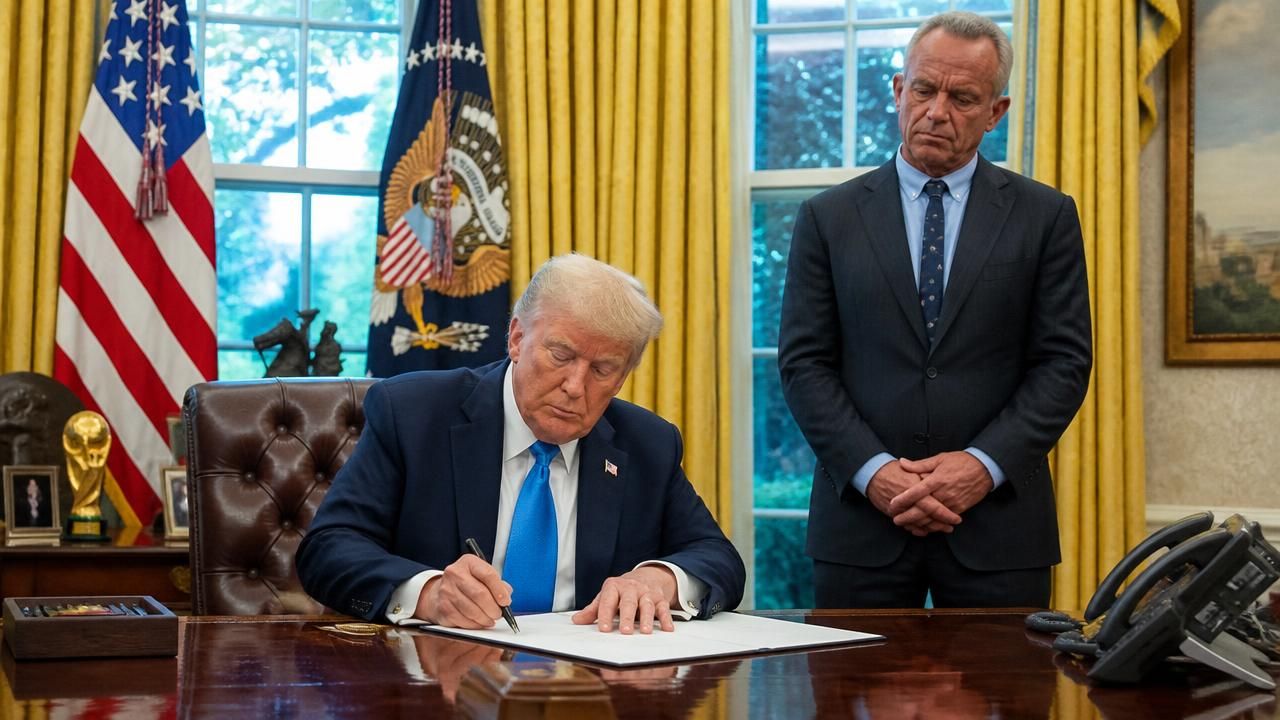
President Donald Trump signed an executive order on Monday that seeks to reduce the number of vaccines administered to children, reigniting a contentious battle over immunization policy. The order, which directs federal agencies to reassess the recommended childhood vaccine schedule, comes just weeks after a federal court blocked a previous attempt by the administration to unilaterally alter vaccine requirements. The move is being spearheaded by Health and Human Services Secretary Robert F. Kennedy Jr., a longtime vaccine skeptic who has promised to overhaul the nation's vaccine programs.
The executive order, which was signed in the Oval Office, instructs the Department of Health and Human Services (HHS) and the Centers for Disease Control and Prevention (CDC) to conduct a comprehensive review of the Advisory Committee on Immunization Practices (ACIP) — the panel that sets the official vaccine schedule for children. According to a White House fact sheet, the order aims to ensure that vaccines meet the 'gold standard' of safety and efficacy, and explicitly calls for reducing the number of immunizations children receive during their first two years of life.
Critics immediately condemned the order as a dangerous step backward for public health. 'This is not about safety; it's about ideology,' said Dr. Richard Besser, a former acting CDC director, in an interview. 'The current vaccine schedule has been rigorously studied and has dramatically reduced deaths and hospitalizations from preventable diseases.' Besser and other public health experts point to the resurgence of measles, a disease once declared eliminated in the United States, as evidence of what happens when immunization rates fall.
A New Front in the Vaccine Wars
The executive order is the latest salvo in a broader campaign by Trump and Kennedy to dismantle the federal vaccine infrastructure. Earlier this year, the administration attempted to pause federal funding for vaccine education programs, but that effort was blocked by a federal judge. The new order bypasses the funding issue by directing the scientific review process itself, a move that legal experts say could be challenged on procedural grounds.
According to a report from Politico, Kennedy's allies on the outside have already begun drafting a more sweeping plan to 'upend' childhood vaccination requirements. The plan reportedly includes moving the ACIP under direct control of HHS, stacking the committee with vaccine-skeptical appointees, and creating an alternative vaccine schedule that would be published as an official government document. While the executive order doesn't go that far, it lays the groundwork by ordering a review of 'the entire existing vaccine schedule' and asks for recommendations on 'reducing the number of vaccines on the schedule.'
Kennedy, who has long promoted the debunked link between autism and vaccines, has repeatedly argued that the childhood schedule is 'scientifically unproven' and that children receive far too many injections too early. In a statement following the signing, Kennedy said the order was a 'first step toward restoring integrity to our vaccine programs.' He added that parents should have more say in their children's immunization plans, echoing a key theme of the administration's 'Make America Healthy Again' agenda.
Legal and Scientific Hurdles
The courts have emerged as a major obstacle to the administration's vaccine agenda. In late April, a federal judge in Texas blocked a rule that would have allowed exemptions for religious and philosophical objections to mandatory school vaccinations, ruling that the administration had overstepped its authority. The executive order is likely to face similar legal challenges from public health organizations and medical associations.
Beyond the legal battles, the scientific consensus remains clear: vaccines are safe and effective. The CDC reports that routine childhood immunizations prevent more than 20 million hospitalizations and 4 million deaths annually among children born in the U.S. The current schedule protects against 15 serious diseases, including measles, mumps, rubella, polio, tetanus, and whooping cough. Public health officials warn that any disruption to the schedule could lead to outbreaks, especially in communities with low vaccination rates.
Dr. Sean O'Leary, a professor of pediatrics at the University of Colorado and chair of the American Academy of Pediatrics Committee on Infectious Diseases, emphasized that the vaccine schedule is not static. 'The schedule is continuously updated based on rigorous scientific evidence,' he said. 'It is designed to protect children at the age when they are most vulnerable to severe complications from these diseases. Changing that schedule without scientific justification is reckless.'
Perspectives and Reactions
The executive order has deeply divided the public. Supporters, many of whom are part of the vaccine-skeptic movement, applauded the move as a victory for parental rights and medical freedom. 'Parents should be the ones deciding what goes into their children's bodies, not government bureaucrats,' said Stephanie Burns, a mother of two from Ohio who attended the signing ceremony. 'This is about informed consent.'
But pediatricians, epidemiologists, and parent advocates expressed alarm. They note that vaccine mandates have been one of public health's greatest achievements, contributing to the near-eradication of diseases that once killed or disabled thousands of American children each year. 'We stand on the brink of reversing decades of progress,' said Dr. Yolanda Johnson, a pediatrician in Atlanta. 'If this order leads to fewer vaccines, we will see children in the hospital with diseases we haven't seen in generations.'
Several state attorneys general have already indicated they will sue to block the order, arguing that it violates the separation of powers by undermining Congress's authority over interstate commerce and public health. The American Academy of Pediatrics and the American Medical Association also issued statements denouncing the order, calling it 'unscientific' and 'dangerous.'
What Happens Next
The executive order requires HHS to submit a preliminary report within 60 days, with final recommendations due in 180 days. In the meantime, the administration is expected to continue pushing for vaccine-related changes through other administrative levers, including the appointment of sympathetic members to the ACIP and the reshaping of FDA advisory panels.
For public health experts, the stakes could not be higher. The U.S. is already seeing measles outbreaks in several states, including Ohio and Texas, with case numbers surpassing last year's totals. If the administration succeeds in rolling back the vaccine schedule, the long-term consequences for disease prevention could be profound. But with legal challenges mounting and opposition from the medical establishment, the path forward is uncertain.
What is clear is that the debate over childhood vaccines has moved from the margins of American politics to the center of the White House agenda. The next few months will determine whether the executive order becomes a blueprint for a new vaccine policy — or another episode in a growing legal confrontation over public health governance.