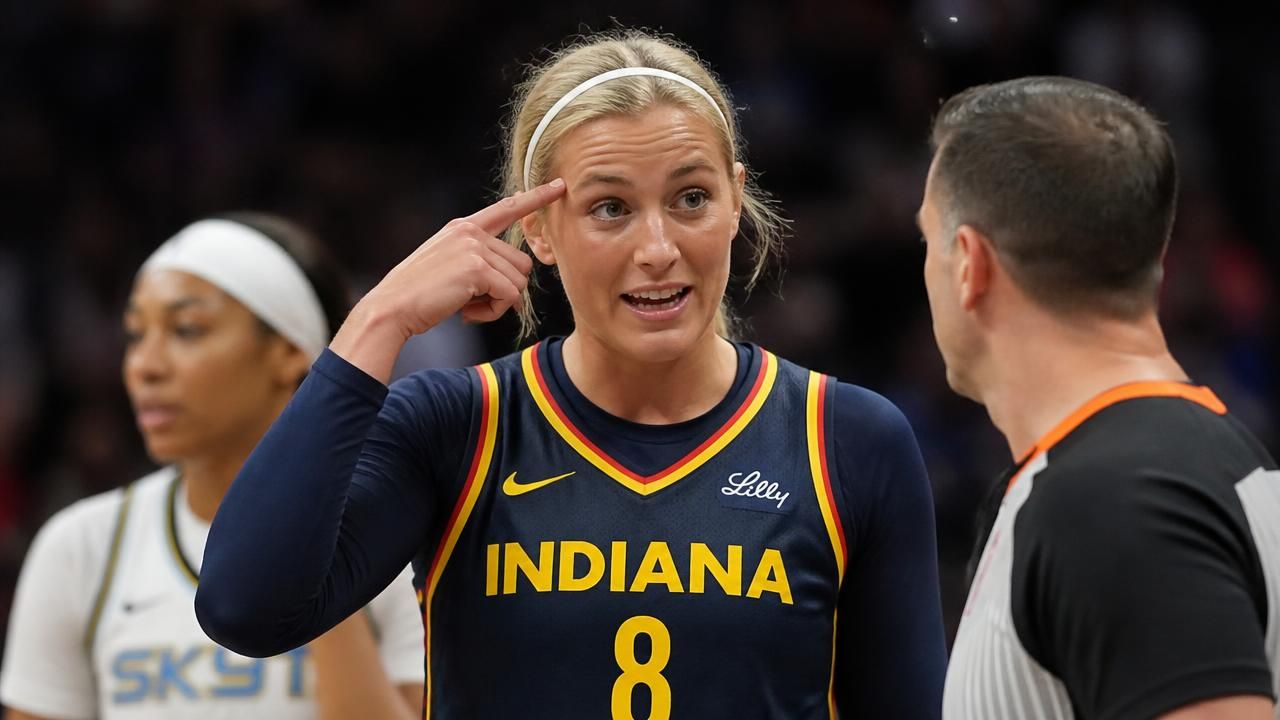
The WNBA has found itself at the center of a fiery cultural and political storm this week, triggered by a single comment from Indiana Fever forward Sophie Cunningham. In a media appearance, Cunningham declared that banning transgender women from women's sports is “common sense,” reigniting a debate that has now drawn in former NBA stars, provoked on-court tensions, and prompted the league to consider urgent policy talks.
The controversy began when Cunningham, a veteran player known for her outspokenness, was asked about transgender participation in women's basketball. Her blunt response—“it's common sense” to exclude transgender women—quickly spread across social media, drawing both support and condemnation. Cunningham later doubled down, framing her stance as a defense of Title IX and the integrity of women's athletics. “I believe in protecting women's sports,” she told reporters, reiterating her position amid mounting backlash.
A Firestorm of Reactions
The WNBA community split almost immediately. Some players and fans applauded Cunningham for speaking what they see as an obvious truth, while others accused her of transphobia and undermining inclusive values. The debate intensified when Chicago Sky guard DiJonai Carrington was ejected from a game after a hard foul on Cunningham—an incident many interpreted as more than just competitive aggression. Carrington's ejection became a flashpoint, with analysts arguing it symbolized the growing animosity spilling onto the court.
Off the court, the criticism grew louder. U.S. women's soccer legend Megan Rapinoe, a prominent advocate for LGBTQ+ rights, took aim at Cunningham after photos surfaced of the Fever star posing with anti-trans activist Riley Gaines. Rapinoe wrote that the photo “told me everything I need to know,” a thinly veiled rebuke that amplified the cultural divide. Meanwhile, conservative commentators and politicians seized on the controversy as evidence that the WNBA is out of step with mainstream values.
Former NBA Players Announce 2027 Draft Bids
The most bizarre twist came when former NBA players, including Enes Kanter Freedom, announced they would declare for the 2027 WNBA Draft. Kanter Freedom, a Turkish-American center known for his political activism, said eligibility rules effectively allow men to enter the league, and he intends to make a point by doing so. Another former NBA star reportedly joined him, with the pair issuing a joint statement: “See you at training camp.”
The announcements were widely seen as a stunt designed to highlight what critics call a loophole in WNBA regulations. The league's rulebook, as detailed by multiple outlets, does not explicitly prohibit men from declaring for the draft—only requiring players to be at least 22 years old and to submit paperwork. This ambiguity has fueled concerns that the league is unprepared for the legal and competitive implications of transgender and male participation.
What the Rulebook Actually Says
According to the WNBA's official collective bargaining agreement and constitution, the draft is open to “all female players” and “players who have exhausted college eligibility.” However, the language is vague on gender identity, leaving room for interpretation. Legal experts note that if a biological male declares, the league might face a Title IX challenge or be forced to clarify its stance. The Kanter Freedom bid, while theatrical, has forced the issue into the open.
League Faces Calls for Action
With the All-Star Weekend looming, reports emerged that WNBA officials are planning “crunch talks” to address transgender athlete eligibility. The league has remained publicly silent, but behind the scenes, executives are said to be scrambling to craft a policy that balances inclusivity with competitive fairness. The pressure is mounting: sponsors have reportedly expressed concerns, and political figures are weighing in from both sides.
Critics argue the WNBA is risking its moment of unprecedented growth—spurred by stars like Caitlin Clark and Angel Reese—by allowing a divisive issue to dominate headlines. “The league cannot afford to alienate its core audience or its players,” said one sports business analyst. “What happens in the next few months could define the WNBA for a generation.”
A Fact-Check Amid the Noise
As the debate raged, misinformation flourished online. One viral rumor claimed that WNBA players would undergo mandatory “sex testing,” with names like Brittney Griner and White House press secretary Karoline Leavitt dragged into the story. Fact-checkers have debunked these claims, noting that no such testing protocol exists and that Griner's history is unrelated to the current policy vacuum. Still, the spread of such rumors illustrates the charged atmosphere surrounding the issue.
Broader Implications
This is not just a sports story; it is a cultural flashpoint. The WNBA has long positioned itself as a progressive league, championing LGBTQ+ rights and social justice. But Cunningham's comments and the ensuing backlash reveal a deep fracture within that identity. Players are being forced to choose sides, and the league's leadership is caught between a vocal progressive faction and a growing counter-movement that frames transgender inclusion as a threat to women's sports.
Title IX, the landmark 1972 law prohibiting sex-based discrimination in federally funded education programs, has become the battleground. Cunningham and her supporters argue that allowing transgender women to compete undermines decades of hard-won gains for female athletes. Opponents counter that Title IX's protections extend to transgender individuals and that exclusion itself is a form of discrimination.
What’s Next?
The WNBA's next moves will be closely watched. Will the league issue a definitive policy on transgender athletes, or will it continue to let ambiguity fester? The 2027 draft deadline gives Kanter Freedom and others ample time to force the issue. Meanwhile, the on-court hostility between players like Carrington and Cunningham suggests that the dispute is far from academic.
For now, the WNBA finds itself in an unenviable position: a league celebrated for its inclusiveness, now under fire from all sides. The coming weeks, leading into All-Star Weekend, may determine whether it emerges stronger or more divided. As one league insider put it, “This is a test of leadership.”
“I believe in protecting women's sports,” Cunningham said, reiterating her position amid mounting backlash. “It's common sense.”
The debate shows no signs of cooling. With political figures, athletes, and advocacy groups all weighing in, the WNBA is the latest arena for a broader societal conflict over gender, fairness, and the future of competitive sports.