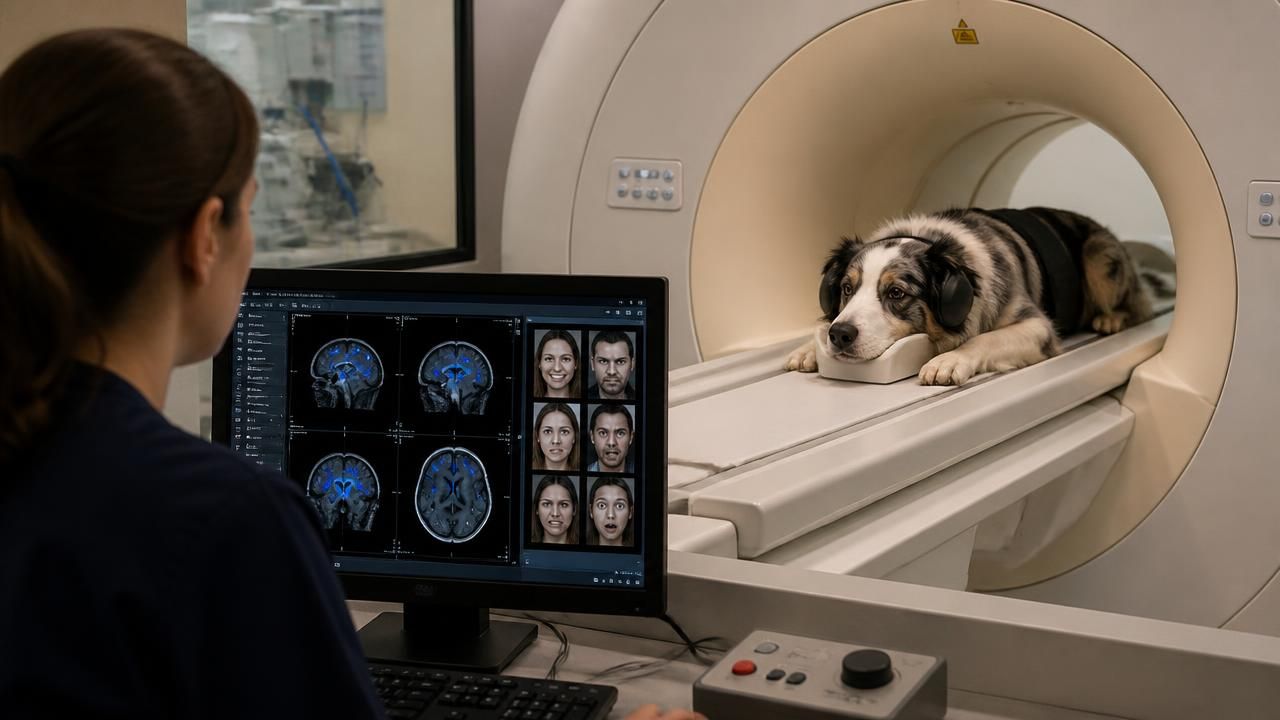
For millennia, dogs have earned the title of "man's best friend" through loyalty, companionship, and an uncanny ability to sense when something is wrong. Now, new research published in the journal iScience provides the strongest neurological evidence yet that dogs can actually distinguish between human emotions like happiness, anger, sadness, and fear—just by looking at our faces.
Using functional magnetic resonance imaging (fMRI), an international team of researchers led by the University of Vienna identified a specific region in the canine brain that processes happy human facial expressions, and found that dogs' brains respond differently to negative emotions, allowing them to tell apart anger, sadness, and fear. The study offers a neural basis for what pet owners have always suspected: our dogs are wired to understand us.
"Humans are really good at picking up small details on the face, and so are dogs," said co-author Raúl Hernández-Pérez of the University of Vienna. "This makes dogs very interesting. By studying their brains, we can understand what adaptations have developed to support their remarkable social and emotional understanding of humans."
Inside the Canine Mind
The research team scanned the brains of trained dogs while they viewed images of human faces expressing six basic emotions: happiness, anger, fear, sadness, disgust, and surprise, alongside neutral expressions. The dogs were awake and unrestrained during the scans, with their heads positioned comfortably in the MRI machine—a technique that has been refined in recent years to study canine cognition without causing distress.
The results revealed a clear pattern: a region in the left temporal cortex, an area known to be involved in face processing, lit up more strongly when dogs saw happy faces compared to negative ones. Even more intriguingly, the brain activity patterns for anger, fear, and sadness were distinct from each other, suggesting dogs can not only detect emotional valence (positive vs. negative) but also differentiate between specific negative emotions.
Earlier behavioral studies have already shown dogs are sensitive to human emotions. In one classic experiment, dogs chose a box associated with a happy human face over one associated with fear or disgust. Previous fMRI investigations also found that areas like the caudate, hippocampus, and amygdala—brain regions tied to reward and emotional processing—respond more strongly to faces showing emotion than to neutral faces. However, the new study goes a step further by demonstrating that the canine brain encodes the identity of specific emotions, not just whether they are positive or negative.
"This makes dogs very interesting. By studying their brains, we can understand what adaptations have developed to support their remarkable social and emotional understanding of humans."
— Raúl Hernández-Pérez, University of Vienna
More Than Just a Look: Smell and Emotional Contagion
The visual processing of faces is only one piece of the puzzle. Dogs are also famously adept at reading human emotions through scent. Research covered by National Geographic and Live Science has shown that dogs can "catch" their owners' emotions, a phenomenon known as emotional contagion. When a human feels stressed, their body releases cortisol and other stress hormones, which dogs can detect in sweat and breath. Studies have found that dogs' heart rates and stress levels synchronize with their owners', meaning your calm or anxious state can directly influence your dog's mood.
"Dogs are hyper-vigilant to human cues," notes a veterinarian interviewed by Parade Pets. "They don't just see your face; they smell your chemical changes, hear the pitch of your voice, and read your body posture. It's a multi-sensory system tailored to bond with us."
This ability likely stems from thousands of years of domestication, during which dogs that were better at reading human emotions were more likely to be cared for and bred. The result is an animal uniquely attuned to our every sigh, frown, or tear.
What This Means for Dog Owners
The findings carry practical implications. Because dogs can distinguish between emotions, they may also be affected by our emotional states in nuanced ways. A 2019 study from the University of Michigan, widely covered by outlets like Smithsonian and Reader's Digest, found that dogs can become stressed when they sense their owners' stress. The study measured cortisol levels in dogs and their owners over several months, and found that the two were closely matched—meaning chronic stress in people can lead to chronic stress in their pets.
So how can you use this knowledge to care for your dog?
- Manage your own stress. Since dogs mirror our emotional state, staying calm during thunderstorms, vet visits, or when you're angry can help reduce their anxiety.
- Use positive expressions. Smiling at your dog activates their reward pathways, reinforcing your bond and training them to associate your happiness with positive outcomes.
- Learn to read your dog's body language. Tail wagging, ear position, and eye contact all convey their feelings. The direction and speed of a tail wag, for instance, can indicate excitement, fear, or anxiety.
- Don't mistake "guilty" looks for genuine guilt. As The Dodo explains, the classic guilty expression in dogs is actually a response to human anger, not a moral judgment about their actions.
A Two-Way Street: Humans Can Read Dogs, Too
The emotional connection is not one-sided. Studies featured in Smithsonian show that people can accurately read dogs' facial expressions, distinguishing between happy, sad, and angry faces in dogs with surprising accuracy. This mutual understanding likely evolved through cohabitation, with both species adapting to read each other's signals.
Yet this interspecies empathy has limits. As a Fordham Observer opinion piece wryly notes, not everyone is a dog lover, and strong emotional reactions can sometimes lead to misunderstandings. A viral story from People about a pit bull who cried after trick-or-treaters were too scared to pet him underscores how human fear—often based on breed stereotypes—can hurt dogs that are simply trying to connect. The new research on emotion recognition reminds us that dogs are intensely social beings; when we fear them, they feel it.
The Future of Canine Neuroscience
The iScience study opens up new avenues for research. Questions remain about how dogs integrate visual, olfactory, and auditory cues to form a complete picture of human emotion. The researchers plan to investigate whether the brain regions activated by human faces are also involved in processing dog emotions, and how these circuits develop through life.
"This is a foundational study," says co-author Hernández-Pérez. "It shows that dogs have a dedicated neural mechanism for reading our faces. Next, we want to see how that mechanism is shaped by experience—whether dogs who live closely with humans are better at it than those in shelters."
One thing is certain: the special bond between humans and dogs is far more than a learned behavior. It is written into the canine brain, shaped by evolution to ensure that our furry companions can comfort us when we're sad, celebrate with us when we're happy, and stand by us through every emotion in between. The next time your dog rests its head on your lap after a bad day, you can be sure it knows exactly how you feel.