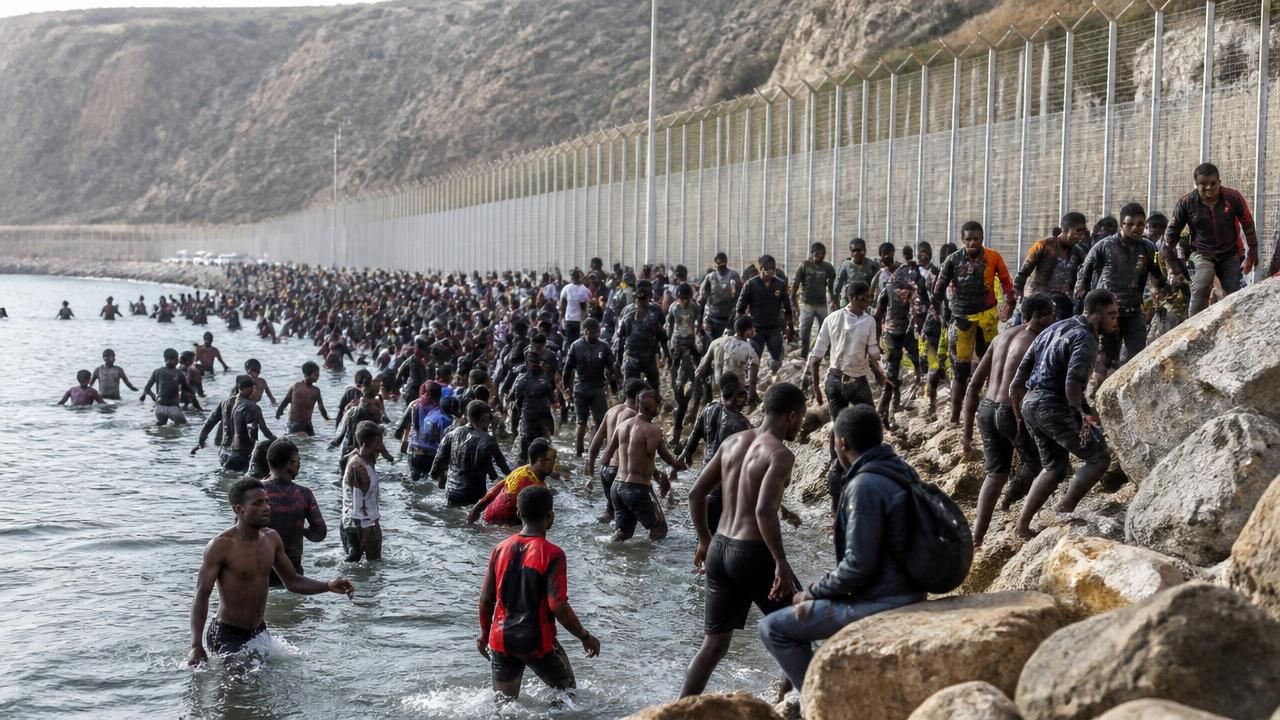
In an extraordinary 24-hour surge, tens of thousands of migrants crossed from Morocco into the Spanish enclave of Ceuta, overwhelming the tiny North African territory and triggering a diplomatic crisis between Madrid and Rabat. At least 57 people are reported to have died during the attempt, according to The Guardian and the Boston Herald, while other outlets gave lower figures as the situation unfolded. Spanish Prime Minister Pedro Sánchez condemned the movement as a "violation of Spain's territorial integrity."
A 24-hour crisis
Ceuta, a city of approximately 85,000 people, was suddenly flooded with an estimated 50,000 to 60,000 migrants who swam, waded, or crossed through porous border checkpoints after Moroccan security forces appeared to stand aside. The influx, described by The Guardian as the largest of its kind in decades, quickly overwhelmed local shelters, roads, and emergency services. Many migrants were seen sleeping on streets and beaches, while humanitarian agencies scrambled to provide basic aid.
Initial reports from the Irish Examiner placed the death toll at 43, while NTD reported at least 34. As the crisis continued, The Guardian and the Boston Herald confirmed at least 57 fatalities, though officials warned the number could rise. The causes of death reportedly included drowning, crushing, and injuries sustained during the mass push.
- Up to 60,000 migrants entered Ceuta in a single day, according to the Boston Herald.
- The city's population is roughly 85,000, making the inflow proportionately enormous.
- All nine sources agree the event represents a major escalation in migration pressure at Europe's southern border.
'Violation of territorial integrity'
Sánchez, speaking after an emergency cabinet meeting, said Spain would not accept what he described as a deliberate challenge from Rabat. "This is a violation of Spain's territorial integrity," he said, vowing to restore order and work with Morocco to repatriate those who had entered illegally.
"This is a serious challenge to our borders. Spain will defend its territorial integrity with firmness." — Pedro Sánchez
EU backlash and Schengen threats
The crisis quickly took on a broader European dimension as other member states criticized Madrid's handling of the border. According to The Guardian, several EU governments — including France and Germany — expressed anger that Spain had failed to prevent the mass entry. Some officials went further, demanding Spain be suspended from the Schengen free-movement zone for failing to protect the bloc's external frontier.
The criticism reflects a long-standing tension between southern EU states, which bear the brunt of migration, and northern members, which insist on strict border enforcement. It also raises questions about the viability of Europe's border-free travel area in times of crisis.
A diplomatic lever: Morocco's role
Behind the chaos lies a complex geopolitical relationship. Ceuta and its larger sister enclave Melilla have been European territories for centuries, but Morocco has never fully accepted their status as Spanish. Many analysts — and some Spanish commentators, as reflected in an AOL piece titled "Ceuta migrant surge is not just an invasion - it is a betrayal and a surrender" — argue that Rabat deliberately loosened border controls to pressure Madrid over disputes such as Western Sahara and maritime boundaries.
Morocco denied any intentional policy change, but the sudden, coordinated nature of the crossing — and the fact that Moroccan security forces did little to stop it initially — fueled suspicion. The Guardian reported that Spanish officials believed the influx was orchestrated to blackmail Madrid into concessions.
Migration begins to reverse
Within days, the tide started to turn. Reuters reported that Spain said migrants were already returning to Morocco, and the Boston Herald noted that many left voluntarily, driven by the realization that Ceuta could not support them. Spain and Morocco then began joint operations to halt further crossings, with Moroccan police reinforcing checkpoints and roundups of migrants inside Ceuta.
By midweek, the number of migrants remaining in the enclave had dropped significantly from the peak, but hundreds refused to leave, and Spain scrambled to set up temporary accommodation and negotiate flights back to Morocco. The Irish Examiner, reporting the lower death toll, also emphasized the ongoing humanitarian strain.
Framing a crisis
The nine sources covering this story show sharply different editorial angles. The Guardian prioritizes the human toll and the diplomatic fallout, while Reuters focuses on the practical return of migrants. NTD, citing official numbers, gives a lower death count. The Boston Herald highlights the voluntary nature of many returns. And the AOL opinion piece frames the episode not as an accident but as a calculated act of aggression — a "betrayal and a surrender" by Spain.
These divergent perspectives reflect the underlying disagreements about who is responsible, what the appropriate response should be, and whether Spain has been overrun or has failed to protect its sovereignty. What is clear is that the crisis at Ceuta is far from resolved, and it has exposed deep fault lines within the European Union over migration policy.
Looking ahead
For now, Spain's immediate priority is stabilizing the enclave and repatriating the remaining migrants. But the longer-term questions remain. Can Europe secure its southern borders without relying on Moroccan cooperation? Will the EU impose penalties on Spain, as some have threatened? And will the deaths of at least 57 people become a catalyst for reform — or just another statistic in an ongoing humanitarian tragedy?
As the water carries new arrivals to Ceuta's shores, the answers remain as uncertain as the waves themselves.