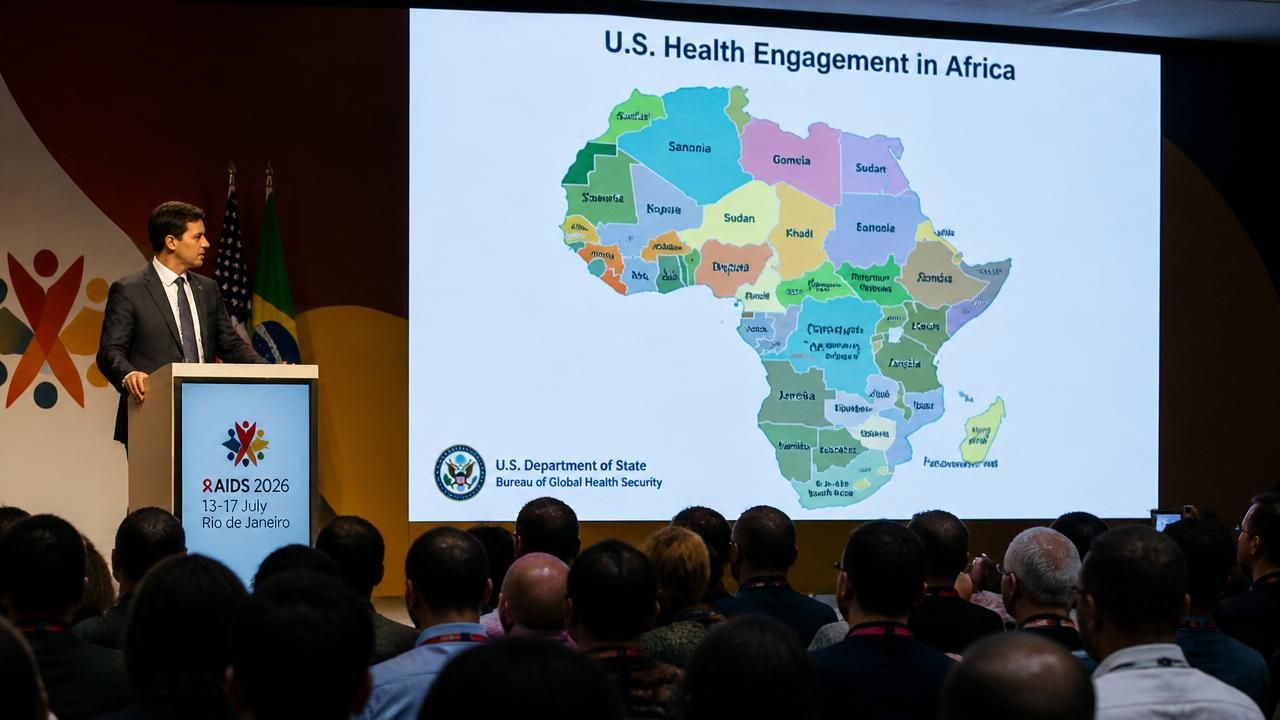
The U.S. State Department was forced into an embarrassing retraction this week after a map of Africa displayed during an official presentation at the International AIDS Conference in Rio de Janeiro mislabeled every single country on the continent. The error, which unfolded on July 13, 2026, was caught by attendees who quickly took screenshots and shared them across social media, turning a routine policy briefing into a global diplomatic embarrassment.
The map appeared midway through a presentation on the State Department's new health agreements, a centerpiece of U.S. global health diplomacy. Instead of correctly identifying nations such as Nigeria, Kenya, or South Africa, the chart shuffled names across the continent, leaving some countries entirely mislabeled and others unidentifiable. Reuters, which viewed a video of the presentation, confirmed that the map was visibly wrong in nearly every instance.
An 'Unfortunate Error'
The State Department quickly acknowledged the blunder. In a statement to multiple news outlets, a spokesperson said the department “takes full responsibility for this unfortunate error” and promised to review its internal vetting procedures. The apology, however, did little to temper the wave of criticism and mockery that followed. One attendee told The Guardian that “people in the room were visibly confused, then amused, then concerned about what else might be inaccurate in the presentation.”
“We take full responsibility for this unfortunate error,” a State Department spokesperson said, adding that the map was “not an accurate representation of the African continent.”
AI-Generated Map Raises Questions
Perhaps the most troubling detail to emerge from the incident is that the map appears to have been generated using artificial intelligence tools. Several reports, including from Inkl and Legit.ng, noted a visible watermark consistent with OpenAI's image generation technology. The inclusion of an AI-generated graphic in an official U.S. government presentation underscores the growing challenge of ensuring accuracy as federal agencies increasingly adopt generative AI for routine tasks.
“This is a textbook example of why AI-generated content must be carefully reviewed by subject-matter experts before it is used in official settings,” said Tipp Insights, a technology analysis firm. “A map of Africa with every country mislabeled is not just a minor oversight; it signals a dangerous lack of human oversight in the production of diplomatic materials.”
The AI connection also fueled speculation that the error stemmed from the Trump administration's aggressive downsizing of the State Department, particularly in regional and cartographic expertise. Critics were quick to point out that experienced Africa specialists and maps officers had been purged in recent rounds of staffing cuts, leaving a vacuum in which a flawed AI-generated graphic could slip through unchecked.
Political and Diplomatic Fallout
The map immediately became a political flashpoint. Democrats in Congress seized on the incident as evidence that the administration's approach to foreign policy is reckless and understaffed. One senior Democratic aide called it “a symbol of an administration that prioritizes speed and cost-cutting over competence and accuracy.”
In Africa, the response ranged from disappointment to outright anger. The East African reported that several African diplomats at the conference were “deeply offended” by the error, which they saw as emblematic of a broader lack of respect and attention to the continent. The incident also drew sharp reactions on X (formerly Twitter), where African netizens mocked the U.S. government's apparent inability to locate African countries despite having military bases and diplomatic missions across the region.
Observers noted that the episode could undermine Washington's credibility in Africa, a region where China and Russia have been aggressively courting allies. The State Department's health agreements, which were the focus of the presentation, are a key part of U.S. soft power strategy. A highly visible mapping error risks trivializing that work and reinforcing narratives of U.S. incompetence.
Context and Historical Precedents
This is not the first time a U.S. government map has caused embarrassment. In 2015, the White House was forced to apologize for a map of Asia that omitted several countries. More recently, in 2023, a State Department press release about a new trade agreement mistakenly labeled the Indian Ocean as the “China Sea.” But the scale of the error at the AIDS conference—a continent entirely mislabeled—is widely seen as unprecedented.
The timing is especially awkward. The AIDS 2026 conference is one of the largest gatherings of global health experts, and the U.S. has long been the largest donor to HIV/AIDS programs in Africa through PEPFAR. The presentation was meant to highlight the administration's renewed commitment to fighting the epidemic, but the map overshadowed that message and stole the headlines.
How the Error Happened
While the exact chain of events remains unclear, inside reports suggest that the map was produced by a lower-level staffer using an AI tool to quickly generate visuals for the slideshow. The image was not vetted by the Africa bureau or the cartography office, which had seen its staff reduced by 40% under the administration's reorganization. A senior State Department official, speaking on condition of anonymity, told NBC News that the department is now reviewing “all visuals generated with AI for any foreign policy presentation.”
The official also acknowledged that the map was not intentionally malicious but was a product of “overconfidence in technology and underinvestment in human expertise.”
Implications for Diplomacy and AI Governance
Beyond the immediate diplomatic spat, the incident raises broader questions about the intersection of AI and governance. Governments worldwide are increasingly relying on AI to draft reports, create visuals, and even shape policy. This episode is a stark reminder that AI tools are only as reliable as the data they are trained on and the humans who supervise them.
- AI oversight: Federal agencies must implement mandatory human review for all AI-generated content used in official communications.
- Staffing: The cuts to expert staff in the State Department have been linked to a decline in the quality of diplomatic materials.
- Reputation: Restoring trust among African partners will require more than a simple apology; it will require demonstrated commitment to accuracy and engagement.
At least one positive outcome has emerged: the incident has spurred a broader conversation about the role of AI in diplomatic work. Some experts argue that AI, when properly supervised, can enhance efficiency and creativity. But the Rio map is a cautionary tale that resonates far beyond a single conference slide.
What's Next
The State Department has promised to issue corrected materials and to formally apologize to the African Union and the governments of the affected countries. The department is also expected to release a “comprehensive audit” of its AI use policies within the next 30 days. Meanwhile, the AIDS conference continues, and many participants have tried to refocus attention on the urgent global health challenges at hand. But the image of a muddled map—one that placed Tunisia where Madagascar should be and labeled the Democratic Republic of the Congo as Algeria—will not soon fade.
As one African delegate put it, “We came to Rio to talk about saving lives, and the United States showed us they can't even find our countries on a map. What does that say about their commitment to us?”