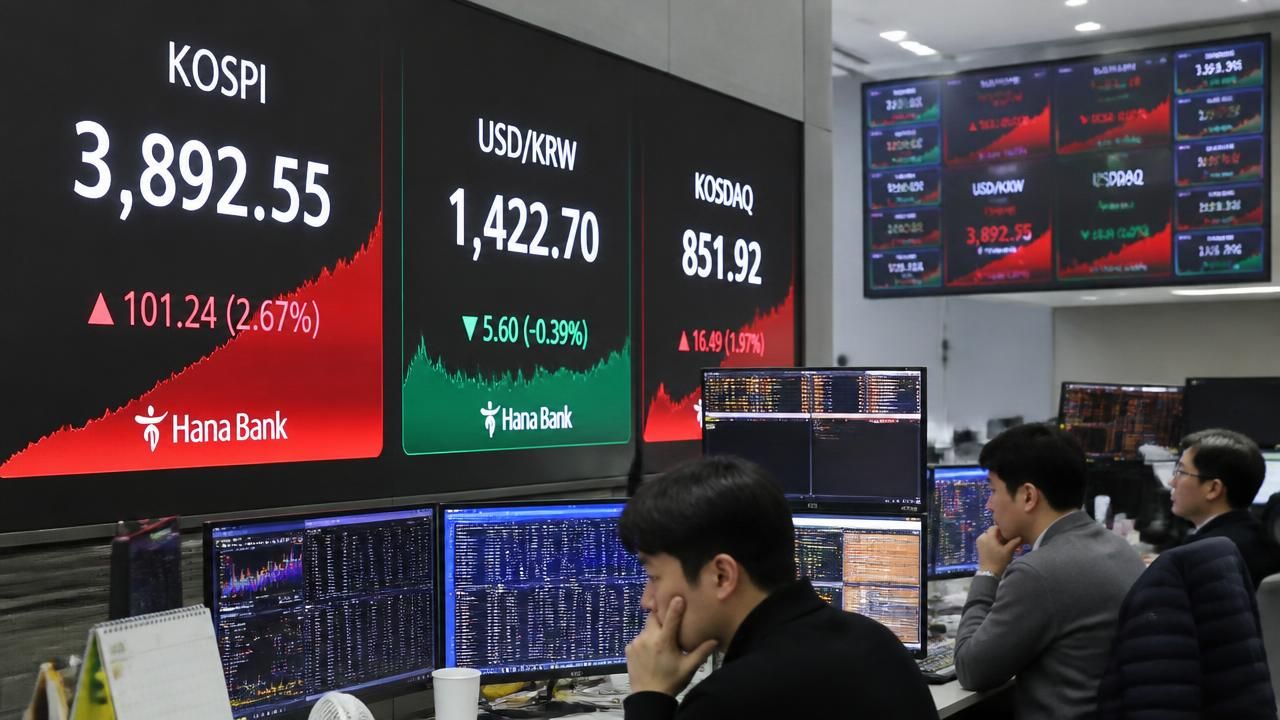
Asian stocks rallied on Friday, led by a record intraday gain in South Korean equities, as investors renewed bets on the artificial intelligence (AI) trade following this week's sharp selloff. The yen weakened, giving back some of Thursday's intervention-driven gains, after the Bank of Japan (BOJ) held its benchmark interest rate steady. The moves come amid growing political uncertainty in Japan, where a recent election outcome is clouding the central bank's policy path.
Asian Markets: A Rebound Led by Tech and South Korea
Equities across Asia advanced Friday, with South Korea's KOSPI index posting an all-time intraday high. The surge was fueled by a recovery in technology and AI-related shares, which had been hit hard earlier in the week. Analysts attributed the rebound to dip-buying and a reassessment of the AI growth narrative, which remains intact despite short-term volatility. According to Bloomberg Markets, the positive sentiment spread across the region, lifting benchmarks in Japan, Australia, and China.
The BOJ's Holding Pattern
The Bank of Japan concluded its two-day policy meeting on Friday, keeping its short-term interest rate target unchanged and making no adjustments to its yield curve control program. The decision was widely expected by economists, but it did little to clarify the central bank's next move, especially in light of Japan's recent political shifts. The BOJ has been under pressure to normalize monetary policy after years of ultra-low rates, yet fragile economic conditions and government instability have complicated the timeline.
Yen Volatility and Intervention Concerns
The yen weakened against the dollar following the BOJ's announcement, sliding back toward levels that triggered suspected intervention by Japanese authorities on Thursday. Market participants believe the Ministry of Finance stepped in to support the currency after it plunged to multi-decade lows. The BOJ's decision to stand pat gave traders the green light to sell yen again, raising concerns that further intervention may be necessary if the currency continues to depreciate. Friday's move reversed some of the previous day's gains, underscoring the volatile dynamics.
Japan's Election and the BOJ's Policy Outlook
The BOJ's path is now increasingly entangled with Japan's political landscape. A recent election outcome, which reportedly weakened the ruling coalition's grip, has muddled expectations for policy normalization. Analysts note that a politically fragile government may be reluctant to support aggressive rate hikes, which could constrain the BOJ's ability to act independently. The central bank will likely need to navigate a delicate balance between fighting inflation and supporting economic growth, all while facing political headwinds. Reuters highlighted this tension, pointing out that the election result complicates the BOJ's ability to communicate its intentions clearly.
Political Implications
Political uncertainty often leads to policy inertia. With the government's mandate under pressure, the BOJ may prefer to maintain the status quo or delay major shifts until the political landscape stabilizes. This could keep the yen under downward pressure and sustain volatility in Japanese assets.
The AI Trade Finds Its Footing Again
This week's earlier equity rout was largely attributed to a sharp selloff in AI-related stocks globally, triggered by concerns about overvaluation and rising interest rates. However, Friday's rebound suggests investors are regaining confidence in the sector. Chipmakers, data center operators, and software firms were among the biggest gainers in Asia. The renewed enthusiasm for AI was seen as a key driver of South Korea's record performance, given its heavy weighting in memory chips and electronics. As one market strategist put it, 'The AI story is not over; it is just experiencing a breather.'
Looking Ahead: Implications for Investors
The confluence of BOJ policy, election uncertainty, and AI market dynamics creates a complex environment for investors. Here are some key takeaways:
- Currency risk: The yen's instability may continue, with intervention risks keeping traders on edge.
- Political risk: Japan's political situation could delay BOJ normalization, affecting bond yields and the yen.
- AI volatility: While the AI trade is recovering, sharp swings could persist as valuations recalibrate.
- Regional divergence: South Korea's strength may not be mirrored uniformly across Asia, as each market faces domestic issues.
Investors would be wise to stay diversified and monitor both central bank communications and political developments in Japan. The BOJ's next meeting will be closely watched for any hints of change, but with the political landscape in flux, clarity may remain elusive for some time.