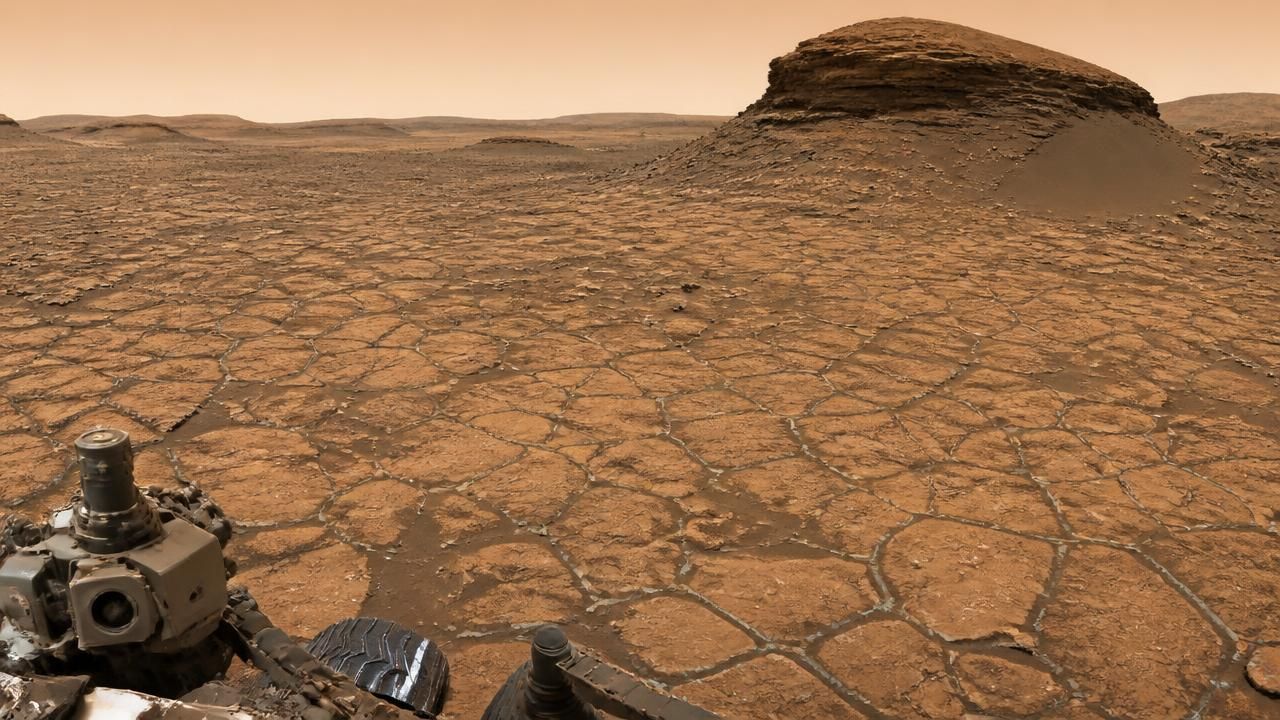
NASA's Curiosity rover has stumbled upon a landscape unlike any seen before in its decade-long exploration of Mars: a vast sea of honeycomb-like textures, known as polygonal fractures, covering the ground in all directions. The discovery, made in a valley nicknamed 'Valle Grande' within Gale Crater, has captivated scientists and the public alike, with some outlets dubbing the features 'dragon scales' or 'dragon skin.'
Curiosity captured the stunning 360-degree panorama on June 19 and 20, 2025—the 4,930th and 4,931st Martian days (sols) of the mission. The polygonal shapes, each measuring about 1.5 to 3 inches (4 to 8 centimeters) across, spread across the terrain and even wrap around the sides of a nearby 20-foot-tall butte nicknamed 'Miraflores,' which is topped with a thick sand cap.
A Familiar Sight, But Never on This Scale
While Curiosity has spotted small patches of these geometric shapes several times before, the extent of the field in Valle Grande is unprecedented. 'We've seen a lot of fascinating landscapes through Curiosity's eyes, but this sea of polygons took our breath away,' said Ashwin Vasavada, the mission's project scientist at NASA's Jet Propulsion Laboratory. 'We measured their shapes and chemistry carefully and are hopeful there are clues in the data as to how these features formed.'
'We've seen a lot of fascinating landscapes through Curiosity's eyes, but this sea of polygons took our breath away.' — Ashwin Vasavada, NASA JPL
The features have been described in various ways by media outlets: NASA's official release calls them 'polygonal fractures,' while others have used more evocative terms like 'honeycomb textures' (Space.com), 'dragon scales' (Live Science), and 'dragon skin' (Daily Galaxy). The popular press has latched onto the fantastical imagery, with headlines on MSN and AOL touting mysterious patterns that 'no one can yet explain.'
What Are These Polygons?
Polygonal fractures are not unique to Mars. On Earth, they commonly form in drying mud, where wet sediment contracts as it dries, cracking into polygonal shapes. They can also result from thermal contraction in permafrost regions. On Mars, similar patterns have been observed in ancient lakebeds, suggesting they may be linked to the presence of water in the past. Indeed, a separate Space.com article from 2024 reported on 'strange underground polygons on Mars' that hinted at the Red Planet's wet past.
However, the Valle Grande polygons present a mystery. Their size—only a few inches across—and their sheer abundance in one location are puzzling. 'Scientists have never seen so many of these features in one place and are unsure how they formed,' NASA noted in its press release. The butte Miraflores, which is adorned with the patterns, adds another layer of intrigue, as the polygons appear to cover its sides despite its elevation.
Different Perspectives on the Discovery
The story has been framed in various ways across different news organizations:
- NASA focused on the scientific mystery, emphasizing the data collection and the hope of understanding the formation process.
- Space.com highlighted the visual spectacle, featuring the panorama as its 'photo of the day' on July 14, 2026, and noting the rover's puzzlement over the 'boxwork' pattern in a separate article.
- Live Science and Futura-Sciences leaned into the 'dragon scale' metaphor, emphasizing the strange, almost mythical appearance.
- RealClearScience and TechEBlog took a more straightforward approach, describing the structures as honeycomb-like and noting the lack of explanation.
- Daily Galaxy covered the terrain as one of the most unusual ever seen in Gale Crater.
The diversity in coverage reflects the public's fascination with Martian mysteries and the rover's continued ability to surprise.
Context: Gale Crater's History
Curiosity has been exploring Gale Crater since its landing in 2012, gradually climbing the slopes of Mount Sharp, a 3-mile-high mountain at the crater's center. The region is rich in evidence of ancient water: sedimentary rocks, mineral veins, and now these polygonal fractures. The current discovery adds to the picture of a once-wet environment that may have been habitable for microbial life.
Implications for Mars Science
Understanding the formation of these polygons could provide insights into the past climate and hydrological cycles. 'If these are desiccation cracks, they would indicate a period of drying after the lake that once filled Gale Crater receded,' explained a planetary scientist not involved with the mission, speaking on condition of anonymity. 'Alternatively, if they result from thermal contraction, they could tell us about permafrost activity.'
The team plans to continue analyzing the chemical composition of the polygons using Curiosity's instruments, including the ChemCam laser and the SAM (Sample Analysis at Mars) suite. Data from these tools could help differentiate between formation mechanisms.
What's Next for Curiosity?
Curiosity is now climbing out of Valle Grande, but the team has already collected extensive imagery and spectral data. The rover's next targets include higher layers of Mount Sharp, which may reveal even older environmental conditions. The polygonal field, however, will remain a focus of ongoing research.
'Every time we think we've seen it all on Mars, the planet throws us a new curveball,' Vasavada added. 'That's what keeps exploration exciting.'
As the scientific community pores over the data, the 'dragon scales' of Mars are sure to inspire both rigorous study and the kind of wonder that drives humanity to explore the cosmos.