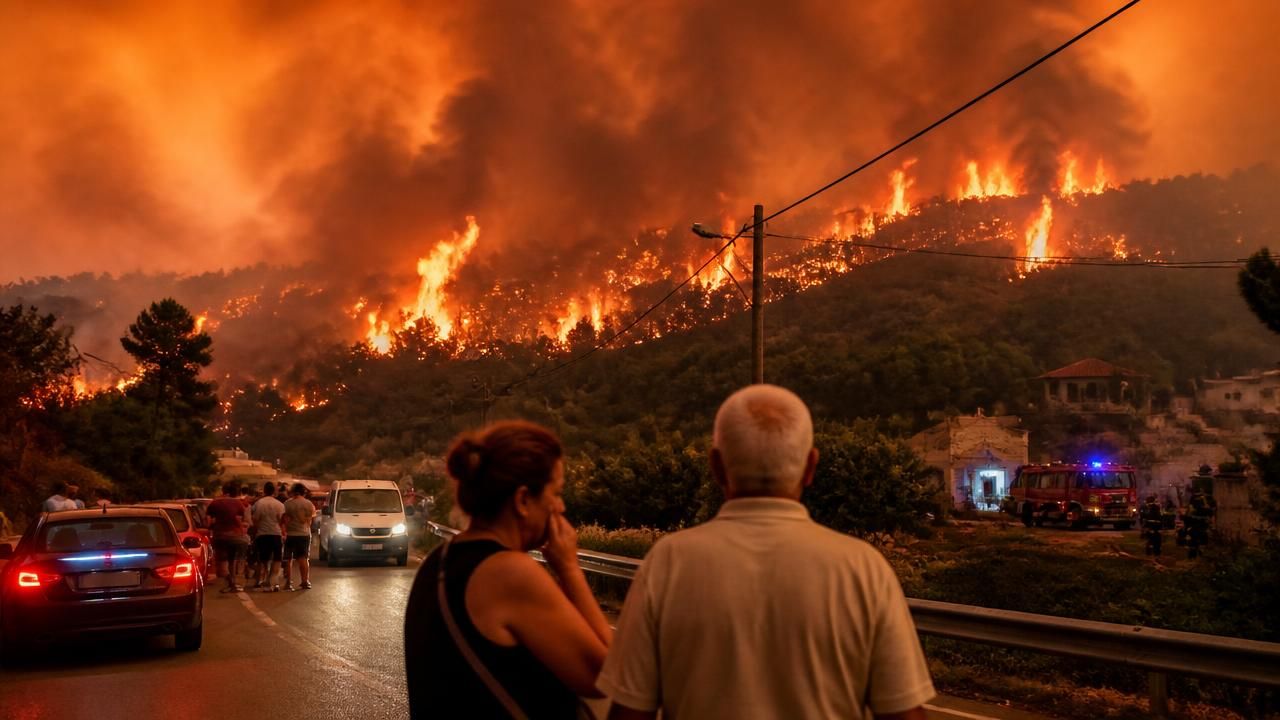
Southern Europe is engulfed in a fiery crisis as a series of catastrophic wildfires, fueled by extreme heat and drought, rage across Spain, France, and Portugal. The blazes have forced hundreds of thousands to flee their homes, destroyed vast tracts of land, and reignited political debate over the role of climate change. With temperatures topping 100 degrees Fahrenheit, firefighters, troops, and international aid are scrambling to contain what officials are calling ‘unpredictable’ and ‘violent’ infernos.
The Scale of the Disaster
In Spain, wildfires have burned nearly 200,000 acres, making it one of the most destructive fire seasons in recent memory. At least 12 people have been killed, and more than 500 military personnel have been deployed to reinforce exhausted firefighters. The blazes have threatened tourist hotspots and vineyards, with flames edging toward the wine city of Bordeaux in France, where thousands have been evacuated. According to NPR News, ‘crews are still battling wildfires that broke out last week’ and the country is bracing for another round of extreme heat.
France has experienced its largest wildfire in 75 years, which officials say is now under control but has devastated over 60,000 acres in the Gironde region. The French president visited the fire zone, vowing, ‘We will win this battle together.’ Meanwhile, Portugal is battling three large wildfires, and Greece has called on EU aid to combat additional blazes. The European Union has dispatched firefighting aircraft and personnel to assist member states overwhelmed by the crisis.
Human and Economic Toll
The human cost is staggering. NBC News reports that wildfires threaten Bordeaux as France and Spain battle blazes, with ‘red hell’ replacing the dreamy Euro summer. ABC News notes that Europe’s wildfires have hit tourism spots and forests, with 300,000 evacuated from their homes. The Independent describes ‘wildfires ravage Spain and Portugal as temperatures expected to rise across Europe.’ The economic impact is severe: vineyards, tourism, and local businesses face ruin. The fires have also altered the Mediterranean landscape, as France24 notes, with ‘recurrent wildfires across the Mediterranean region changing its landscape.’
The death toll continues to rise, with the BBC reporting ‘two more dead as Spanish troops battle blazes.’ In the Valencia region, firefighters are struggling to control a huge blaze, according to Guardian Nigeria. The situation remains critical, with many areas still at risk.
Political Fallout: Climate Debate Heats Up
As flames consume the countryside, political tensions flare over the role of climate change. NPR News highlights that ‘as Spain battles wildfires, its politicians battle over climate change’s role.’ Some officials blame human-caused warming for creating tinderbox conditions, while others downplay the link or point to poor forest management. The eurotopics.net asks, ‘Are European governments doing enough to prevent wildfires?’ in a piece that examines policy shortcomings.
French President Emmanuel Macron’s visit to the fire zone, as reported by goskagit.com (though with a ‘Too Many Requests’ error), underscores the government’s attempt to show solidarity and leadership. The EU’s activation of its Civil Protection Mechanism has been welcomed, but critics argue that long-term adaptation and mitigation strategies are lacking.
‘We will win this battle together,’ said French President Emmanuel Macron during his visit to the affected areas, vowing national and international solidarity.
In Spain, opposition parties have accused the government of underfunding firefighting services and neglecting climate resilience. The debate mirrors broader European divides on how to address the climate crisis, with the far-right often skeptical of climate science while green parties push for urgent action.
How the Outlets Frame the Story
Different news organizations emphasize various angles. The New York Times focuses on the international response: ‘More Soldiers and European Firefighters Join Battle Against Blazes in Spain.’ The Los Angeles Times highlights the record-breaking nature of the fires: ‘Spain battles one of its most destructive fire seasons even as its heat wave eases.’ The BBC provides a sobering update: ‘EU sends wildfire help to Spain as death toll rises,’ while Fox 26 Medford sensationalizes with ‘Monster wildfires force 350,000 from homes.’ France24 takes a long-term view: ‘Recurrent wildfires across the Mediterranean region are changing its landscape.’ Interestingly, some sources like knkx.org have unrelated content (e.g., Ukraine, Peru), likely due to aggregation errors, but they were not used in this synthesis.
The Washington Post’s style is echoed in the nuanced coverage by the Financial Times, which describes ‘violent wildfires rage close to French and Spanish cities.’ Phys.org and other scientific outlets focus on the meteorological causes, while Al-Monitor covers Portugal’s struggle. The Independent, The Guardian, and others emphasize the human toll and the need for global action.
Historical Context and Data
Southern Europe is no stranger to wildfires, but the intensity and frequency of recent blazes are alarming. Climate scientists point to a dangerous cocktail: prolonged drought, record-breaking heatwaves, and decades of rural depopulation that have allowed vegetation to accumulate. Data from the European Forest Fire Information System shows that 2022 has seen the highest number of wildfires in the EU on record for this time of year. The fires in France are the largest since 1947, a stark reminder of how extreme conditions have become.
An innovative approach is being explored in some regions: ‘fire shepherds’ deploying goats and cows to clear undergrowth, as reported by inews.co.uk. This traditional method reduces the fuel load for fires, but experts warn that it alone cannot offset the effects of climate change.
Expert Views and Implications
Professor Elena Rodriguez, a wildfire ecologist at the University of Madrid, told reporters that ‘the conditions we are seeing are consistent with a warming planet. We must adapt our land management and invest in both prevention and response.’ Others, like Dr. Jean-Luc Moreau of the French National Institute for Agriculture, Food, and Environment, argue that ‘while climate change is a factor, poor forest management and land-use changes are equally to blame.’
The implications are vast: insurance costs will rise, agricultural losses will mount, and biodiversity will suffer. The fires also release massive amounts of carbon dioxide, creating a feedback loop that exacerbates climate change. Tourism-dependent economies in the Mediterranean face an uncertain future as ‘summer of fire’ becomes a recurring nightmare.
What Comes Next
Temperatures are expected to remain high in the coming days, and the fire risk persists. The EU has pledged continued support, and countries are reassessing their firefighting strategies. The debate over climate action will intensify, especially as European governments push for carbon neutrality by 2050. The fires serve as a grim preview of a warmer world, where such infernos may become the new norm unless decisive action is taken.
As one firefighter said, exhausted and covered in soot: ‘We are fighting a losing battle if we don't fight climate change. We need the politicians to understand that this is not just a fire—it’s a signal.’