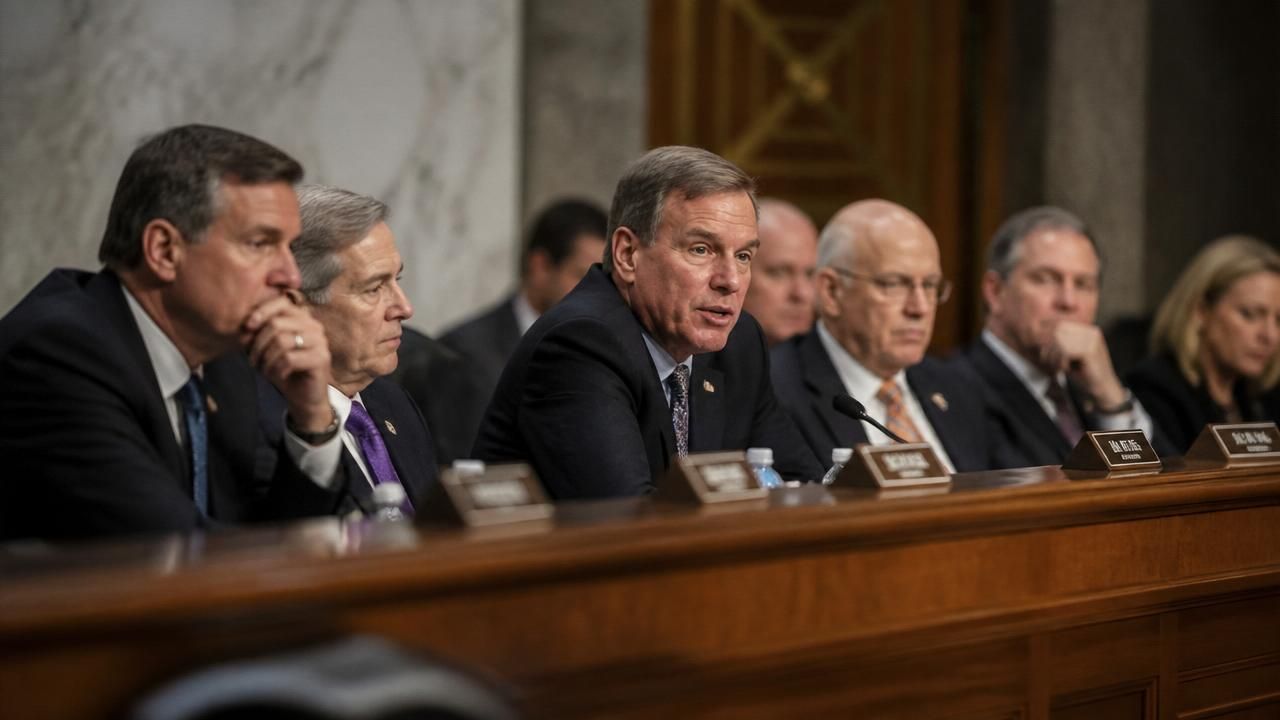
The Senate Intelligence Committee voted along party lines on Tuesday to advance the nomination of Jay Clayton, former chairman of the Securities and Exchange Commission, to serve as the next Director of National Intelligence. The 14-7 vote sends Clayton’s nomination to the full Senate, where a confirmation vote is expected later this week.
If confirmed, Clayton would succeed Bill Pulte, a housing official with little national security experience who has served as acting DNI since January. The Office of the Director of National Intelligence (ODNI) oversees the 18 agencies that make up the U.S. intelligence community, including the CIA and NSA.
Controversial Pick Draws Democratic Fire
Democrats on the committee uniformly opposed Clayton, citing his lack of intelligence experience and concerns about his independence from President Trump. Senator Mark Warner (D-VA), the vice chairman of the committee, argued that Clayton’s background in securities law did not prepare him for the role. “Mr. Clayton has never served in the intelligence community, has never held a national security position, and has no apparent expertise in the complex threats facing our nation,” Warner said in a statement.
Republicans, however, praised Clayton’s management experience and legal acumen. Committee Chairman Senator Richard Burr (R-NC) noted that Clayton had “demonstrated a commitment to the rule of law” during his tenure at the SEC. “Jay Clayton is a steady hand who will bring accountability and transparency to the intelligence community,” Burr said.
Background and Experience
Clayton served as SEC chairman from 2017 to 2020, where he oversaw the agency’s response to the COVID-19 pandemic and led efforts to modernize securities regulations. Before that, he was a partner at the law firm Sullivan & Cromwell, specializing in corporate governance and regulatory enforcement. His nomination to lead the intelligence community has been met with skepticism from former intelligence officials, who question whether his background is suited for the role.
“The DNI is one of the most sensitive positions in government, requiring deep knowledge of intelligence operations and a willingness to stand up to political pressure,” said John Sipher, a former CIA officer. “Clayton has none of that.”
Political Implications
The vote comes amid heightened tensions between the Trump administration and intelligence agencies. President Trump has frequently clashed with the intelligence community over assessments of Russian interference in the 2016 election and other matters. Critics fear that Clayton may be too deferential to the president, undermining the DNI’s role as an independent arbiter of intelligence.
“This nomination is part of a pattern of installing loyalists in key national security positions,” said Elizabeth Goitein, co-director of the Liberty and National Security Program at the Brennan Center for Justice. “The DNI must be able to provide unvarnished intelligence to policymakers, and there are serious questions about whether Clayton will do that.”
Supporters counter that Clayton’s legal background will help him navigate the complex legal frameworks governing intelligence activities. “Jay Clayton is a man of integrity who will follow the law and protect the nation’s secrets,” said a senior administration official who spoke on condition of anonymity.
What’s Next
The full Senate is expected to vote on Clayton’s nomination later this week. With Republicans holding a 53-47 majority, he is likely to be confirmed, though some GOP senators have expressed reservations. Senator Susan Collins (R-ME) has not yet announced her position, while Senator Lisa Murkowski (R-AK) has voiced concerns about the politicization of intelligence.
If confirmed, Clayton will face immediate challenges, including managing the intelligence community’s response to the COVID-19 pandemic, addressing cybersecurity threats from China and Russia, and rebuilding morale after a series of leadership upheavals. The ODNI has been without a permanent director since January, and acting director Pulte has faced criticism for his handling of the role.
The nomination has drawn widespread media attention, with outlets like The New York Times, The Guardian, and CBS News covering the committee vote. While some sources focused on the partisan divide, others highlighted Clayton’s lack of experience. The Washington Examiner noted that Clayton had “inched closer” to confirmation, while MSNBC reported on the postponed hearing earlier this month when President Trump demanded a delay.
As the Senate prepares for the final vote, the debate over Clayton’s qualifications and independence continues. For now, the former SEC chairman appears poised to take on one of the most challenging jobs in Washington.