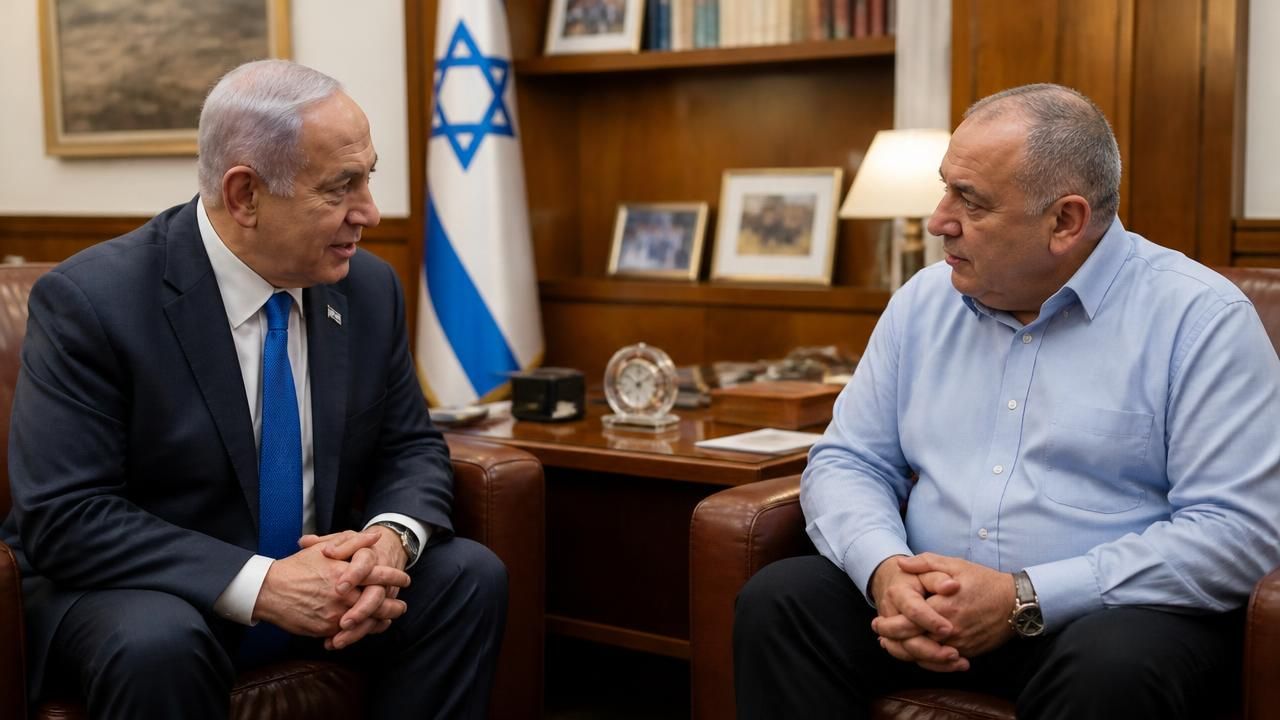
Israeli Prime Minister Benjamin Netanyahu and former Israel Defense Forces chief Gadi Eisenkot met on Sunday to discuss forming a national unity government, but the talks ended without a deal, according to a joint statement by their parties and Israeli media reports. The two sides described the meeting as an effort to bridge "substantial differences," signaling that a breakthrough remained elusive even as negotiations appeared set to continue.
The joint statement said the leaders had discussed "the formation of a national unity government," with "both sides seeking to bridge the substantial differences between them." The wording was notable for what it did not say: no agreement, no timetable, and no confirmation of the more dramatic proposals that surfaced in Israeli and Indian media during the day.
A Meeting, a Statement, and No Immediate Deal
The talks between Netanyahu, the Likud leader and sitting prime minister, and Eisenkot, a former IDF chief of staff and prominent opposition lawmaker, were closely watched as a possible prelude to a broader emergency coalition. Accounts of the meeting's length varied—Hindustan Times reported two hours, while ynetnews said no deal emerged after four hours—a sign of the fluid and heavily briefed nature of the negotiations.
Early reports from MSN and other outlets said the talks ended without immediate word on a unity government deal. Later, ynetnews reported that despite no agreement, the teams had agreed to more unity talks. Other reports suggested no follow-up meeting had been scheduled, underscoring how quickly the picture was shifting.
"The formation of a national unity government," the joint statement said, adding that "both sides seeking to bridge the substantial differences between them."
The language echoed reports that the talks had hit a roadblock over "substantial policy differences." Those differences were not spelled out in detail, but they are likely to include ministerial portfolios, policy authority, and the terms under which an emergency coalition would operate.
Rotation Proposal and an Eight-Day Deadline
The most striking claims came from Indian outlets. Indian Express reported that Netanyahu was ready to let rival Eisenkot take Israel's prime minister's chair first, while India TV framed the idea as a possible "rotation Prime Minister model." A report carried by dailynewsen made a similar claim. If confirmed, such an offer would amount to a remarkable concession by Netanyahu, who has long been Israel's dominant political figure.
Neither the joint statement nor immediate comments from the parties confirmed the rotation proposal. Still, the reports added a new dimension to the talks: not just whether Eisenkot would join a Netanyahu-led government, but whether the two camps were discussing a sequential premiership arrangement in which Eisenkot would serve first.
Another report carried by MSN said Eisenkot had vowed to form a government within eight days and accused Likud of stalling unity talks. That claim, too, was not confirmed in the joint statement, but it reflected the pressure on both sides to show momentum. Eisenkot's camp has reportedly been wary of entering a government without clear policy commitments, while Netanyahu's coalition partners may resist a deal that dilutes their influence.
How Different Outlets Framed the Story
Media coverage diverged in emphasis. NPR and the Los Angeles Times focused on the halting nature of the talks and the "major differences" between the sides. MSN headlines stressed that the Netanyahu-Eisenkot talks ended after two hours without immediate word on a deal, and later that there was no major breakthrough and no follow-up meeting scheduled. Israel National News highlighted the effort to bridge "major gaps." Ynetnews, by contrast, reported that no deal had been reached after four hours but that the teams had agreed to more talks.
The Indian outlets focused on the possibility of a rotation government, with Indian Express reporting that Netanyahu was ready to let Eisenkot take the first turn as prime minister. That framing shifted attention from the talks' immediate outcome to the potential reshaping of Israel's leadership arrangement. The varying headlines reflected genuine uncertainty as well as the different sources available to each outlet.
Why Unity Talks Matter
A national unity government would expand Netanyahu's coalition and potentially stabilize Israeli politics during a period of sustained uncertainty. It would also give Eisenkot, a relative newcomer to party politics after a long military career, a formal role in shaping national policy. For Eisenkot, joining a Netanyahu-led government carries political risk: it could be seen as legitimizing a prime minister his camp has criticized, or it could be framed as a responsible act of national service.
A rotation arrangement would be even more consequential. It would make Eisenkot the first to occupy the prime minister's office under the deal, an extraordinary reversal of Israel's usual coalition hierarchy. Such an outcome would require trust between two rivals who have not previously governed together and would almost certainly face resistance from Netanyahu's existing coalition partners.
The talks also come amid broader questions about Israel's political direction. A unity government could alter the balance of power within the cabinet, affect decision-making on security and domestic policy, and change the calculus for opposition parties weighing whether to join or stay out.
What Happens Next
The joint statement left open the possibility of further negotiations, and ynetnews reported that the teams had agreed to more talks. But the absence of a scheduled follow-up, according to some reports, suggested the sides remain far apart. The next phase is likely to focus on whether Netanyahu's reported rotation offer is real, whether Eisenkot is willing to accept it, and whether the policy differences can be narrowed enough to produce a formal coalition agreement.
For now, the only confirmed outcome is that the two men met, discussed a national unity government, and acknowledged substantial differences. The rest—including the premiership rotation, the eight-day deadline, and the follow-up talks—remains contested and fluid. In Israeli politics, where coalition negotiations often move in bursts and reversals, the coming days will determine whether Sunday's meeting was a false start or the beginning of a major realignment.