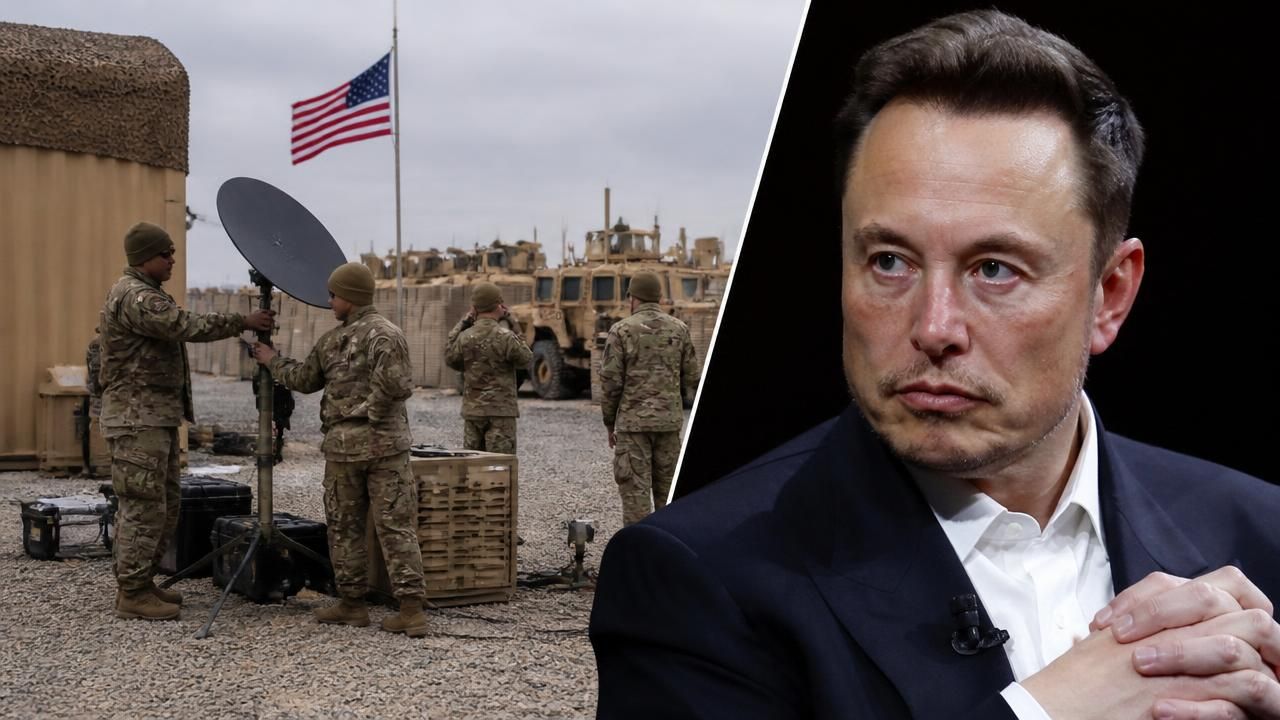
Iran used SpaceX's Starlink satellite internet service to help coordinate and carry out attacks on American military positions across the Middle East during the opening phase of the U.S.–Iran war, according to a Washington Post report that has been picked up by outlets around the world — and that has reportedly left Elon Musk incandescent.
The account centers on a March 1 Iranian drone strike on a U.S. military facility in Kuwait that killed six service members. According to the Post, Starlink terminals were used in the broader campaign of strikes on American bases, raising uncomfortable questions about the dual-use nature of a commercial network that has become critical infrastructure for militaries, civilians and insurgents alike.
What the report alleges
The Post's reporting, summarized in outlets ranging from The Verge and Yahoo to Turkey's Daily Sabah, Ukraine's LIGA.net, India's Republic World and South Korea's Kukmin Daily, describes a company caught off guard by how its own hardware was being used. The story spread rapidly through aggregators — MSN alone carried at least eight variants — with headlines emphasizing two threads: the deadly attack, and the corporate fallout inside SpaceX.
According to those accounts, Musk was enraged to learn that Starlink had been turned against U.S. forces. The Saudi outlet Sabq, citing the Post, reported that at least two executives were dismissed in the aftermath; the British tabloid The Sun led with the same claim, framing the story around a CEO "sacking" lieutenants over a deadly blitz. SpaceX has not publicly confirmed any personnel changes, and those details remain the least substantiated element of the reporting.
A second, quieter controversy
The Post's account also describes a separate source of friction inside the Pentagon–SpaceX relationship: that the U.S. military was using a cheaper Starshield configuration — the company's military-grade variant — intended for ground operations, in order to fly one-way attack drones. Starshield, which SpaceX markets to defense and intelligence customers, is a different product line from consumer Starlink, though it shares the same satellite constellation and ground architecture.
That detail matters because it complicates the narrative of a company simply being victimized by unauthorized users. It suggests a murky middle ground in which the same network carries both sanctioned military traffic and traffic the company never intended — with the distinction between them enforced largely by contract language and software controls rather than by physics.
"Working as intended," Musk wrote in a cryptic post that went viral after the report surfaced, a remark that supporters read as a jab at critics and skeptics read as anything but reassuring.
The verification crackdown
Following the report, SpaceX imposed strict identity-verification requirements on Starlink users, part of an effort to rein in abuse of a system that has always been difficult to police. Terminals are small, portable and easily smuggled; service can be activated in one country and carried into another. The company has previously used geofencing to disable service in unauthorized territories — most notably in Ukraine, where Starlink proved decisive for battlefield communications and where SpaceX at times restricted use for offensive operations.
The Ukraine precedent hangs over this story. Starlink's value to a military is precisely its resilience: a low-Earth-orbit mesh that is hard to jam and easy to deploy. That same resilience makes it attractive to actors the United States would rather not empower. SpaceX has, since 2022, tried to manage this tension with export controls, account vetting and regional shutoffs — measures that critics on all sides have called either too lax or too intrusive.
Skepticism from the Pentagon
Not everyone is treating the report as settled. The Pentagon said it had no knowledge of the CENTCOM assessment described in the Post's account, a denial that leaves the central factual claim — that Iranian forces used Starlink in attacks on U.S. bases — resting on a single, anonymously sourced news investigation rather than on any publicly released intelligence finding.
Security analysts caution that "used Starlink" can mean many things: a terminal in a command post passing targeting data; a relay for drone telemetry; or merely incidental communications traffic. Distinguishing among these requires forensic access that outside observers do not have.
Why it matters beyond the battlefield
The story lands in the middle of a broader reordering of war powers and military technology policy. Congress has been moving to reclaim authority over the use of force — the Senate voted to repeal the 1991 and 2002 authorizations for the use of military force against Iraq — even as the executive branch leans on private infrastructure for command-and-control. Meanwhile, the region remains volatile: Saudi Arabia reported intercepting Houthi missiles as the wider conflict rippled outward.
- The precedent problem: Commercial constellations are now strategic assets. Whoever operates them exercises a form of sovereignty that no treaty currently governs.
- The accountability gap: When a private network is used in an attack on U.S. troops, who answers — the operator, the exporter, or the state that acquired the terminals?
- The information war: The story's journey from a single newspaper investigation to dozens of aggregated headlines, some accurate and some not, illustrates how quickly unverified details harden into fact.
For now, the most defensible reading is this: a Washington Post investigation alleges that Iran exploited Starlink during the war's opening days, that Musk reacted with fury, and that SpaceX tightened its controls in response. The personnel moves are unconfirmed, the Pentagon is publicly skeptical, and the underlying intelligence has not been released. What is no longer in doubt is that the question of who controls satellite internet — a question Musk has answered, so far, largely alone — has become a matter of national security rather than corporate policy.