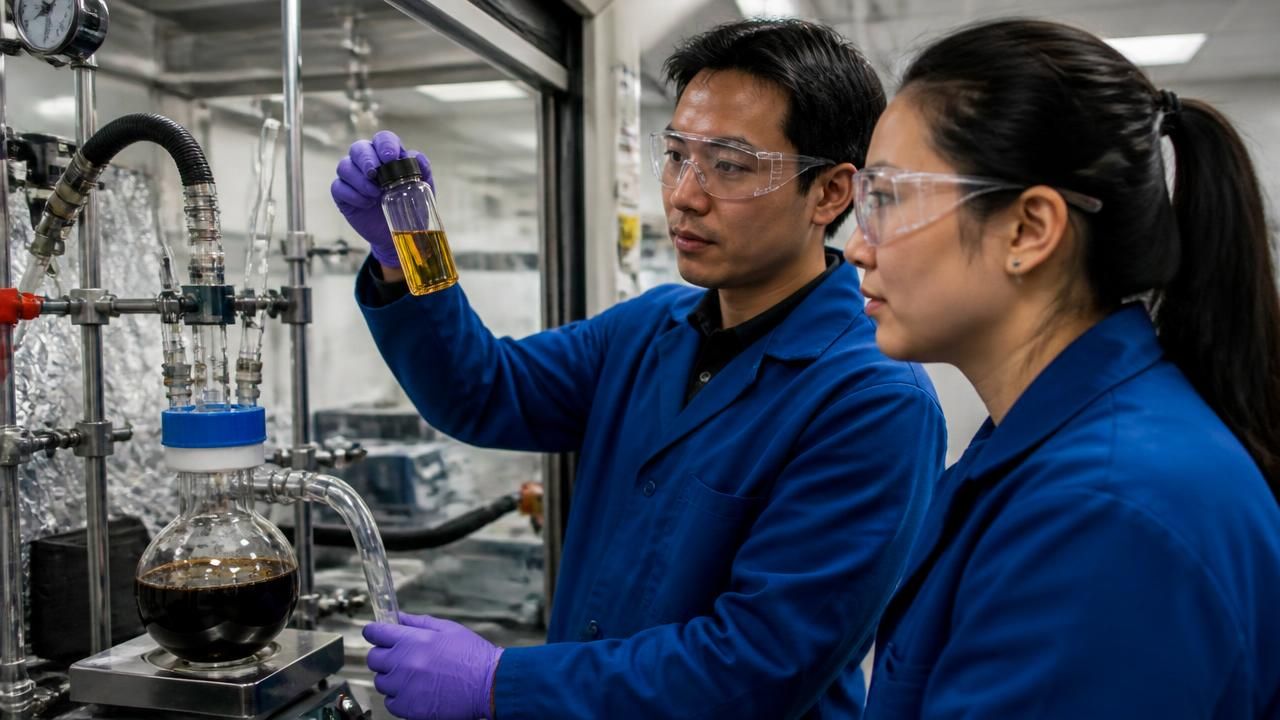
Researchers at Virginia Tech say they have found a way to transform polyvinyl chloride — the brittle, chlorine-heavy plastic known as PVC and widely regarded as one of the most difficult materials in the waste stream to recycle — into a high-performance lubricating oil suitable for engine use. According to the university's announcement of the work, the conversion takes roughly three hours, a strikingly short timeframe for a chemical process that ordinarily requires harsh conditions and long residence times to break down chlorinated polymers.
The finding, reported this week and carried by ScienceDaily and Newswise, is being framed by the researchers as a rare double win: a route to divert a major source of plastic pollution from landfills and incinerators, and a potentially more sustainable feedstock for the lubricant industry, which today relies overwhelmingly on refined crude oil.
Why PVC has resisted recycling
PVC is among the most produced plastics on earth, with global capacity estimated at roughly 40 million tonnes a year. It appears in window frames, pipes, flooring, cable insulation, medical tubing and credit cards. Yet its recycling rate is widely estimated at well under 5 percent globally, and in many markets in the low single digits — far below the roughly 9 percent figure for plastics overall.
The chemistry explains much of the problem. PVC's polymer backbone is roughly 57 percent chlorine by weight, and heating it releases hydrogen chloride, which is corrosive to processing equipment and can generate dangerous byproducts if handled poorly. PVC is also heavily formulated: plasticizers, stabilizers, lead and cadmium compounds in older stock, and pigments make mixed PVC waste chemically inconsistent. That variability is poison to conventional mechanical recycling, which grinds and re-melts plastic into new products.
A different approach: breaking the polymer down
Rather than attempting to remelt PVC, the Virginia Tech team's method falls into the category of chemical or feedstock recycling — dismantling the polymer into smaller molecules and rebuilding value from the carbon skeleton. In describing the advance, the researchers said the process strips the chlorine from the plastic and converts what remains into hydrocarbon material suited to lubricant applications, rather than merely burning it for energy recovery.
"The breakthrough could turn a major source of plastic pollution into a valuable industrial resource while making lubricant production more sustainable," the researchers said in summarizing the work, which they describe as taking approximately three hours from discarded PVC to usable lubricant material.
That speed is significant. Many candidate chemical-recycling routes for chlorinated plastics run for hours longer, require expensive catalysts, or demand extreme temperatures that undermine their climate credentials. A three-hour process, if it holds up outside the lab, would be far easier to slot into continuous industrial operations.
How the outlets framed it
The story's coverage reveals how the same result can be packaged for different audiences. ScienceDaily, which serves a general science readership, led with the technical and environmental framing: a hard-to-recycle plastic becoming a "high-performance lubricating oil," with emphasis on pollution reduction and sustainable manufacturing. Newswise, which distributes research news to journalists, took a more populist angle, describing PVC as "one of the world's most hated plastics" and the output as a "premium lubricant" — leaning into PVC's poor public reputation, earned through controversies over phthalate plasticizers and the vinyl chloride release at East Palestine, Ohio, in 2023. Yahoo's syndicated version carried the ScienceDaily headline and framing directly to a mass consumer audience.
The divergence is more than stylistic. The scientific framing stresses process chemistry and yield; the consumer framing stresses redemption — turning a villain of the plastics world into something useful.
The market it would enter
Lubricants are a vast, high-value business. Global demand runs to roughly 40 million tonnes a year, worth well over $100 billion, dominated by base oils refined from crude. High-performance synthetic basestocks command premium prices, and that is the pool this process would compete in. Waste-derived base oil already exists in the form of re-refined used motor oil, an established industry, which suggests a commercial pathway is at least plausible.
- Feedstock advantage: PVC waste is abundant and cheap, often a disposal cost for manufacturers.
- Environmental upside: Diverting PVC from landfill and incineration avoids both methane generation and toxic chlorinated emissions.
- Economic hurdle: The process must compete with virgin base oils, whose prices fluctuate with crude.
The caveats
The announcement does not resolve several questions that will determine whether this becomes an industry or a paper. Scale is the first: laboratory demonstrations routinely produce grams where refineries handle thousands of tonnes a day. The handling of chlorine is the second — any commercial plant must capture and safely dispose of, or sell, the hydrogen chloride stream, adding capital cost and complexity. Energy balance and carbon footprint are the third; a process fueled by natural gas may offer modest climate benefit over virgin oil.
There is also feedstock purity. Real-world PVC waste arrives contaminated with other plastics, metals and additives, and tolerance for that mess will decide whether the process works at a municipal recycling facility or only on clean industrial scrap.
What happens next
Independent replication and techno-economic analysis will be the near-term tests. If the process survives them, it points toward a broader shift in how the plastics industry thinks about its waste: not as a sorting problem to be solved mechanically, but as a chemical feedstock to be cracked, stripped and rebuilt. For PVC — long the material recyclers quietly decline to accept — that would be a meaningful change in standing.