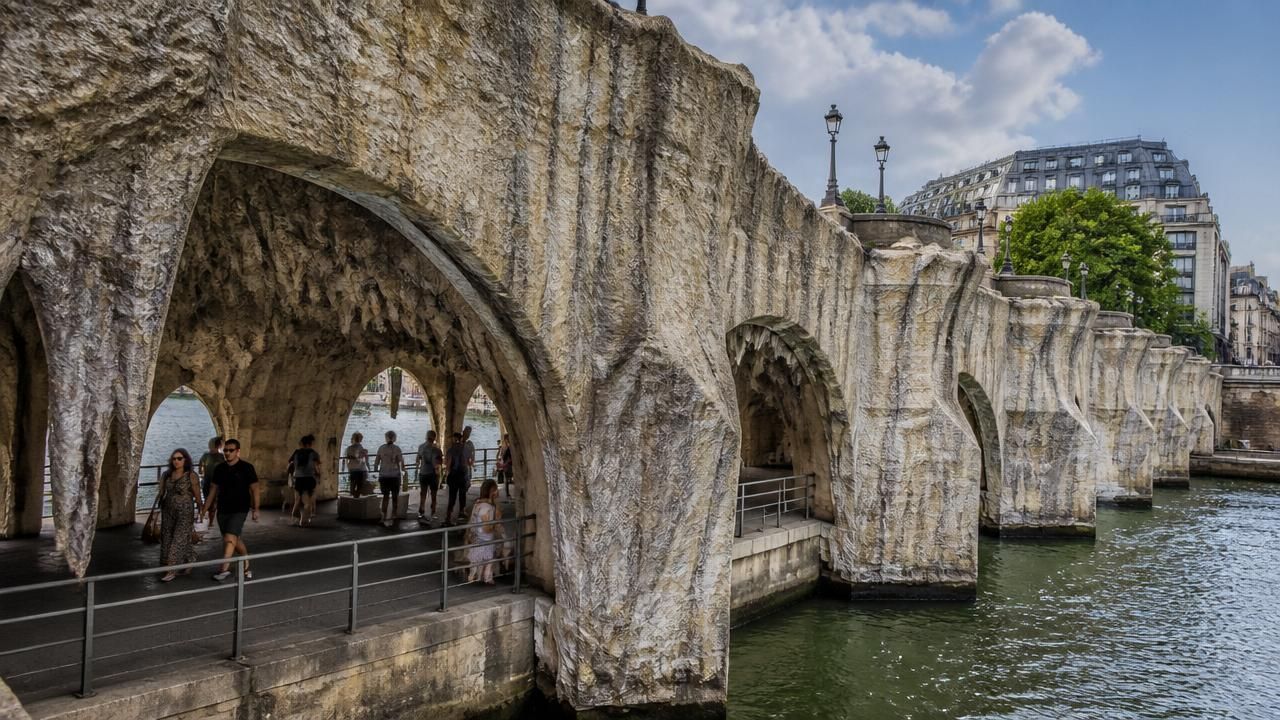
For a few weeks this summer, Parisians and tourists alike have been treated to an extraordinary sight: the Pont Neuf, the city's oldest bridge, transformed into a rocky cave. The installation, titled "La Caverne du Pont Neuf," is the work of French artist JR, often dubbed the "French Banksy" for his large-scale, anonymous public artworks. The project, which opened in mid-July 2024, envelops the bridge's arches and walkways in a fabric skin painted to resemble limestone, creating an artificial cavern that rises above the Seine.
A Nod to Christo and Jeanne-Claude
The installation is a direct homage to the late artists Christo and Jeanne-Claude, who famously wrapped the Pont Neuf in fabric in 1985. JR's project, however, goes a step further by painting the fabric to mimic a cave's texture and color, complete with stalactites and rock formations. The Observer notes that the work "is a portal into Paris's geologic history," evoking the limestone quarries that once supplied the city's building materials. NPR reported that the installation "didn't provide respite from a brutal heat wave," but offered a visual escape from the summer sun.
An Immersive Experience
Visitors are invited to walk along the bridge and peer through openings in the fabric, which reveal the river and city beyond. The experience is multisensory: the fabric rustles in the wind, and the scent of canvas and paint mixes with the Seine's river air. According to Vogue, the installation is "dramatic" and "monumental," drawing crowds who snap photos and marvel at the illusion. The Times Argus noted that the public "steps and sniffs inside," engaging with the work in a tactile, immersive way.
Artistic and Historical Context
JR's work often explores themes of memory, identity, and public space. The Pont Neuf, built in 1607, is a symbol of Parisian history, and the cave installation references the city's geological past. The limestone used to build Paris was quarried from beneath the city, and the cave aesthetic evokes the underground tunnels and catacombs that lie beneath the streets. The Observer describes the installation as "a cavern of memory and illusion," blurring the line between reality and artifice.
Public and Critical Reception
The installation has drawn mixed reactions. Some praise its ambition and visual impact, while others question the temporary nature of the work. Newsday called it "monumental," and KMBC highlighted the spectacle. However, some sources noted that the fabric can feel claustrophobic or hot during peak summer days. Despite these critiques, the installation has become a popular attraction, with long queues forming daily.
Implications for Public Art
JR's project continues a tradition of large-scale public art that challenges perceptions of urban space. By transforming a functional bridge into a fantastical cave, JR invites viewers to reconsider the familiar landscapes of Paris. The installation also raises questions about the role of temporary art in a city saturated with historic monuments. As the Times Argus put it, the work is "a moment of wonder" that will disappear once the fabric is removed, leaving only photographs and memories.
In a city known for its art and architecture, "La Caverne du Pont Neuf" stands out as a bold, ephemeral statement. It is a reminder that even the most ancient structures can be reimagined, and that art has the power to transport us to other worlds—even if only for a few weeks.