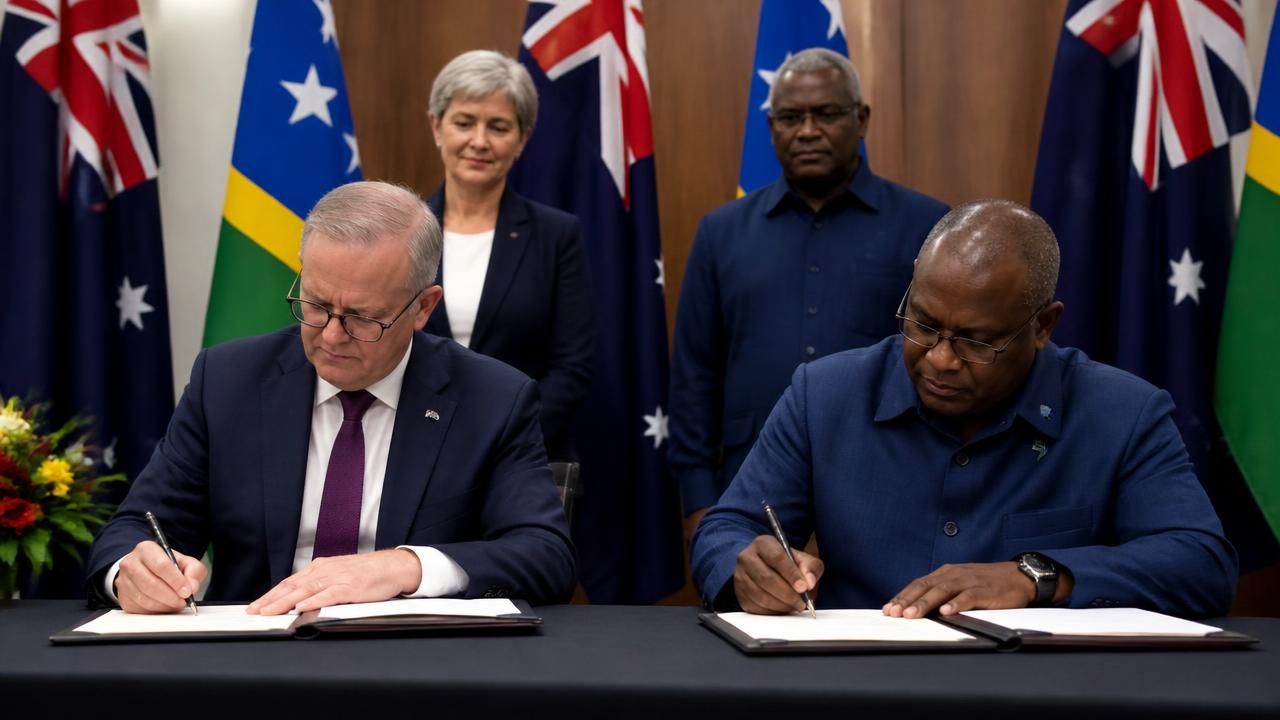
Australia and the Solomon Islands have signed a new security treaty that makes Canberra Honiara’s primary security partner and excludes China from that role, a strategic shift that partly unwinds Beijing’s most significant Pacific foothold and hands Australia what several outlets described as a historic win.
The agreement, reported by Bloomberg Markets, Newsday, MSN and Radio Free Asia, is aimed at “rolling back China’s access to the Pacific,” according to Bloomberg, and reverses part of the gains Beijing made three years ago in a move that alarmed the United States and its allies. The Solomon Islands government has named Australia as its primary security partner under the new treaty, Newsday reported, while MSN described the deal as a “sweeping pact” that stymies China and a “historic win” for Australia.
Bloomberg Markets framed the treaty as “aimed at rolling back China’s access to the Pacific,” a partial reversal of Beijing’s gains that had alarmed Washington and its allies.
A Pacific pivot away from Beijing
At the center of the deal is a simple but consequential hierarchy: Australia becomes the Solomon Islands’ primary security partner, and China is left outside that role. Newsday reported that the new treaty “excludes China,” while MSN said the Solomon Islands plans to replace its China security pact with the Australia treaty. The language matters because it is not a routine bilateral aid or defense arrangement but a reordering of Honiara’s security relationships.
Bloomberg’s framing places the treaty in the context of great-power competition. The deal, it reported, is aimed at rolling back China’s access to the Pacific and partly reversing Beijing’s gains from three years ago. For Washington and Canberra, the earlier China-Solomon Islands security agreement was a wake-up call: it raised fears that Beijing could gain a durable military and strategic presence in a region long shaped by Australia, the United States and their partners. The new treaty is Canberra’s attempt to claw back influence and reassert itself as the Pacific’s preferred security partner.
The economic stakes are inseparable from the strategic ones. Pacific influence is exercised through infrastructure, aid, investment, fisheries and security cooperation, and the treaty signals that Australia is willing to formalize its role in ways that could shape future funding and development ties. For Honiara, closer alignment with Canberra may bring security guarantees and economic engagement, but it also narrows the space for maneuvering between rival powers.
How the deal is being framed
Different outlets emphasize different dimensions of the same story. Bloomberg places the treaty in the context of great-power competition and China’s Pacific ambitions, casting it as a partial reversal of Beijing’s gains. Newsday focuses on the legal architecture: the Solomon Islands has named Australia as its primary security partner in a treaty that excludes China. MSN’s headlines are more declarative, describing a sweeping pact that stymies China and a historic win for Australia.
Radio Free Asia shifts attention to the domestic political crisis, reporting that regional power rivalries have spilled into Solomon Islands domestic politics. That framing is important because Pacific security deals are often negotiated at the elite level but contested in domestic arenas, where sovereignty, foreign influence and local priorities collide. The treaty may therefore become a flashpoint in Honiara’s politics, where competing loyalties to Canberra, Beijing and other partners have already been contentious.
Those frames are not contradictory. The same treaty can be a strategic win for Australia, a setback for China, a legal reordering of security ties and a domestic political problem for the Solomon Islands government. What changes across outlets is the emphasis: Bloomberg stresses the regional balance of power, Newsday stresses the treaty’s exclusion of China, MSN stresses the scale of Australia’s victory, and Radio Free Asia stresses the domestic fallout.
Domestic politics and regional rivalries
Radio Free Asia’s reporting captures a less tidy side of the story. Its framing, “Solomon Islands crisis: regional power rivalries spill into domestic politics,” suggests the treaty is not only a diplomatic achievement but also a source of internal tension. In small Pacific states, security partnerships are rarely purely technical. They touch on national sovereignty, elite bargaining, provincial grievances and public perceptions of foreign influence.
For Australia, the pact is a diplomatic and strategic victory but also a commitment. It will need to deliver on security cooperation, maintain trust in Honiara and manage perceptions that it is dictating the Solomon Islands’ foreign policy. For the Solomon Islands government, the treaty may strengthen ties with a major regional partner, but it could also deepen domestic divisions over which outside power offers the best path to development and security.
What it means for China and the region
The agreement is a blow to China’s ambitions in the Pacific. By excluding China from the primary security role, the treaty limits Beijing’s access and symbolic reach in a country that had become a test case for Chinese influence. The sources do not detail any immediate Chinese response, but the deal is likely to be read in Beijing as a setback in a region where it has invested heavily in diplomacy, infrastructure and security ties.
For the United States and its allies, the treaty is a welcome development in a strategic competition that has intensified across the Pacific. It suggests that Australia remains the region’s indispensable security partner and that smaller Pacific states can be pulled back from closer Chinese alignment. Yet the deal also shows how fluid those alignments are: three years after Beijing’s gains alarmed Washington, Canberra has partly reversed them through a formal treaty.
Implementation questions remain
The treaty’s long-term significance will depend on implementation. Questions remain about funding, the specific security commitments involved, the durability of political support in Honiara and how Beijing will respond. The sources describe a sweeping pact and a historic win, but they also point to domestic political tensions that could complicate its execution.
What is clear is that the Solomon Islands has become a focal point for Pacific power rivalries. Australia’s new treaty is a major win for Canberra and a blow to China’s regional ambitions. But it is also a reminder that in the Pacific, security, economics and domestic politics are deeply intertwined — and that influence can shift quickly when major powers compete for footholds.