Nearly a decade after President Trump first promised to revive American steel, the practical consequences of his second-term industrial policy are coming into focus — and they look very different depending on which factory town, boardroom or border you are standing in.
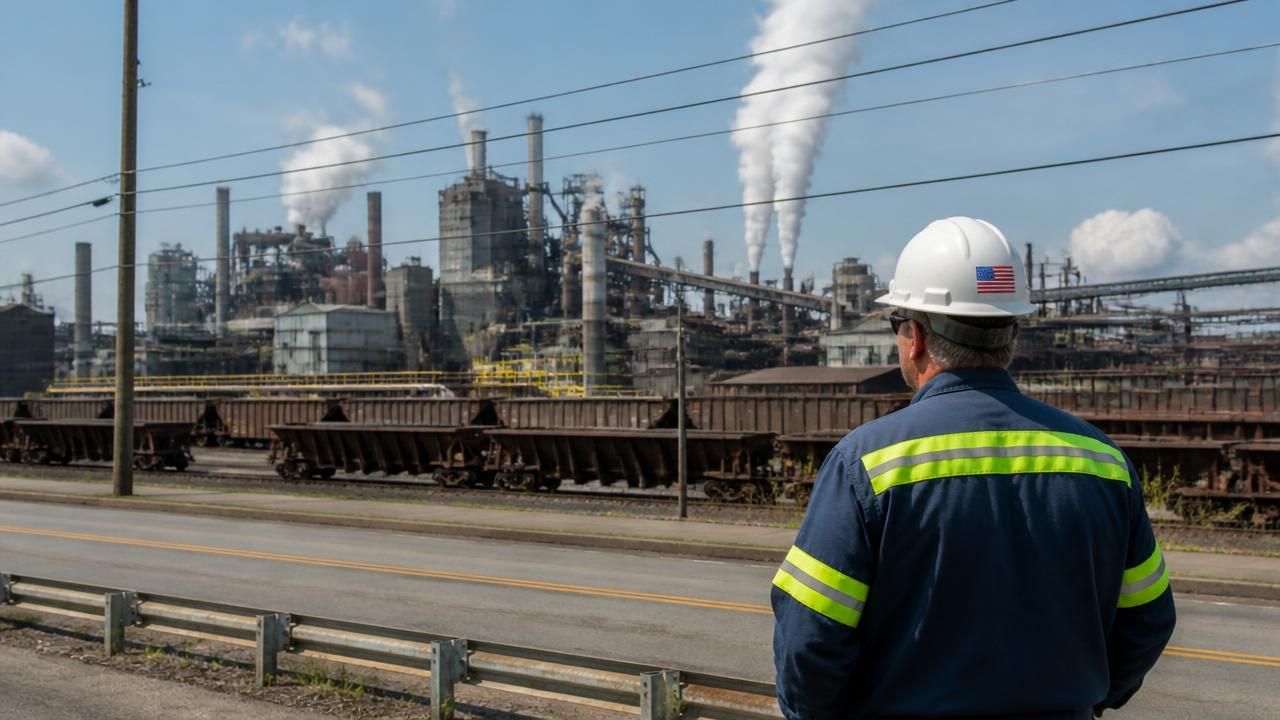
In Middletown, Ohio, a sprawling steel plant that had planned to move away from coke — a refined form of coal — has reversed course under the current administration, according to reporting from NPR News and member station KEDM. The abandoned switch would have cut hazardous air pollution and greenhouse gas emissions, making the facility cleaner and, its operators argued, more competitive in a market increasingly attentive to carbon. The reversal is being framed by environmental and public-health advocates as a cost of the administration's deregulatory posture; industry allies counter that the retrofit was an expensive bet on pollution rules and power prices that are no longer guaranteed.
The Middletown decision sits inside a much larger story about how Washington is now trying to steer capital into domestic manufacturing — and how that effort is landing with allies and trading partners.
The tariff wall and the northern neighbor
The most pointed warnings have come from Canada. Ottawa's ambassador to Washington has warned that Trump's tariffs are raising investment costs on both sides of the border, arguing that the uncertainty inflicts damage on the U.S. economy as well as Canada's, according to reports carried by MSN. Coverage of the ambassador's remarks stressed that the impact is not one-directional: supply chains in autos, steel and machinery are so integrated that a tariff on one side of the line functions as a cost on the other.
Canada's ambassador warned that Trump's tariffs are raising investment costs on both sides of the border — and that the resulting uncertainty does measurable damage to the U.S. economy, not just Canada's.
That framing cuts against the administration's core claim that tariffs are a cost-free lever for extracting concessions and reshoring jobs. If the price of certainty rises, the argument goes, firms delay or relocate projects — and the jobs arrive later, or not at all.
Allies as investors: Japan and India
Yet the picture is not uniformly negative. The New York Times reported on a Japanese effort to revive an American industrial icon — one of several high-profile cross-border deals in which foreign capital is being asked to do what domestic capital has been reluctant to: recapitalize aging American steel and manufacturing capacity. The political logic is delicate, blending national-security concerns about foreign ownership with the practical need for new investment.
India is pursuing a parallel strategy. Indian firms are betting roughly $40 billion on manufacturing in the United States across sectors from steel to pharmaceuticals, according to Business Standard — a wager that suggests some investors see tariffs less as a wall than as a toll worth paying in exchange for access to the world's largest consumer market. For New Delhi's industrial groups, building inside the tariff perimeter has become a way to stay competitive in American markets.
A $15 billion mill in Lee County
Domestic expansion is moving too. The White House has announced a $15 billion steel plant, and Lee County officials have begun taking steps toward welcoming it, according to the Globe Gazette. Such a project would be among the largest single industrial investments in the region in decades, and local governments are already weighing the infrastructure, workforce and permitting demands that come with it — road and rail capacity, power supply, and the housing a construction boomlet would require.
The juxtaposition is stark: a new multibillion-dollar mill in one community, while an existing plant a few states away decides that cleaning up its coke operations is no longer worth the investment.
The bill, the truck and the follow-through
Underpinning much of this is the budget and tax package Trump has branded the "big, beautiful bill," whose provisions are expected to ripple through Ohio's economy in particular — shaping incentives for capital investment, energy costs and the fiscal capacity of states competing for mega-projects, Spectrum News reported.
Not every industrial bet is paying off. Reuters' reporting on the Cybertruck's short ride underscores how quickly consumer-facing manufacturing enthusiasm can cool: Tesla's stainless-steel pickup, launched with enormous fanfare, has struggled to sustain momentum in a crowded and price-sensitive electric vehicle market. It is a reminder that steel demand from the auto sector is fickle, and that tariff-protected domestic capacity still needs buyers.
What to watch
- Middletown's trajectory: Whether the plant's abandoned cleaner-fuel retrofit becomes a template for other coke-dependent facilities or an outlier.
- Canadian retaliation and renegotiation: Whether tariff tensions translate into formal trade action or a new round of bargaining.
- Execution risk: Whether the announced $15 billion Lee County mill and the roughly $40 billion in Indian investment commitments convert from announcements into shovels in the ground.
- Japanese ownership debates: How Washington balances national-security scrutiny of foreign buyers against its appetite for industrial recapitalization.
The unifying theme across outlets is that the administration's approach is producing winners and losers simultaneously — and that the decisive variable may not be the tariff rate itself, but the predictability of the rules surrounding it. For Middletown, that meant a cleaner furnace deferred. For Lee County, it may mean a new one built.