Anthropic's arrival on the public markets became a three-part story in a single session: a double-digit first-day pop for the artificial-intelligence developer, a fourth consecutive weekly advance for the U.S. dollar, and a bruising 1,100-point slide in the Dow Jones Industrial Average. Wall Street spent the day trying to reconcile all three at once — and the result was a market that looked less like a single verdict on AI than a violent rotation within it.
A debut that closed up more than 17%
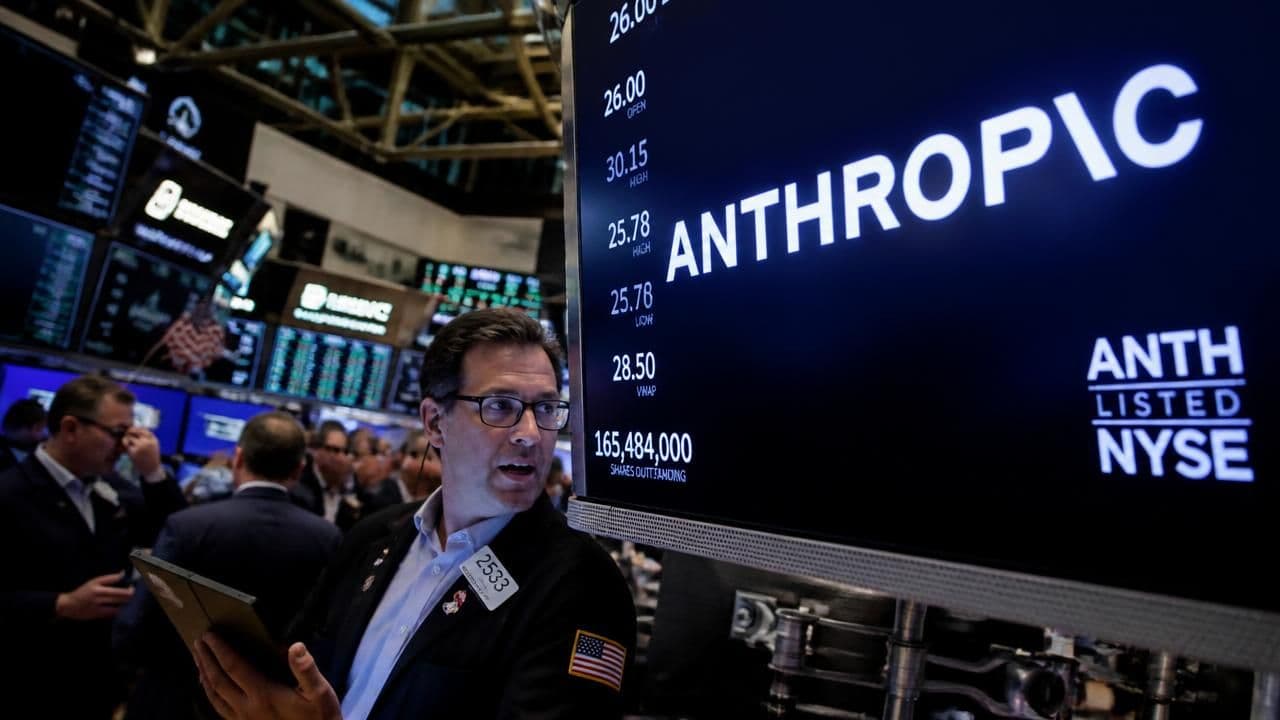
Anthropic shares closed their first day of trading at $97, up more than 17% from the level at which the offering was priced, according to live coverage of the listing carried by Investopedia and MSN. It was a strong but not euphoric debut by the standards of recent technology listings: enough to validate the deal's pricing and reward IPO allocators, but short of the instantaneous doubling that has accompanied some of the most heated AI-adjacent offerings of the past two years.
The distinction matters. A 17% first-day gain typically signals that bankers left some money on the table without misjudging demand outright — a sign of institutional appetite rather than retail mania. Because the reported figures cover only the closing price and the percentage move, the precise size of the offering, the implied valuation and the identity of the lead underwriters were not detailed in the live-coverage reports, which were published in stripped-down, real-time formats.
The dollar's fourth straight weekly gain
Across markets, the more consequential move may have been in currencies. Bloomberg reported that the dollar was headed for a fourth straight weekly gain, with demand tied to the Anthropic IPO adding to a rally already fueled by expectations of further Federal Reserve interest-rate increases and elevated U.S. Treasury yields.
The dollar is headed for a fourth straight weekly gain as demand tied to the Anthropic PBC IPO further lifts the currency that has been supported by expectations of further Federal Reserve interest-rate hikes and elevated US Treasury yields.
The framing is revealing. A mega-cap listing generates enormous ancillary demand for dollars: foreign investors converting into the U.S. currency to participate, underwriters holding proceeds, and the general gravitational pull that large U.S. equity issuance exerts on global capital flows. A four-week winning streak, though, is rarely the product of a single deal. The dominant driver remains the interest-rate picture, where a hawkish Fed and a stubbornly high long end of the curve have kept the greenback bid for most of the month.
The Dow's 1,100-point slide
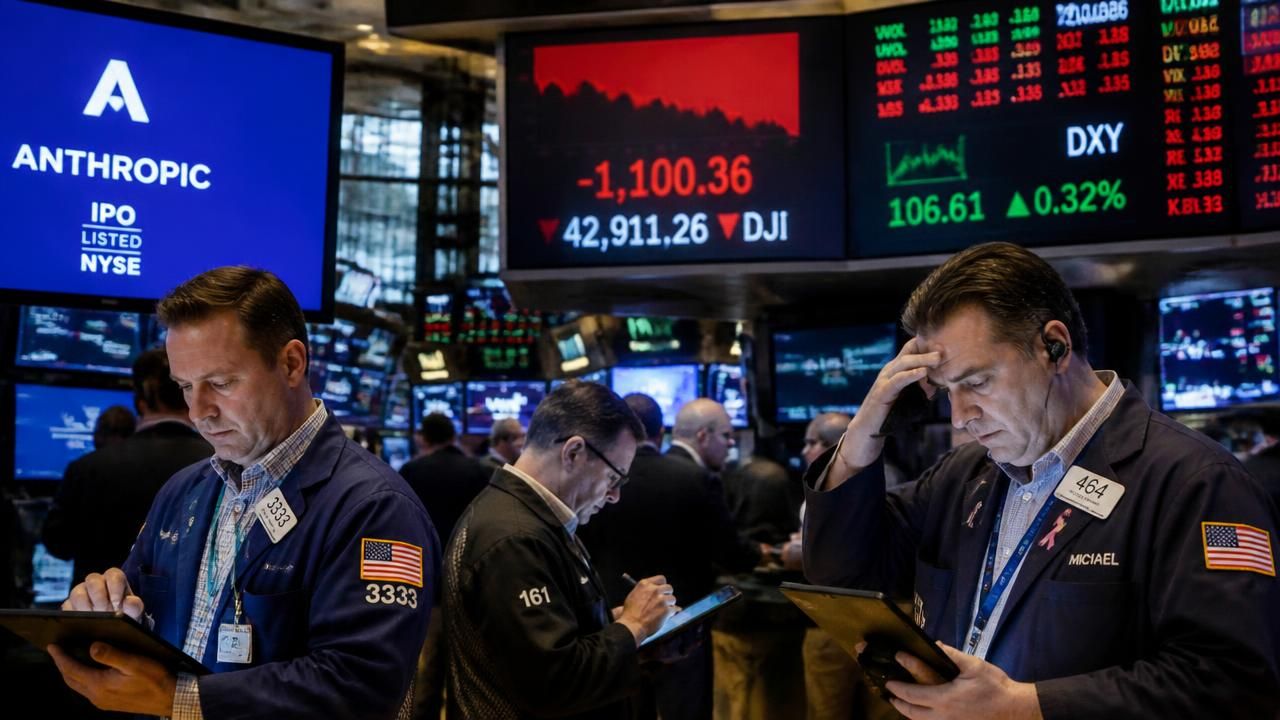
At the same time, the Dow dropped 1,100 points, according to Investopedia's live coverage — a decline of roughly 2.5% at prevailing index levels and a stark contrast to the enthusiasm greeting the new issue. The juxtaposition captured the market's central tension: capital flowing toward the AI frontier and toward dollar-denominated assets, while flowing out of the established, rate-sensitive industrial and consumer names that dominate the price-weighted blue-chip index.
Rising yields are the common thread. Higher Treasury yields raise the discount rate applied to future corporate earnings, pressuring slower-growth, dividend-paying, economically cyclical companies most directly. They also strengthen the dollar, which erodes the overseas earnings of multinationals. In that light, the Dow's rout and the currency's rally are two expressions of the same macro bet — and the Anthropic IPO is a third, as investors pay up for the small cohort of companies seen as structurally insulated from the rate cycle.
Tech's read-across winners
The listing also produced a secondary market effect. MSN's coverage noted that a set of top technology stocks scored big gains on the back of Anthropic's IPO filing and debut — a familiar pattern in which a high-profile new issue re-rates comparable names. The mechanism is straightforward: a public valuation for a leading AI developer gives investors a benchmark for pricing peers, private holdings and adjacent suppliers, and index and fund flows follow.
- Closing price: $97 per share on day one
- First-day gain: more than 17%
- Dollar: fourth consecutive weekly advance
- Dow: down 1,100 points on the session
- Macro backdrop: expectations of further Fed hikes; elevated Treasury yields
How the outlets framed it
The same event produced markedly different headlines, and the differences are instructive. Bloomberg led with the currency and the macro regime — the IPO as a marginal contributor to a dollar rally already underwritten by Fed policy. Investopedia and MSN led with the scoreboard, pairing the 17% pop with the Dow's four-figure decline in a single headline that framed the day as a divergence rather than a triumph. The tech-focused roundup treated the listing as a catalyst for a broader sector re-rating.
None of these framings is wrong; each captures a different slice of the same capital flow. Taken together, they describe a market in which a single large AI issuance can simultaneously lift a currency, enrich a peer group and coincide with a sharp selloff in old-economy equities — without any of those outcomes being directly caused by the others.
What to watch next
Three things will determine whether this pattern persists. First, the Fed: the dollar's streak depends on whether policymakers validate or push back against market expectations for further tightening. Second, the path of Treasury yields, which sit at the intersection of the currency and the Dow's weakness. Third, the mechanics of the new listing itself — the post-IPO stabilization period, the eventual expiration of lock-up restrictions, and any decision on index inclusion, each of which can move the shares independently of fundamentals.
For now, the scoreboard reads: a strong debut, a resilient currency, and a blue-chip index under pressure. Whether that combination represents a healthy reallocation of capital or an increasingly narrow market is the question investors will be arguing about long after the first-day candles are forgotten.