The outages hit the way modern failures always do: not one system at a time, but everywhere at once. Air travel, email and banking services — the plumbing of American daily life — seized up in a cascade of technical failures, and the question that quickly moved from help desks to cable news was not how it happened but who was going to answer for it.
By Tuesday night, the answer from the White House appeared to be: not the president. And that, in turn, became the story.
'Maybe for Trump it's fine'
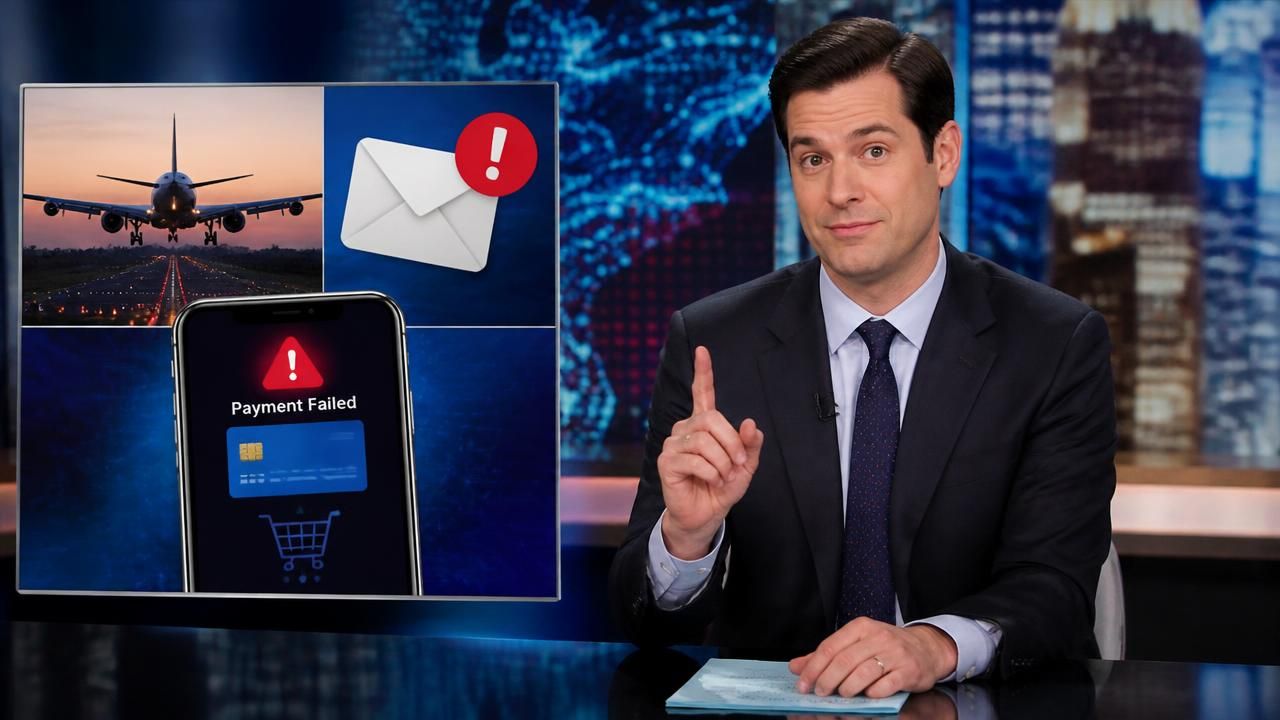
On "The Daily Show," host Michael Kosta devoted his monologue to what he framed as President Trump's conspicuous detachment from the disruption. The comedian's setup was built on a simple contrast — the president, he argued, inhabits a bubble in which the systems that failed are simply not part of his day.
"Maybe for Trump it's fine," Kosta said. "He doesn't fly commercial, he doesn't know how to use email, his bank is a guy from Qatar. For the rest of us though, it's not fine."
The joke landed because it doubled as an indictment. Late-night comedy has long functioned as a pressure gauge for political empathy, and Kosta's bit measured a gap — between the lived experience of stranded travelers and locked-out banking customers and the apparent indifference emanating from the top. MSN's coverage of the segment described the president's response as resembling a "fortune cookie" — cryptic, generic and offering little beyond vague reassurance that things would work themselves out.
Republicans break ranks
The more consequential pressure came from inside the president's own coalition. According to reporting by The Hill, skepticism is growing among Republican lawmakers and operatives over how the administration has handled the failures, with one refrain circulating among critics: "Americans aren't stupid."
That line is doing a lot of work. It is, first, a warning about political risk — the conviction that voters will not accept a response that amounts to telling them the outages were not as bad as they seemed, or that they were someone else's fault. Second, it is a tell about the broader mood inside the party, where the impulse to defend the president is increasingly being weighed against the cost of appearing to minimize a genuine disruption to ordinary life.
The dynamic is familiar from previous infrastructure and disaster cycles: a president's base will tolerate a great deal, but not the perception that Washington is insulated from consequences that land squarely on everyone else. When the failures touch aviation, payments and communications simultaneously, the constituency for "it's fine" shrinks fast.
Markets add a second shock
The political turbulence collided with financial markets, which had already been recalibrating. Bloomberg reported that equities staged a sharp U-turn and gold gained ground following Democrats' win — a classic risk-off signature in which investors rotate toward safe havens while repricing exposure to policy uncertainty.
The timing matters. A market that swings on election results is a market that has stopped pricing stability, and the combination — deteriorating confidence in the government's technical competence alongside a fresh political realignment — amplifies both signals. Gold's rise is the tell: investors buy it when they want protection not from a single event but from a period of unpredictability.
Why it resonates
The outages arrived into an already-thinned margin for error. Since the CrowdStrike-linked global IT failure of July 2024, which grounded flights and disrupted hospitals and banks worldwide, both the public and policymakers have grown acutely aware of how few companies sit beneath the digital economy — and how quickly a single bad update can propagate.
- Concentration risk: A handful of cloud and security vendors underpin thousands of critical services.
- Accountability gap: No single agency owns end-to-end resilience across aviation, finance and communications.
- Political exposure: Voters increasingly judge leaders on whether the lights stay on, not on ideology.
The White House's instinct — to downplay, deflect and move on — is a well-worn playbook. But it works best against discrete, quickly resolved incidents. Cascading failures are different: they generate days of stranded passengers, delayed payments and unanswered questions, each an opportunity for the story to grow rather than fade.
The road ahead
Expect two tracks from here. On Capitol Hill, look for renewed calls — potentially bipartisan — for resilience mandates, disclosure requirements for major vendors, and a clearer chain of responsibility during outages. Republicans quoted in The Hill's reporting have already signaled they will not carry water for a response they consider condescending.
On the political track, the president's challenge is that the story is being written by comedians and markets at the same time. Kosta's monologue will be forgotten in a week; the gold price and the stranded gate agents will not. "Americans aren't stupid" is less an insult than a diagnosis — and it is the one the administration may find hardest to shrug off.