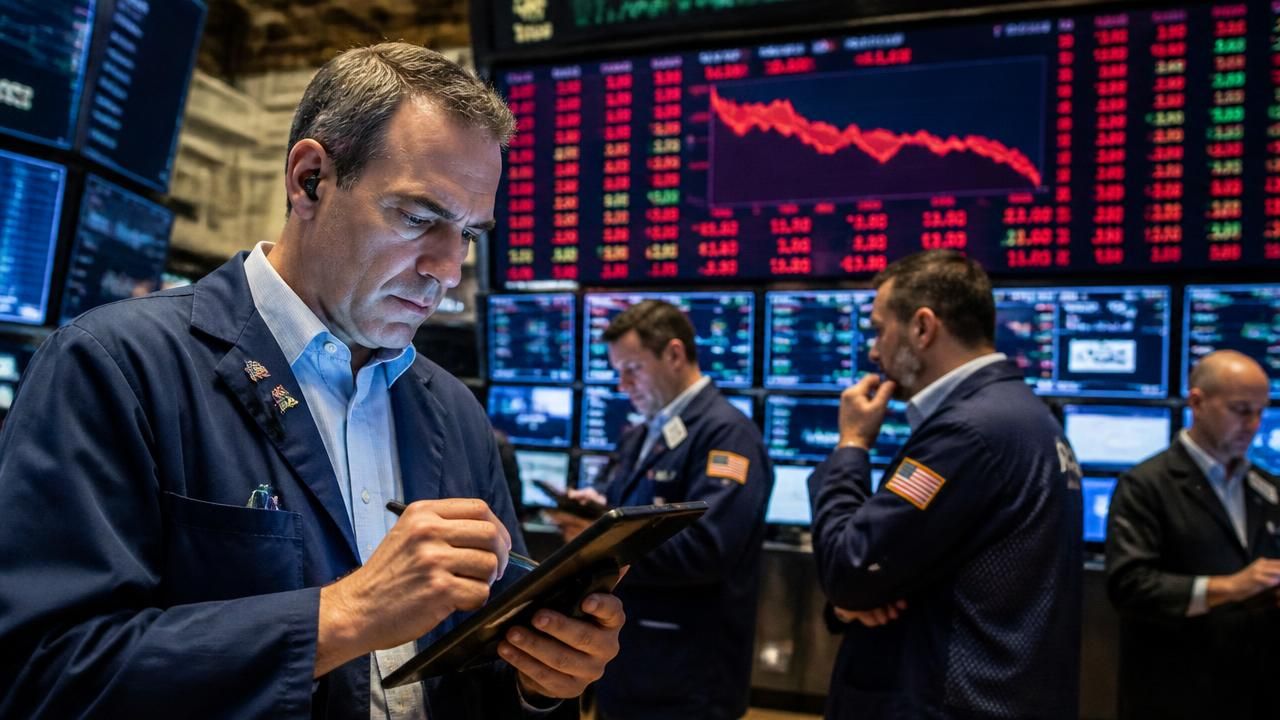
Global equity markets turned risk-off on Friday as a renewed wave of anxiety over artificial intelligence valuations spread from Wall Street into Asian and emerging-market technology stocks, with investors positioning defensively ahead of Nvidia Corp.'s highly anticipated earnings report.
According to Bloomberg Markets, a selloff in technology giants dragged down major U.S. benchmarks, with concerns about "technical disruptions" compounding a broader unease about the durability of the AI-driven rally. The same outlet reported that emerging-market stocks fell as Nvidia-related jitters weighed heavily on Asian technology shares — evidence that a story which began in U.S. megacap semiconductors had quickly become a global one.
Other outlets framed the session in similar but subtly different terms. Yahoo Finance described Wall Street as ending "sharply lower on AI jitters ahead of Nvidia results," while MSN's market wrap led with the S&P 500 sinking as losses in Amazon and Intel shook the index; a separate MSN report emphasized the S&P 500 and Nasdaq falling as Nvidia anxiety dragged down tech. Still another MSN edition of the market blog pointed to Alphabet stock sinking 12% as "AI jitters return" — a framing that puts the search giant, rather than the chipmaker, at the center of the narrative.
The AI Trade Becomes a Referendum
The common thread across every account is Nvidia. The chipmaker has become the single most important bellwether for the entire AI investment thesis, and its results are being treated less as a quarterly earnings event than as a stress test for the market's most crowded trade. Investors want evidence that the enormous capital expenditure flowing into data centers — from hyperscalers such as Amazon, Microsoft and Alphabet, and from AI-native firms — can be converted into durable revenue rather than a spending bubble.
"The AI trade has shifted from a question of potential to a question of proof," is how one market strategist described the mood — a sentiment echoed across trading desks as positioning thinned before the print.
That skepticism is being amplified by the growing concentration of index returns in a handful of names. When a small cohort of megacap technology stocks accounts for a disproportionate share of benchmark performance, any wobble in the group transmits directly into broad-market volatility — precisely the dynamic visible in this week's trading.
Alphabet, Amazon and Intel Add Fuel
While Nvidia set the tone, company-specific damage did much of the work. Alphabet's 12% slide, as reported in one market wrap, stands out as the kind of single-session move that forces portfolio managers to reassess assumptions about AI monetization in search and cloud. Amazon and Intel losses, meanwhile, pulled the S&P 500 lower and reinforced the sense that the market is no longer willing to extend generous multiples to every participant in the AI supply chain.
The divergence in how outlets covered the same session is instructive. Bloomberg's framing centered on technology-sector jitters and the global spillover into emerging markets; Yahoo Finance foregrounded the AI narrative and Nvidia; MSN's coverage split between an index-level, megacap-loss story and an Alphabet-centric, sentiment-driven one. Each is accurate — but together they illustrate a market being pulled by several anxieties at once, not a single catalyst.
The Anthropic Factor
Adding a further layer, Yahoo Finance's headline referenced an Anthropic IPO alongside the Nvidia results. The prospect of a high-profile listing from a leading AI developer gives investors a new way to price the sector — and a new way to be disappointed. A successful debut could validate private-market AI valuations and pull capital toward pure-play AI names; a tepid one could crystallize fears that public investors are not prepared to underwrite the spending levels the industry has committed to.
Context: A Rally Built on Expectations
The current episode echoes earlier moments of AI-related turbulence, when a single earnings report or capex disclosure triggered outsized moves across semiconductors, cloud computing and utilities tied to data-center power demand. Historically, such pullbacks have been buying opportunities during periods of strong earnings growth — but they have also marked inflection points when spending outran returns.
What makes this test harder is the macro backdrop: valuations remain elevated, positioning in AI leaders is crowded, and the bar for "beating expectations" has risen with each successive quarter. A company can deliver strong results and still see its shares fall if forward guidance fails to justify the multiple.
What to Watch
- Nvidia's data-center revenue and guidance — the clearest read on whether AI infrastructure demand is still accelerating.
- Hyperscaler capex commentary — Amazon, Microsoft and Alphabet spending plans will determine the durability of chip demand.
- Alphabet's rebound potential — whether the 12% drop proves an overreaction or a repricing of AI-driven search risk.
- Asian technology and emerging markets — supply-chain names remain the highest-beta expression of the AI trade.
- The Anthropic IPO — a live test of public-market appetite for AI pure plays.
The immediate takeaway is that the market's tolerance for ambiguity has narrowed sharply. Investors are no longer rewarding AI ambition on its own; they are demanding proof of monetization, disciplined spending and a credible path to returns. Until Nvidia and its largest customers supply that proof, the global technology complex is likely to remain volatile — and, as this week demonstrated, so is everything correlated with it.