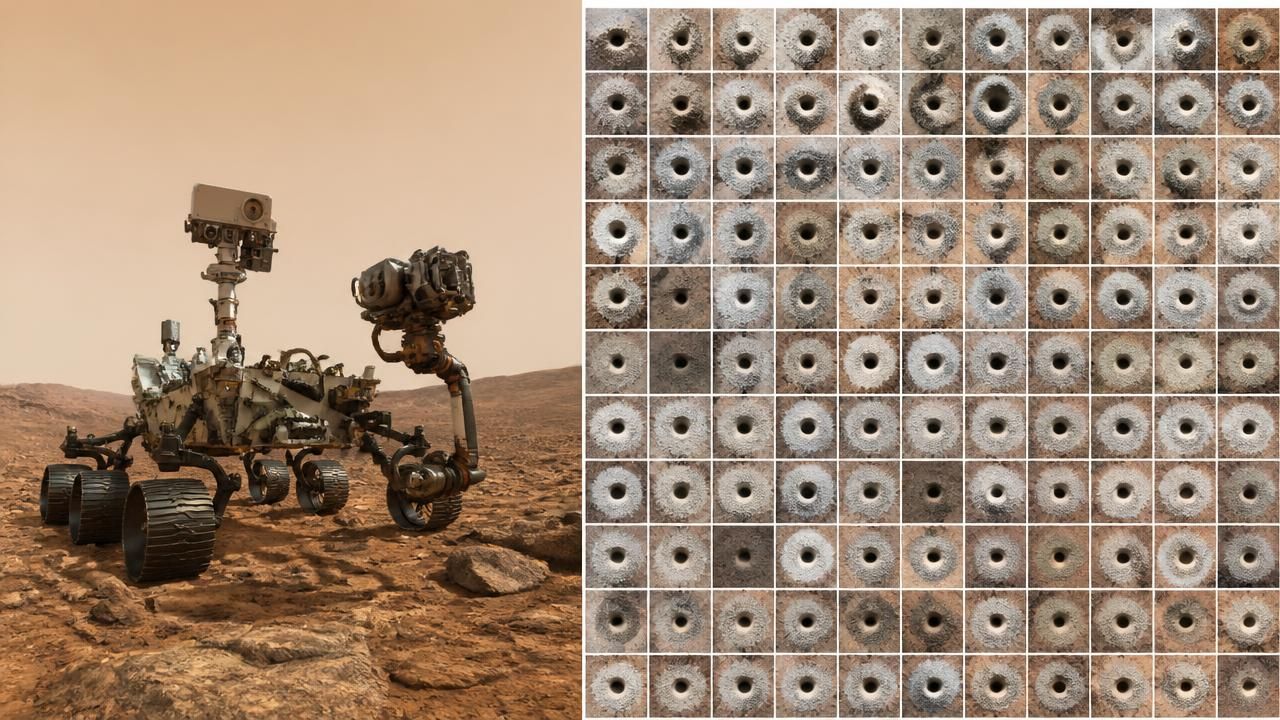
NASA has released a striking visual accounting of its most prolific Mars geologist: a collage of 49 drill holes bored into Martian rock by the Curiosity rover. The image, catalogued as PIA26802 and credited to NASA, JPL-Caltech and Malin Space Science Systems, captures every sample site the rover has punched into the Red Planet's surface as of November 2026 — a pockmarked record of more than a decade of chemical detective work.
Each of those holes, NASA notes, "represents a sample collected from rocks on the Martian surface." The collage arrives alongside — and in contrast to — a very different kind of Curiosity story: a recent drilling mishap in which the rover's drill became lodged in a rock, forcing engineers to improvise a release and, in the process, handing scientists an unexpectedly clear window into the rock's interior.
A portrait of the rover's work, one hole at a time
The collage is deceptively simple. Every circular scar in the grid is 0.63 inches (16 millimeters) across — roughly the width of a pencil eraser — and was imaged by the Mars Hand Lens Imager (MAHLI), a camera mounted, like the drill itself, on the end of Curiosity's robotic arm.
Each hole represents a sample collected from rocks on the Martian surface; Curiosity's drill, located on the end of its robotic arm, drops pulverized rock samples into instruments in its belly that analyze their composition.
That description undersells the stakes. Once a hole is bored, the powdered rock is delivered to two of the most sophisticated instruments ever flown to another world: SAM (Sample Analysis at Mars), which heats samples and sniffs the resulting gases for organic molecules, and CheMin (Chemistry and Mineralogy), which uses X-ray diffraction to identify minerals. Together they have established that Gale Crater once hosted a lake-and-stream environment with the chemical ingredients and energy sources that life as we know it requires.
Reading the collage chronologically is reading the mission's itinerary. Early holes cluster in the Yellowknife Bay area, where Curiosity's first drilling campaign in 2013 revealed clay minerals formed in fresh water. Later holes climb the lower slopes of Mount Sharp, tracking a shift from clay-rich to sulfate-rich rocks — a mineralogical signature of changing environmental conditions as Mars dried out.
The mishap: when the drill wouldn't let go
The celebratory collage lands against the backdrop of a more anxious episode. Reports this week describe Curiosity's drill becoming stuck in a rock, with NASA's team working to free it — an operation captured on video and covered by outlets including Phys.org under the headline "Watch as NASA's Curiosity Rover frees its drill from a rock." MSN's coverage framed the same event as a scientific windfall: "NASA's Curiosity gets unprecedented view of Mars rock after unexpected drill mishap on the Red Planet."
That divergence in framing is telling. Engineering outlets treated the incident as a tense operational drama — a multi-ton nuclear-powered robot on another planet, 225 million kilometers away, with a stuck tool and no possibility of a service call. Science-focused coverage emphasized what the failure revealed: with the drill lodged and the surrounding rock fractured, cameras could see freshly exposed surfaces that a nominal drilling operation would never have presented so cleanly.
Curiosity has been here before. In late 2016, a stall in the drill's feed mechanism — the hardware that extends the bit — sidelined drilling for more than a year. Engineers ultimately redesigned the process, drilling without the stabilizing posts that had anchored the tool against the rock, relying instead on the rover's arm to absorb the force in a technique mission members described as "freehand" drilling. That workaround has since produced dozens of the holes now displayed in the collage, making the drill one of the mission's most rehabilitated and most valuable instruments.
Why a hole in a rock matters
Mars rovers cannot bring samples home, so the drill is the mission's proxy for a laboratory. Every hole is a decision about where to look next — which layer of sedimentary rock might preserve a chemical record of water, which vein might hold sulfates precipitated from evaporating brine. The 49-hole tally is also a measure of engineering endurance: Curiosity landed in August 2012 for what was planned as a two-year prime mission and has now operated for well over a decade, its power supply slowly declining as its radioisotope generator ages.
The rover's younger sibling, Perseverance, is simultaneously caching cores in Jezero Crater for eventual return to Earth — a division of labor that makes Curiosity's on-site analyses increasingly valuable as a bridge between orbital observations and the samples that may one day arrive in terrestrial labs.
What comes next
NASA has not indicated that the stuck-drill episode caused lasting damage; the rover's recent history suggests the team will fold whatever was learned into the next drilling attempt. What is clear is that the collage is both a scientific ledger and a public-communication artifact — a way of making visible the incremental, hole-by-hole accumulation of knowledge that rarely produces a single dramatic headline.
The irony is that the most quotable Curiosity story of the week was the one where something went wrong: a drill jammed, a robot wrestled itself free, and scientists got an unpredicted close-up of Martian rock. Forty-nine neat circles tell the story of the mission as planned. The fiftieth hole — whenever it comes — may tell the story of a mission that keeps adapting.