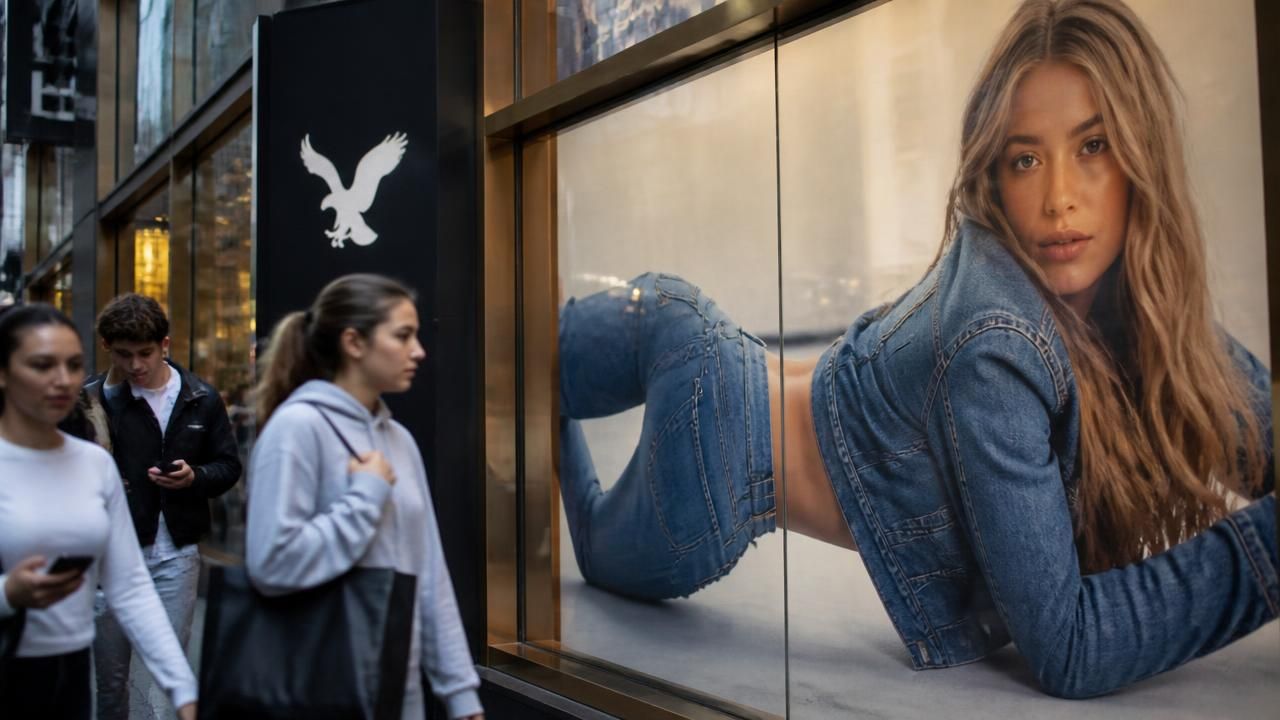
American Eagle Outfitters’ campaign featuring Sydney Sweeney was built to sell jeans. Instead, it has become a collision point between celebrity marketing, global supply-chain scrutiny and Wall Street’s sober view of the retailer’s future. The ad—centered on the line “Sydney Sweeney has great jeans”—is drawing renewed attention after MSN reported that the controversial campaign is back. At the same time, NPR is asking a question the ad never answers: who made the jeans, and under what conditions?
The story spans three arenas. In pop culture, the Sweeney campaign generated chatter and controversy, with the New York Post describing it as a “steamy jeans campaign.” In labor reporting, NPR and dailynewsen.com connect the product to garment workers in Pakistan and Bangladesh. On Wall Street, American Eagle’s shares fell about 14%—the Post’s article body cited 15%—after a dismal forecast, despite the campaign’s visibility.
A marketing moment meets a supply-chain question
MSN’s headline says the controversial ad is back, suggesting a second wave of attention around a campaign that had already sparked debate. But the more consequential reporting comes from NPR, which shifts the focus from the celebrity to the people who stitch the product. The NPR report asks: “Sydney Sweeney has great jeans, American Eagle Outfitters tells us. But who made them?” That question turns a fashion campaign into a labor story.
“Sydney Sweeney has great jeans, American Eagle Outfitters tells us. But who made them?” — NPR
The reporting points to garment factories in Pakistan and Bangladesh, two of the world’s largest apparel exporters. The dailynewsen.com headline makes the same connection, saying the jeans “point to garment workers’ conditions.” Together, the coverage reframes the ad: what looks like a simple celebrity endorsement becomes a window into the complex, multi-country supply chains that produce affordable denim for American shoppers.
Why Pakistan and Bangladesh matter
Pakistan and Bangladesh are central to the global garment trade. Bangladesh’s apparel sector employs millions of workers and has been under international scrutiny since disasters such as the 2013 Rana Plaza factory collapse, which killed more than 1,100 people and led to stronger—though still uneven—safety and labor reforms. Pakistan’s apparel industry is also a major supplier to Western brands, and labor advocates have long raised concerns about wages, working hours and enforcement of factory standards.
The NPR report does not present the Sweeney campaign as the cause of those conditions. Rather, it uses the ad as a way to ask whether the brands that profit from celebrity-driven marketing can trace their products and ensure decent working conditions. For consumers, the jeans are a product; for brands, they are a supply chain that can carry reputational risk.
The market’s verdict: buzz is not enough
If the campaign was meant to give American Eagle a marketing lift, the financial reaction was a reminder that advertising cannot overcome a weak outlook. The New York Post reported that American Eagle dropped 14% on a dismal forecast despite the Sweeney campaign; the article body cited a 15% decline. The difference is minor, but the direction is clear: investors were not buying the buzz.
That does not mean the campaign failed commercially. Celebrity endorsements can drive traffic, social media engagement and brand awareness. But they operate on a different timeline from earnings forecasts, inventory costs and consumer demand. A viral ad may sell a few more pairs of jeans; a disappointing forecast tells investors that broader pressures remain.
Three frames, one story
- Marketing frame: MSN and the New York Post emphasize the ad’s controversy and celebrity power, treating Sweeney as the story.
- Labor frame: NPR and dailynewsen.com ask who made the jeans and under what conditions, shifting attention to Pakistan and Bangladesh.
- Financial frame: The New York Post’s stock-market coverage shows that a high-profile campaign did not shield American Eagle from a dismal forecast.
The contrast is instructive. A brand can control the image it projects through a celebrity, but it cannot fully control the questions that image invites. When shoppers see Sydney Sweeney in a pair of jeans, they may see style. When labor reporters see the same ad, they see a global supply chain. And when investors see the same campaign, they see one variable among many—not a cure for weak guidance.
What comes next
For American Eagle, the challenge is twofold: stabilize the business and answer the supply-chain questions with transparency. That could mean publishing more detailed factory information, strengthening audits or explaining how it enforces labor standards in Pakistan and Bangladesh. For consumers and advocates, the Sweeney campaign has created an opening: a pop-culture moment that makes a wonky supply-chain issue easier to discuss.
The ad may be back, but the bigger story is what it exposes. In an era when celebrities sell everything from skincare to sneakers, the Sweeney jeans campaign shows how quickly a marketing message can become a test of corporate accountability—and how little Wall Street cares about virality when the forecast turns dark.