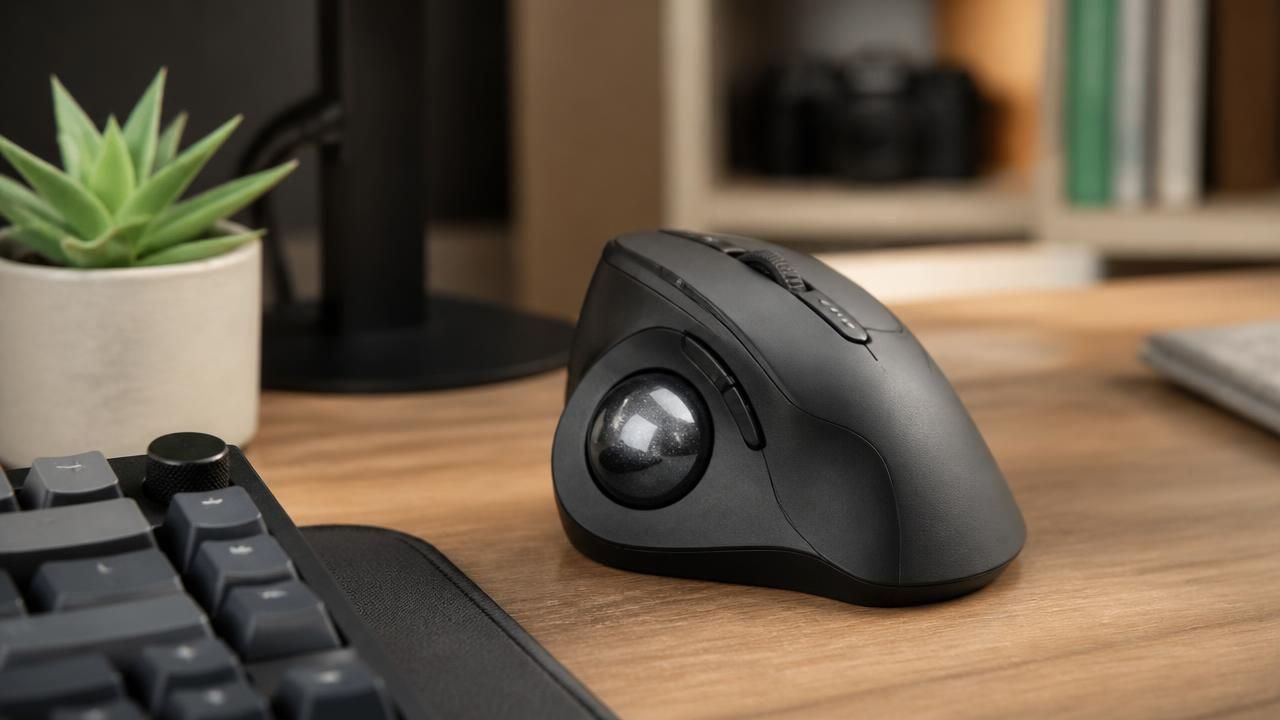
Keychron, the company best known for churning out well-built mechanical keyboards at prices that undercut the establishment, is quietly building out the other half of the desktop. This week the brand opened preorders for the T1 HE, a wireless trackball mouse with a 34mm ball mounted on the side and — unusually — a ball that can be physically repositioned to sit squarely under the user's thumb. At the same time, a wave of reviews for the company's M3 wireless gaming mouse has landed, and the verdict across outlets is remarkably consistent: Keychron's peripherals are getting genuinely good, not just cheap.
A trackball that fits your hand, not the other way around
The T1 HE is the headline. As The Verge reported, the mouse places its 34mm trackball on the side, in the same broad ergonomic category as long-established designs from Logitech and Kensington. What separates it is adjustability: because hands and fingers come in wildly different sizes, Keychron allows the trackball's position to be fine-tuned with minor positional adjustments, so the ball rests under the thumb without the user having to reach for it. The T1 HE is available for preorder through Keychron's own online store.
The "HE" in the name points to Hall Effect magnetic switches, a technology Keychron has already deployed across its keyboard line and is now carrying into pointing devices. Notebookcheck framed the product squarely as an "affordable Logitech MX Ergo alternative," highlighting three differentiators in its headline: on-board memory, the adjustable trackball position, and those magnetic switches. On-board memory matters more than it sounds — it means button remaps, DPI stages and macros travel with the mouse between machines, rather than living in driver software that has to be reinstalled on every computer.
Not Keychron's first ball
The T1 HE does not arrive in a vacuum. Keychron's first trackball, the Nape Pro, was shown at CES 2026 with a slim, compact design intended to sit right up against the edge of a keyboard — a layout aimed at keyboard-first users who want to nudge a cursor without moving their hand to a conventional mouse. The T1 HE represents a pivot toward the mainstream: a side-mounted ball and a more conventional palm-and-thumb posture that will look familiar to anyone who has used an MX Ergo.
Weeks of hands-on: 'it grew on me'
Trackballs are a polarizing category, and early impressions reflect that. Phandroid's long-term test of Keychron's unusual new mouse ran for several weeks under a headline that captures the arc many users report with trackballs: "I tried Keychron's odd new mouse for weeks, and it grew on me." That framing — initial skepticism giving way to comfort — is the classic adoption curve for thumb-operated trackballs, which trade gross-motor sweeping for fine thumb articulation and, advocates argue, reduce shoulder and wrist strain.
The adjustability angle is Keychron's answer to the category's biggest complaint. Ergonomic devices are usually sold in fixed shapes that fit some hands well and others poorly; a sliding ball mount turns a single SKU into something closer to a fitted device. For a company whose identity is built on customization — hot-swappable switches, remappable layers, open firmware — it is a logical extension of the same philosophy.
"Because hands and fingers come in various sizes, the T1 HE allows the position of its trackball to be fine-tuned." — The Verge
The M3 reviews: budget price, no obvious compromise
While the T1 HE grabs the attention, the reviews landing for the M3 wireless mouse explain why Keychron's peripheral ambitions are credible. AppleInsider titled its review "Customization at a budget-friendly price," praising the degree to which the mouse can be tailored to the user. PCWorld's verdict was broader still — "this wireless gaming mouse does just about everything" — the kind of line reviewers reserve for products that refuse to specialize. MacWorld's framing was the most provocative, positioning the M3 as "faster than Magic" in a direct jab at Apple's own first-party mouse.
The consistency is notable given how differently these outlets usually judge hardware. Apple-focused publications tend to weigh build quality and macOS integration; PCWorld weighs specs and value; The Gadgeteer weighs long-term ergonomics. That all three converge on roughly the same conclusion suggests Keychron has closed much of the gap with incumbents on fundamentals — sensor performance, wireless stability, battery life — while retaining the price advantage that made its keyboards popular.
- Adjustable trackball position: the 34mm ball on the T1 HE can be shifted so it sits under the thumb without reaching.
- Hall Effect magnetic switches: the same technology Keychron uses across its keyboard range, now in a pointing device.
- On-board memory: profiles and remaps stored on the mouse itself, no software dependency.
- Pricing posture: positioned explicitly as a cheaper alternative to the Logitech MX Ergo.
- M3 reception: customization, performance and value all singled out for praise across reviewers.
Why it matters
The peripheral market has been remarkably static for a decade. Logitech and Kensington own the trackball niche; a handful of gaming brands own the high-refresh wireless mouse segment; Apple owns the default Mac mouse almost by inertia. Keychron's strategy — enter each category with near-parity specs, aggressive pricing, and one distinctive customization hook — has already reshaped the mechanical keyboard market, where it helped push hot-swappable sockets and gasket mounts from boutique features to commodity expectations.
Whether the same playbook works for pointing devices depends on execution. Trackball users are a small, opinionated, and notoriously loyal constituency; a repositionable ball is a genuinely novel answer to their central complaint, but it must feel rigid in use and survive years of thumb pressure. Meanwhile, the M3's strong reviews give Keychron something it needs as it expands: credibility outside keyboards.
Preorders for the T1 HE are open now through Keychron's store, with the company betting that the ergonomic niche is ripe for the same treatment it gave the keyboard — more options, more adjustability, and a lower price than the name brands have been able to justify.