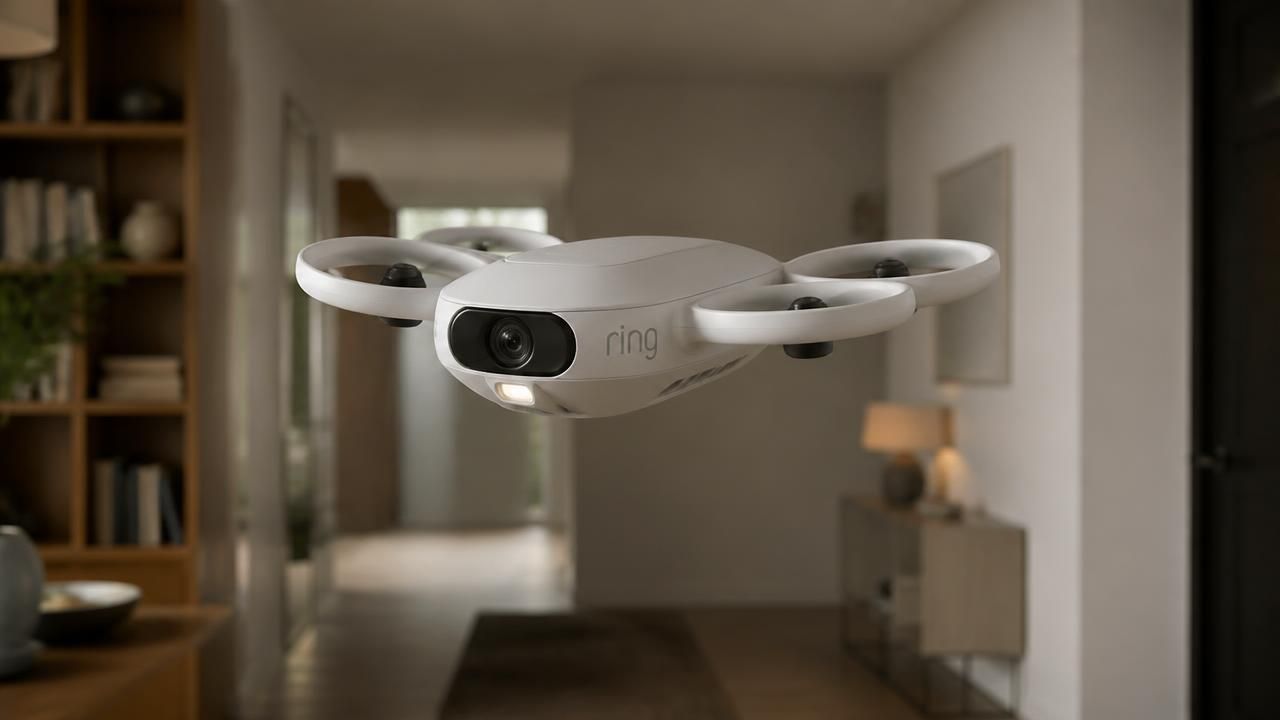
Ring is finally bringing a flying security camera into people’s homes. At a launch event in New York City this week, Ring founder Jamie Siminoff said the Ring Drone Cam will go on sale January 27, 2027, for $249.99. The device is an indoor, AI-powered drone designed to patrol a home when residents are away, and it represents the company’s second attempt at turning a long-promised concept into a shipping product.
The debut is notable less because flying cameras are new than because Ring has spent years promising one. The company announced the Ring Always Home Cam in 2020, but the product never became a mainstream reality. The Drone Cam arrives almost six years later—a delay that The Verge’s hands-on coverage does not ignore. Even as Ring commits to a date and a price, The Verge notes that the device will ship “if it does actually ship,” a phrase that captures the skepticism surrounding a category that has often looked better in concept videos than in daily life.
From Always Home Cam to Drone Cam
Ring’s pitch is straightforward: a camera that can go where fixed cameras cannot. Instead of blanketing a house with lenses, the Drone Cam is meant to launch when something happens. Ring says it can react to triggers from its sensors, including motion detection, a door opening, a water leak, or an alarm sounding. When triggered, the drone flies along pre-programmed routes to a set location, giving homeowners a view of the event in progress.
“The Ring Drone Cam will arrive on January 27th, 2027, for $249.99,” Siminoff said at the New York launch event.
The concept addresses a real gap in home security. Fixed indoor cameras are cheap and reliable, but they can miss hallways, blind corners, and rooms where users do not want permanent hardware. A flying camera could, in theory, provide temporary surveillance on demand. In practice, the idea raises hard engineering questions: battery life, flight safety, obstacle avoidance, noise, and what happens when a drone encounters pets, children, or a closed door. Ring’s pre-programmed route model appears designed to limit those risks by keeping the drone on known paths rather than letting it roam freely.
How the Drone Cam is supposed to work
According to Ring, the Drone Cam is not a continuous flying sentry. It is event-driven. The drone waits until a Ring sensor detects something unusual, then follows a route to a designated waypoint. That makes the product closer to a mobile response camera than to a 24/7 patrol robot.
- Triggers: motion, door openings, water leaks, and alarm events can prompt a flight.
- Navigation: the drone follows pre-programmed routes to a set location.
- Use case: check on a disturbance or leak when the homeowner is away.
- Price and availability: $249.99, scheduled for January 27, 2027.
That design may also be Ring’s answer to privacy concerns. A camera that only flies when cued is easier to justify than one that hovers constantly. But it does not eliminate the harder questions about indoor drones: whether people will tolerate a flying device in their homes, how reliably it navigates in cluttered spaces, and how Ring handles the video and sensor data it collects.
A crowded and fragmenting smart-home market
The Drone Cam lands in a market that is already crowded and increasingly defined by AI features rather than hardware alone. TechRepublic’s 2026 smart-home security camera roundup still frames the category around Ring, Nest, Arlo, and Eufy, a reminder that Ring’s flying camera must compete with mature fixed systems that are cheaper, simpler, and already installed in millions of homes.
The broader platform battle matters too. The Verge separately tested whether Apple Home’s AI camera features can outsmart those from Amazon and Google, highlighting a market split across ecosystems. Ring is owned by Amazon, which gives it distribution and cloud infrastructure, but also ties it to a platform rivalry. Apple and Google are pushing their own AI-powered camera features, and consumers may increasingly choose cameras based on which assistant and app they already use rather than on a single flying gadget.
Drone control is evolving quickly outside the home-security category as well. A report from MSN notes that Antigravity’s 8K drone has received an upgrade allowing control with a wrist and a tiny ring. That development points to a future in which cameras and drones are controlled through wearables and gestures rather than phones. For Ring, the lesson is clear: the Drone Cam is not just a security product; it is part of a wider race to make AI vision more autonomous, more responsive, and more integrated into daily life.
Privacy, practicality, and the road to 2027
The biggest test for Ring will be trust. Indoor cameras already raise sensitive questions about consent, data retention, and third-party access. A camera that flies through a home adds a new dimension: physical movement in private space. Ring will need to explain clearly when the drone flies, who can access the footage, how routes are configured, and what safeguards prevent accidental recording.
The price may help. At $249.99, the Drone Cam is expensive for a single camera but not outrageous for a flagship smart-home device. The real barrier may be practical rather than financial. A fixed camera works every time; a flying camera has to prove it can launch reliably, navigate safely, and return without becoming an obstacle. The six-year gap between the Always Home Cam announcement and the Drone Cam’s scheduled arrival shows how difficult that has been.
What to watch
Ring has given the Drone Cam a date, a price, and a clear use case. The remaining questions are execution and reception. If the device ships on time and works as advertised, it could push indoor security cameras toward a more mobile, event-driven model. If it slips again—or if buyers find the drone noisy, fragile, or unnerving—it may remain a niche gadget in a market that has already moved on to AI features, ecosystem integration, and wearable controls. For now, Ring has finally turned its flying-camera promise into a product. The market will decide whether it is a breakthrough or a curiosity.