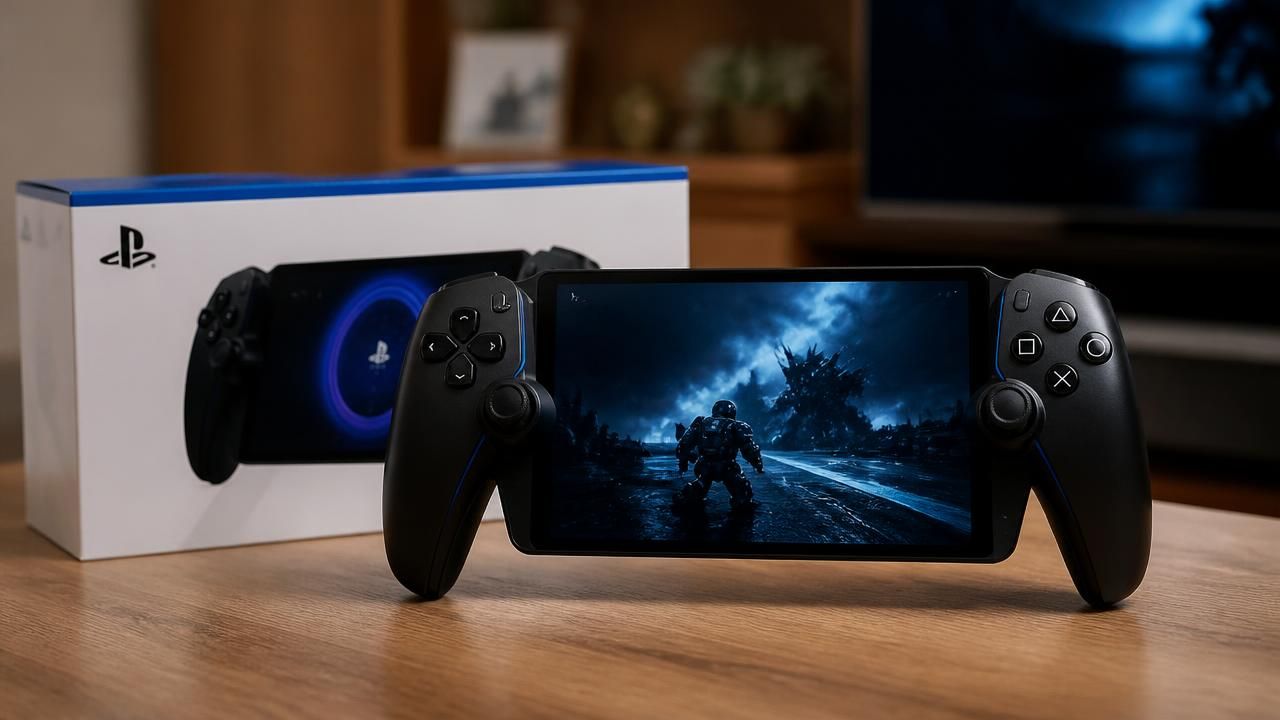
Sony is preparing a new version of the PlayStation Portal, but only Japanese players will be able to buy it. The updated handheld will launch exclusively in Japan next month in the midnight black colorway, and — in the most consequential and least explained change — it will ship with additional internal storage that Sony says is intended for “future functionality” it has not yet detailed.
The announcement, reported by The Verge and picked up across outlets including VideoGamesChronicle, Kotaku, Gematsu, VideoCardz and Analytics Insight, is unusual on several fronts: it is a hardware revision with no headline spec upgrade, a regional exclusivity with hard software locks, and a teaser for features Sony is explicitly declining to describe.
What Sony Actually Announced
The new model is a Japan-only variant of the streaming handheld. According to The Verge, it arrives in the midnight black finish the company has shown before, and includes “additional” internal storage “for future functions” that Sony will announce only once those features are finalized. The Verge described the storage bump as the surprise of the release, given that nothing else about the device's core capabilities appears to have changed.
The regional restrictions are strict. The device will be locked to Japanese language options and can only be used with a PlayStation account registered in Japan — a limitation that effectively rules out imports for enthusiasts hoping to get the extra storage early. Sony is also renaming this particular Portal, shifting away from the “PlayStation Portal Remote Player” branding used at launch.
Notably absent from the reveal is any mention of an OLED display. Analytics Insight framed its coverage around precisely that gap, headlining the update as “more storage, no OLED” — a pointed summary of what many observers had hoped a second-generation Portal might deliver.
The Storage Mystery
Why a device designed almost entirely around streaming needs extra on-board storage is the question Sony has declined to answer. VideoCardz captured the ambiguity bluntly in its headline: Sony is adding internal storage to the new Portal, “but won’t say what it’s for.”
Sony says the extra storage is for “future functionality” that it will announce once those features are finalized.
The speculation writes itself. A handheld with more local storage could support downloadable content, offline play sessions, background caching of streamed titles, or expanded cloud-streaming features for PlayStation Plus Premium subscribers. The original Portal launched in 2023 at $199.99 as a pure Remote Play accessory — an 8-inch 1080p LCD panel flanked by a DualSense-style controller — and was widely mocked at reveal for requiring a PS5 to be useful at all. It has since been rehabilitated, first by a strong holiday season and then by a cloud streaming beta that let owners play supported PS5 titles without a console, a capability that shifted the device from curiosity to genuinely useful product.
Packing in storage that no current feature uses is either forward planning or preparation for a service announcement — and Sony's refusal to specify which is unusual even by its own secrecy standards.
Why Japan First
The Japan-only launch is not arbitrary. The country remains one of the world's most portable-gaming-obsessed markets, dominated by the Nintendo Switch family, where handheld play is the default rather than the exception. Sony has historically given its home market special-edition hardware and colorways, and a midnight black Portal timed for a local push fits that pattern.
But exclusivity here cuts against Sony's biggest opportunity. The Portal's usefulness depends on a strong home broadband connection and a PlayStation Plus library, and the cloud streaming beta — the feature that transformed the device's reputation — was rolled out to a global audience. Restricting a hardware-hungry variant to one country guarantees a gray-market scramble and frustrated messaging elsewhere.
Is It Worth Buying in 2026?
That question, raised by MSN's consumer-focused coverage, is the one most prospective buyers are actually asking. The case for the Portal has improved markedly since launch: cloud streaming removed the PS5 tether, and for households with a contested television the device is a genuinely convenient way to keep playing. The case against is equally durable — it is not a standalone console, it does not run games natively, and even with cloud streaming it is fully dependent on network quality and a subscription.
The absence of an OLED panel on this revision suggests Sony is not yet treating the Portal as a premium display product. Combined with unexplained internal storage, the picture is of a device being incrementally repositioned rather than redesigned — an accessory being quietly upgraded in anticipation of services that do not yet exist.
The Bottom Line
- What's new: a Japan-only, midnight black PlayStation Portal with additional internal storage and a new name.
- What's not: no OLED screen, no announced spec overhaul, no global availability.
- What's unknown: what the extra storage is for. Sony has promised disclosure only when its “future functionality” is finalized.
For Japanese players, the refresh arrives next month with a small but real hardware upgrade and a promise attached. For everyone else, the announcement is a signal about where Sony intends to take the Portal next — a roadmap written in gigabytes, with the destination still withheld.