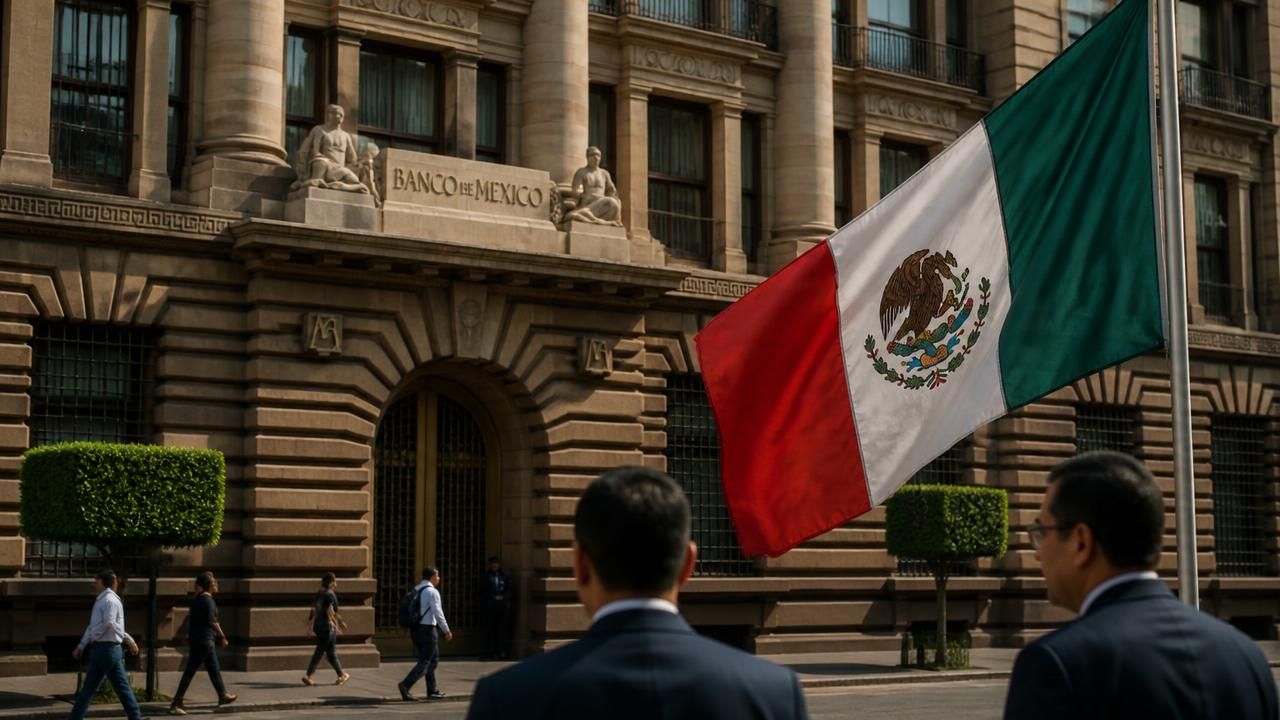
Mexican inflation accelerated more than economists expected in October, a data release that lands barely a week after Banco de México delivered one of its more contentious policy decisions in recent memory: an unexpected cut to its benchmark interest rate to 6.25%, accompanied by guidance suggesting borrowing costs will stay put for an extended period.
The juxtaposition — rising consumer prices on one side, looser monetary policy on the other — has thrust the central bank's reaction function into the spotlight and split market commentary over whether policymakers are getting ahead of the disinflation curve or simply responding to a weakening economy.
The inflation print
According to Bloomberg Markets, October's annual inflation reading came in above consensus, an outcome that will "likely intensify scrutiny of the central bank's decision last week to cut interest rates in the face of persistent price pressures." Yahoo Finance framed the same release more bluntly, describing the acceleration as a direct test of the Banxico rate path — language that underscores how much of the market's forward curve now depends on whether October proves to be a bump in the road or the start of a stickier phase.
That framing matters because Banxico's easing cycle has been built on the premise that inflation is converging toward its 3% target, with a tolerance band of plus or minus one percentage point. Any suggestion of re-acceleration complicates that narrative, particularly if the pressure is concentrated in core components — services and non-food goods — that are less sensitive to one-off shocks in energy or agriculture.
A decision that bucked expectations
The rate move itself was the surprise. Mexico News Daily reported that Banxico lowered rates "bucking expectations," despite lingering inflation concerns, while Bloomberg's headline captured both elements of the decision at once: a cut to 6.25% and a signal of an extended hold thereafter.
That combination — an easing step wrapped in hawkish forward guidance — reflects the awkward position many emerging-market central banks now occupy. Policymakers are trying to support growth without declaring victory on prices, and the guidance of an extended pause effectively tells investors that the cut is not the beginning of a rapid easing sprint.
Markets are being asked to hold two ideas at once: that inflation remains a live risk, and that policy can still move lower. The guidance of an extended hold is the bridge between them.
The decision also invites a question of sequencing. If officials suspected October's inflation number would disappoint, why cut beforehand? One reading is that the central bank is forward-looking and judges the recent uptick to be noise. Another is that the bank is responding to real-economy weakness that the inflation data does not capture.
The growth picture is brightening
Which is where the second strand of coverage becomes relevant. Mexico News Daily also reported that Mexico's 2026 growth outlook improved in surveys conducted by both Banxico and Citi — a signal that the private sector is not uniformly gloomy about the road ahead.
Improved 2026 expectations cut both ways for monetary policy. On one hand, a brighter growth outlook reduces the urgency of aggressive rate cuts as insurance against a downturn. On the other, resilient demand can sustain services inflation, which is precisely the component that keeps core prices elevated. The surveys therefore reinforce the case for the Bank's "extended hold" language: no rush in either direction.
How the story is being framed
The differences in coverage are instructive:
- Bloomberg Markets leads with the inflation beat and treats it as a stress test of the rate decision, emphasizing policy credibility.
- Bloomberg's policy story leads with the cut itself, highlighting the surprise and the signal of a prolonged pause.
- Mexico News Daily emphasizes the unexpected nature of the cut against inflation concerns, then pivots to the improving 2026 growth outlook.
- Yahoo Finance frames the data as a direct challenge to the rate path, a forward-looking markets angle.
Read together, the coverage describes a central bank deliberately trading a small, pre-emptive easing for a longer period of stability — rather than committing to a fast descent.
What to watch next
Attention now shifts to the next inflation readings and to the tone of Banxico's subsequent communications. Three data points will decide the debate:
- Core inflation. If services prices keep drifting higher, the case for the October cut erodes quickly.
- The peso. A softer currency raises imported inflation and narrows the room for further easing.
- The growth surveys. Continued upgrades to 2026 expectations would argue against any acceleration in the easing cycle.
For investors, the practical takeaway is that the Mexican peso's carry appeal remains intact — 6.25% is still a high nominal rate relative to developed markets — but the volatility around data releases is likely to rise. The central bank has effectively sold the market a story of patience. October's inflation number is the first serious test of whether that story holds.
If the next print cools, the surprise cut will look prescient. If it doesn't, Banxico will face the harder question every inflation-targeting central bank dreads: whether it eased too soon, and what it is prepared to do about it.