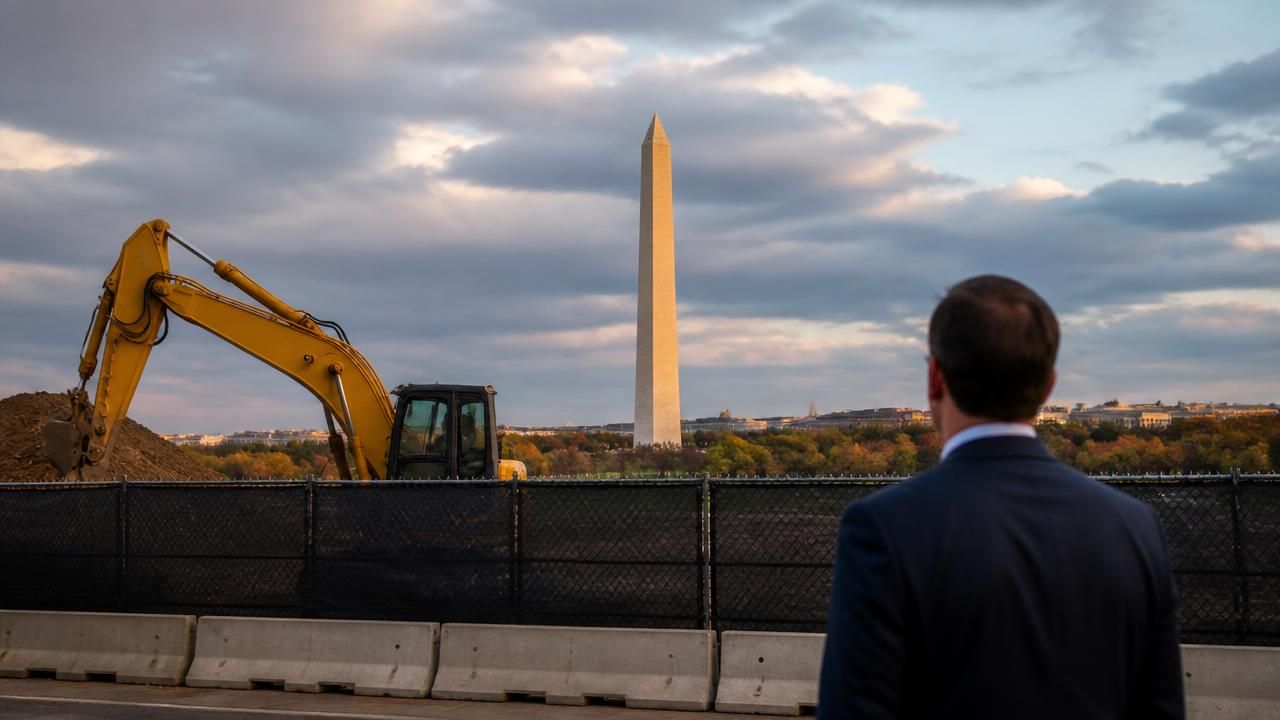
A federal judge has temporarily blocked construction of President Donald Trump's proposed monumental arch in Washington, D.C., issuing an order just after midnight that bars any work from proceeding for 14 days — a decision that landed only minutes after a key federal panel gave the project its formal approval late Thursday night.
The sequence of events, compressed into a matter of hours, produced a striking collision between the executive branch's push to break ground and the courts' power to stop it. According to NPR Politics, the Trump administration had hoped to begin construction immediately after the federal panel signed off. Instead, the judge's order froze the project before a single shovel could turn.
An Approval and a Block, Hours Apart
The timeline is central to the story. Late Thursday, a key federal panel — the body responsible for reviewing major construction in the nation's capital — was expected to approve the arch even as it faced an active legal challenge, according to MSN. That approval duly arrived, and the administration moved to capitalize on it at once.
But shortly after midnight, the judge intervened. Multiple outlets, including NPR Politics and newscentermaine.com, reported the same core facts: a 14-day delay on any work beginning on what one headline called Trump's "monumental arch." Yahoo News framed the development succinctly as a U.S. judge temporarily blocking "Trump's Washington arch."
The near-simultaneity of the two decisions — regulatory green light, judicial red light — was not coincidental. It reflects a legal strategy in which challengers raced to secure emergency relief before construction could begin, on the theory that once heavy machinery arrives at a site, the practical and political calculus shifts sharply.
Why the Timing Matters
A 14-day hold is, on its face, a modest pause. But temporary restraining orders of this kind are often the opening move in a longer fight, buying time for fuller briefing, evidentiary review, and a preliminary injunction that could extend the halt for months or longer.
For the administration, the midnight order is a direct check on momentum. Officials had clearly structured their plans around winning panel approval and starting work without delay; the judge's intervention removes that option and forces the project back into the courtroom.
For opponents, the ruling validates a strategy of parallel tracks — contesting the arch politically and in the courts while simultaneously pressing for emergency judicial protection. That the order came within hours of the panel's approval suggests the legal groundwork had been laid well in advance.
Differing Frames Across Outlets
Coverage of the ruling varied subtly in emphasis, reflecting each outlet's instincts. NPR Politics led with the drama of the moment — a judge acting "moments after" federal approval — foregrounding the institutional clash. Newscentermaine.com's headline emphasized the remedy itself, the "14-day delay," a framing that stresses concrete consequence over conflict. Yahoo News compressed the story to its barest form: the arch is temporarily blocked.
MSN's coverage, meanwhile, focused on the sequence leading up to the ruling, noting that the federal panel was expected to approve the project even while it remained under legal challenge — a detail that underscores just how contested the arch's status was at every stage of review.
The administration hoped to begin construction immediately after a federal panel approved its arch late Thursday. But just after midnight, the judge issued an order blocking work for 14 days.
Context: Monuments, Review, and the Courts
Major construction in Washington is ordinarily subject to layered federal review, precisely because the capital's built environment is treated as a shared national inheritance rather than ordinary real estate. Projects of symbolic scale typically pass through advisory and planning bodies before ground is broken — a process designed to surface objections early and to insulate the skyline from abrupt change.
The arch proposal has followed that path but under unusually compressed and adversarial conditions. Because the project is closely identified with the sitting president, it has drawn attention beyond the usual architectural and planning circles, pulling questions of executive ambition, public land, and judicial oversight into a single dispute.
Legal challenges to such projects commonly center on whether the review process was properly followed, whether statutory requirements were satisfied, and whether interested parties received adequate opportunity to be heard. The judge's 14-day order does not resolve any of those questions. It preserves the status quo while they are argued.
What Comes Next
- The next two weeks: Both sides will file papers and the court will consider whether to extend the pause beyond 14 days.
- The panel's approval: Remains in place but is effectively unusable while the order holds, and will likely face its own legal challenge.
- The broader stakes: The case is an early test of how far a president's monumental ambitions can run when they meet the federal review apparatus and an assertive judiciary.
For now, the arch exists on paper and in renderings only — approved by one arm of the federal government, halted by another, and awaiting a third to decide how the story ends.