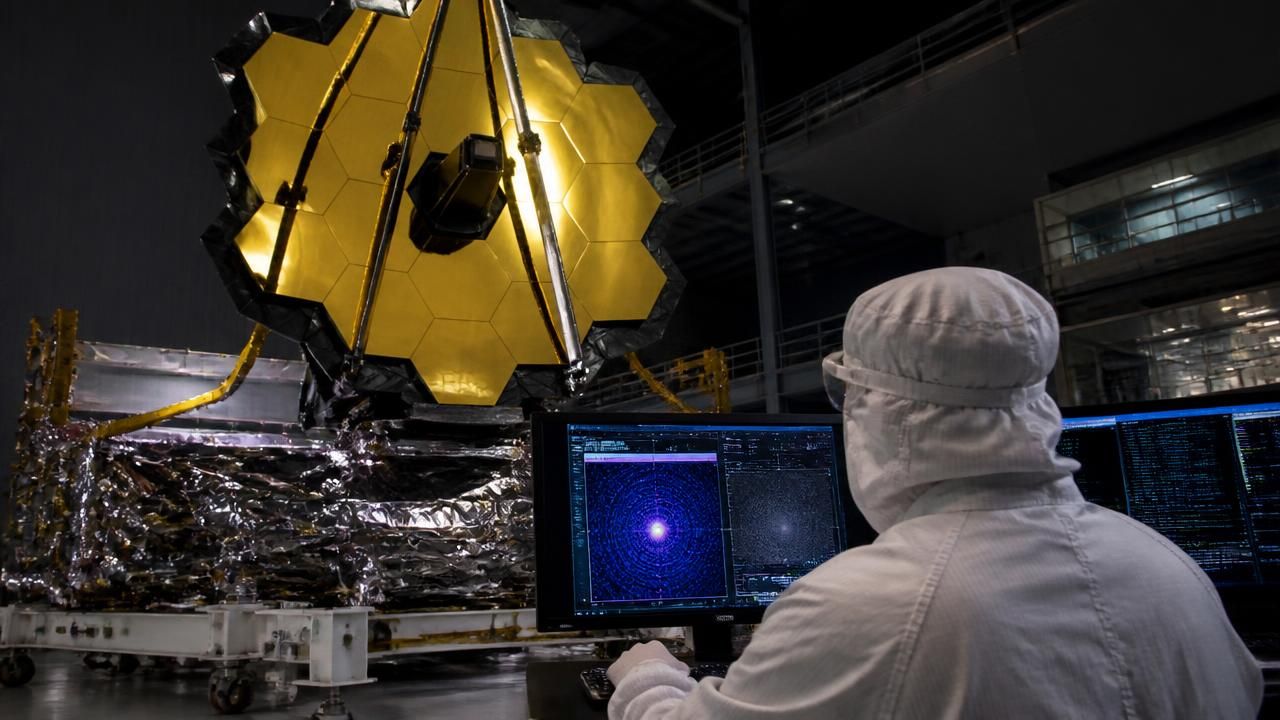
Astronomers trying to photograph planets beyond our solar system face a glaring problem: the stars they orbit can be millions or billions of times brighter than the worlds themselves. Now a team of Northwestern University astrophysicists has developed a computational method that builds a digital twin of the James Webb Space Telescope and uses it to model, then subtract, residual starlight that would otherwise swamp faint exoplanet signals. The work, reported in Nature and described in coverage from Ars Technica, MSN, Labroots and Martin Cid Magazine, could make some planets up to 15 times easier to see in JWST images, according to the team’s claims.
The advance does not require new optics or a new telescope. Instead, it relies on software that optimizes a physical model of JWST—its optics, detector behavior, pointing and configuration—against actual observations. By understanding how the telescope transforms a point of light into a blurred, speckled pattern, researchers can better account for noise that changes subtly between observations and remove the star’s glare while preserving a planet’s faint signal.
The starlight problem
Directly imaging an exoplanet is one of the hardest observations in astronomy. A star and its planet are separated by a tiny angle on the sky, and even a small leak of starlight can drown out the planet. Telescopes can be fitted with coronagraphs, devices that block much of a star’s light, but Ars Technica notes that their effectiveness is limited by noise from subtle variations in the telescope’s configuration and pointing between observations. The mathematical description of how a telescope distorts a point of light is called its point spread function.
“If you use a telescope to image a single point of light, it will not appear that way in the actual image. Instead, it will be slightly blurry and spread out, due to imperfections in the telescope hardware and the limits of our ability to keep it pointed accurately.”
That spread-out pattern is the point spread function, and it is central to the new work. If researchers can model the pattern precisely—including how it changes from one observation to the next—they can subtract more of the star’s contaminating light and expose the planet hidden beneath it.
A digital twin, not a new lens
The phrase digital twin, used by Martin Cid Magazine, captures the idea: the software creates a computational replica of JWST that can be adjusted to match real data. Ars Technica describes the package as optimizing a physical model of the telescope in a way that allows researchers to better model differences between observations, producing low-noise imaging of exoplanets. In effect, the method treats the telescope’s imperfections not as fixed flaws but as variables that can be measured, modeled and compensated for.
Different outlets have emphasized different aspects of the result. Ars Technica focused on the point spread function and the mathematical modeling; MSN highlighted the erasure of stellar glare to spot hidden exoplanets; Labroots described the technique as uncovering hidden exoplanet glare; Martin Cid Magazine framed it as a digital twin making planets up to 15 times easier to see; and Nature placed it in the broader effort to detect faint exoplanets using a computational approach to remove glare from stars. Together, the coverage points to a shift in exoplanet imaging: better software may be as important as bigger mirrors.
Why it matters
JWST has already transformed the study of exoplanet atmospheres by capturing light that filters through or around planets as they pass in front of their stars. But transit spectroscopy works only for planets whose orbits align with our line of sight. Direct imaging can reach worlds in wider orbits and can, in principle, reveal reflected light or thermal emission from the planet itself. That makes it a key tool for studying non-transiting planets and for characterizing young, hot worlds that are still glowing from formation.
The new method could help astronomers make better use of JWST’s limited observing time. With more than 5,000 confirmed exoplanets and a catalog that continues to grow, the demand for follow-up observations is intense. If software can remove more starlight from existing or future images, it could extend the telescope’s reach toward fainter, smaller or more distant planets. The reported improvement of up to 15 times is not a guarantee for every target, but it suggests that computational improvements could meaningfully widen the search.
Limits and next steps
The technique is not a magic eraser. Removing glare computationally depends on assumptions about the telescope and the star, and researchers will need to validate that a residual signal is really a planet rather than an artifact of the model. The method is also most useful when combined with coronagraphs and careful observing strategies; it does not eliminate the need for follow-up confirmation. Still, the approach offers a promising way to squeeze more science out of JWST’s hardware without changing it.
For a field that has spent decades fighting the overwhelming brightness of stars, the result is a reminder that the next breakthrough in exoplanet imaging may come not only from larger mirrors but from smarter algorithms. By building a digital twin of JWST and teaching it to recognize the telescope’s own distortions, researchers are turning an obstacle into a solvable computational problem—and bringing the faint light of distant worlds a little closer to view.