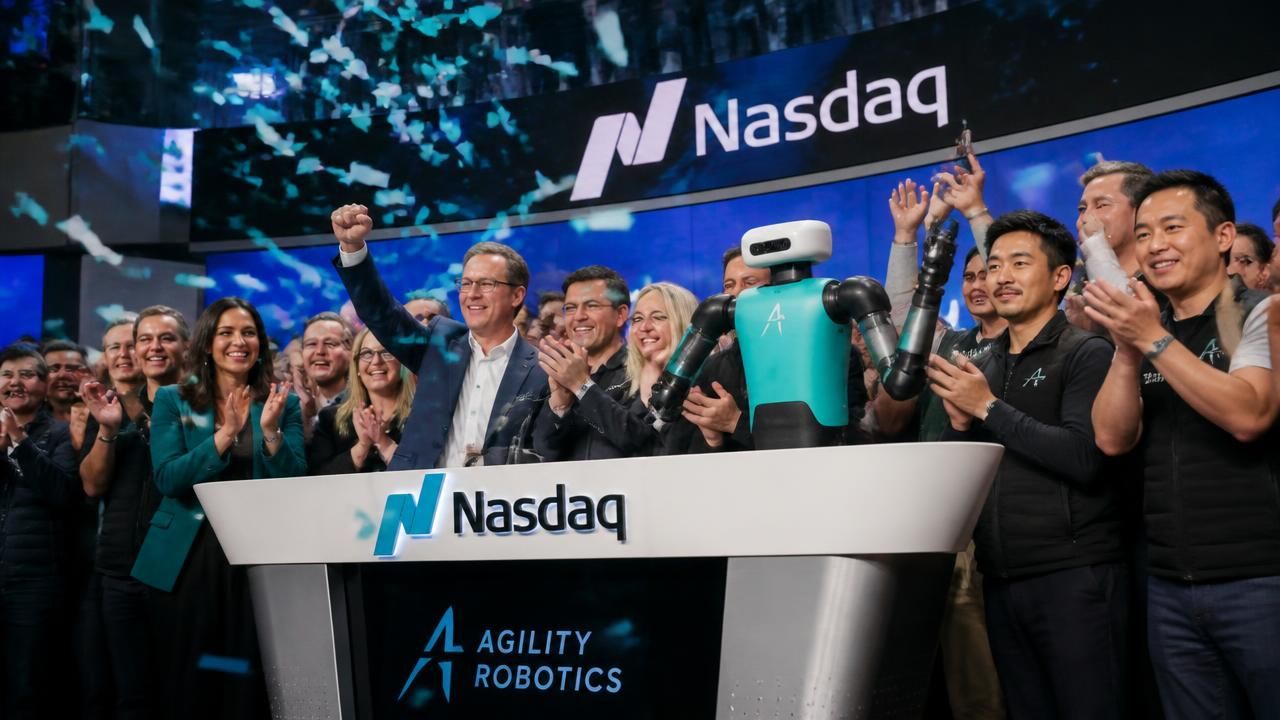
Agility Robotics began trading on the Nasdaq on November 5 under the ticker AGLT, becoming the first dedicated humanoid robot developer in the United States to list its shares on a major exchange. The Salem, Oregon–based company, which is backed by Nvidia, arrived on Wall Street via a merger with the blank-check firm Churchill Capital, a route that turned a privately held robotics startup into what analysts are already calling a pure-play bet on the future of manual labor.
It is a milestone that arrives with unusually little revenue behind it — and a highly unusual amount of investor enthusiasm in front of it. The tension between those two facts runs through nearly every account of the listing.
A First for Wall Street
Agility had already notched a series of firsts before ringing the opening bell. In 2024, it became the first company to achieve full-time commercial deployment of humanoid robots at a customer warehouse, a proof point that has anchored its pitch to investors ever since. Its flagship machine, Digit, is designed to move totes and carry out repetitive material handling in facilities built for human bodies — a deliberate design choice that lets the robot slot into existing workflows rather than demanding that customers rebuild their operations around it.
The company's next-generation machine, Digit 5, will run on Nvidia compute, according to reporting from The Next Web — a detail that ties Agility to the most closely watched name in artificial intelligence and gives the listing a Silicon Valley halo that pure industrial automation firms rarely enjoy. TechRepublic reported that Digit 5 carries roughly $300 million in orders, though it noted there is a catch — order pipelines in the robotics sector typically consist of commitments that must still be converted into delivered, revenue-generating units over time.
Small Revenue, Large Ambitions
Forbes framed the debut bluntly, noting that the humanoid maker went public on the strength of just $1.8 million in 2025 sales. That figure stands in stark contrast to the scale of the market Agility is courting. Warehousing and logistics operators spend hundreds of billions of dollars annually on labor, and even a small slice of that spending would represent a transformation for the company.
The celebratory framing was on display in corporate announcements carried by Yahoo Finance, which described Agility as "the first U.S. publicly listed pure-play humanoid robotics company." Investor-facing coverage from Seeking Alpha took a different angle entirely, casting the Churchill Capital vehicle as "a call option on Agility, America's nascent humanoid robotic innovator" — language that treats the stock less as a business with predictable cash flows than as a levered wager on an industry that may or may not arrive on schedule.
The Robot-as-a-Service Bet
Central to Agility's commercial strategy is a rental model, in which customers pay per robot per hour rather than purchasing hardware outright. Executives argue this removes the capital expenditure hurdle that has slowed adoption of factory automation among mid-sized operators.
"When we are doing robots as a service, it is much lower risk for customers to use it because they are getting a return on investment on day one. Because they're paying a rate that is comparable to the human labor rate, and that makes the economics pretty straightforward."
— Jonathan Hurst, co-founder and chief robot officer, Agility Robotics
The approach also shifts risk onto Agility's balance sheet. If utilization rates disappoint or maintenance costs run high, the company absorbs the difference — a dynamic that will become visible to public investors for the first time in quarterly filings.
Safety as a Selling Point
Agility has also invested heavily in the safety story that underpins any humanoid deployment. Ars Technica has reported that the company's newer humanoid design will stop and squat to avoid harming human coworkers, a maneuver intended to reduce the severity of collisions in shared workspaces. That kind of behavior — reflexive, physically conservative, and designed around human unpredictability — is what separates a warehouse-capable robot from a demo reel.
The Skeptics' Case
Not everyone is convinced the timing is right. In its securities filing, Agility itself acknowledged a set of risks that reads like a checklist for doubters:
- Unproven at scale. Humanoid robots have not yet achieved widespread commercialization, in contrast to industrial robot arms that have decades of proven track record in warehouses and factories.
- Thin revenue base. Roughly $1.8 million in 2025 sales leaves little margin for execution error.
- Order conversion risk. A $300 million order book is only as valuable as the rate at which it becomes shipped, billed product.
- Capital intensity. Manufacturing, service networks, and R&D all consume cash faster than early-stage rental revenue replaces it.
- SPAC track record. Blank-check mergers carry a well-documented history of optimistic projections followed by post-listing markdowns and shareholder litigation.
Ars Technica's coverage leaned into that scrutiny, describing the listing as an invitation to examine a market that remains, by the company's own admission, unproven. Forbes' focus on the revenue figure pointed in the same direction. By contrast, the wire-style announcements and the investor-note framing emphasized category creation — the idea that being first to public markets confers a strategic advantage in talent, credibility, and access to capital.
What to Watch
The next several quarters will be decisive. Agility's first earnings report as a public company will be combed for deployment counts, rental utilization, and gross margin on its service contracts. The expiration of post-merger lockups could test demand for the shares. And the Nvidia relationship will be scrutinized both as a technical advantage and as a dependency.
Competition is closing in from multiple directions: established industrial automation vendors extending into mobile manipulation, well-funded humanoid rivals racing toward their own commercial deployments, and automotive-backed robotics programs with deep manufacturing expertise.
For now, Agility occupies a singular position — the first American humanoid robot company that ordinary investors can buy. Whether that turns out to be a landmark or a cautionary tale will depend on how quickly a machine that squats to avoid a collision can learn to walk a straight line to profitability.