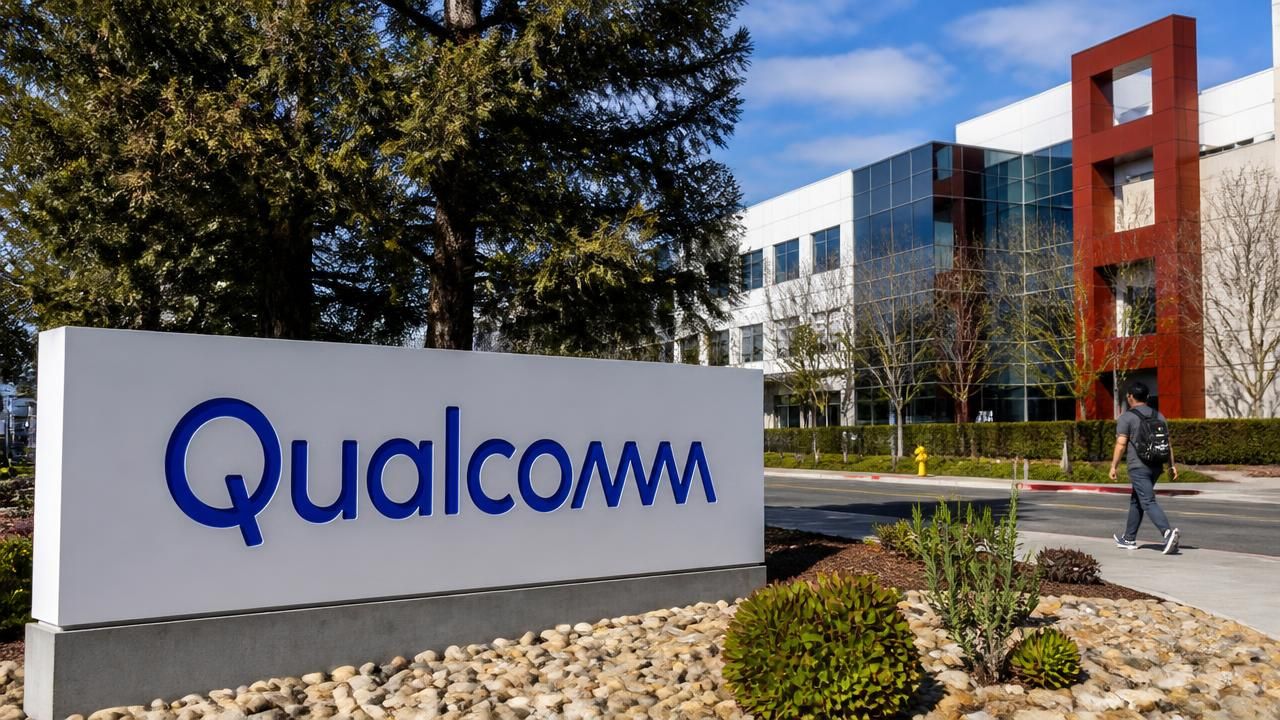
Qualcomm spent decades building a business on the back of the smartphone. Now, with that market contracting sharply, the San Diego chipmaker is asking investors to judge it by a different yardstick: artificial intelligence data centers.
On its Q4 2026 earnings call, the company laid out an unusually aggressive roadmap for a business line that is still, by its own admission, in its infancy. Qualcomm told analysts it expects roughly $650 million in data center revenue in the first quarter of 2027 — a figure it said will climb to $5 billion by the end of that year and reach $15 billion by 2029.
The stakes are hard to overstate. As The Verge noted in its coverage of the call, Qualcomm's total revenue for 2026 was $10.4 billion, meaning the company is effectively forecasting that a business segment barely on the books today could, within three years, be larger than the entire company is right now.
A core business in retreat
The urgency behind the pivot is not hard to find. Smartphone sales are down roughly 20 percent compared with 2025, a decline that strikes directly at Qualcomm's most important profit center. The company's Snapdragon processors power a large share of the world's premium Android handsets, and handset makers' order books have cooled as consumers hold onto devices longer and upgrade cycles stretch out.
That exposure has made Qualcomm unusually vulnerable among the large semiconductor firms. Rivals such as Nvidia and Broadcom have ridden the AI infrastructure boom to record valuations, while Qualcomm's share price has been weighed down by its dependence on a single, maturing end market.
Coverage of the earnings call from MSN and other outlets framed the shift in blunt terms: Qualcomm's smartphone business is hurting, and data centers could fuel its next act. The consistent message across the earnings coverage is that management now views diversification not as a long-term aspiration but as an immediate necessity.
The hyperscaler bet
Qualcomm's data center push is not starting from zero. Earlier this year the company announced partnerships with Amazon and Meta, two of the largest buyers of AI infrastructure on the planet. Those relationships give Qualcomm a route into hyperscale deployments that would be difficult to build from scratch, and they lend credibility to the revenue targets management sketched out on the call.
"We expect that portion of our business to grow quickly," Qualcomm said of its data center arm, forecasting $650 million in the first quarter of 2027 — a figure it projects will reach $5 billion by the end of 2027 and $15 billion by 2029.
The strategy appears to hinge on inference — running trained AI models rather than training them — where power efficiency and cost per query matter more than raw peak performance. That is a segment where Qualcomm's heritage in low-power mobile silicon could translate into an advantage, and where hyperscalers are actively shopping for alternatives to Nvidia's dominant, power-hungry accelerators.
In an interview with Yahoo Finance, Qualcomm's chief financial officer discussed the AI and data center opportunity alongside what the company is positioning as its next major bet: robotics. That framing suggests Qualcomm sees its future as a portfolio of edge and infrastructure compute markets rather than a single flagship product line — a notable shift for a company whose identity has been inseparable from the phone in consumers' pockets.
A market it once walked away from
Qualcomm's data center ambitions carry a cautionary history. The company previously attempted a server chip effort, the Centriq line, built around Arm-based processors for cloud workloads. It was shelved in 2018 amid cost cutting, well before the generative AI boom made data center silicon the most strategically important market in technology.
That earlier retreat is likely to color how Wall Street receives the new targets. Analysts have long noted that entering the data center market requires more than a competitive chip: it demands deep software ecosystems, developer tooling, and years of trust-building with hyperscalers that design their own silicon and guard their supplier relationships closely.
The competitive field is also far more crowded than it was in 2018. Nvidia remains the dominant supplier of AI accelerators, while AMD, Broadcom, Marvell, and the in-house silicon teams at Amazon, Google, and Microsoft all compete for the same racks. Arm's growing presence in server CPUs — and Qualcomm's own licensing relationship with Arm — adds another layer of complexity.
What to watch
- Execution against the ramp: Hitting $5 billion by the end of 2027 requires a near-eightfold increase in roughly twelve months. Investors will want design wins disclosed, not just forecasts.
- Handset floor: If smartphone declines deepen beyond the current 20 percent, the data center business may need to grow faster than planned simply to keep total revenue flat.
- Robotics as a hedge: The CFO's emphasis on robots signals Qualcomm is already looking past data centers for its next growth vector, potentially applying the same edge-computing playbook it used in mobile.
- Hyperscaler commitment: The Amazon and Meta partnerships are the load-bearing element of the entire plan. Any sign of shifting volume commitments would be a red flag.
For now, Qualcomm has done what struggling chipmakers rarely manage: it has convinced the market to debate its future rather than dwell on its present. Whether the $15 billion figure becomes a milestone or a cautionary tale will depend on how quickly the company can turn hyperscaler handshakes into shipping silicon.