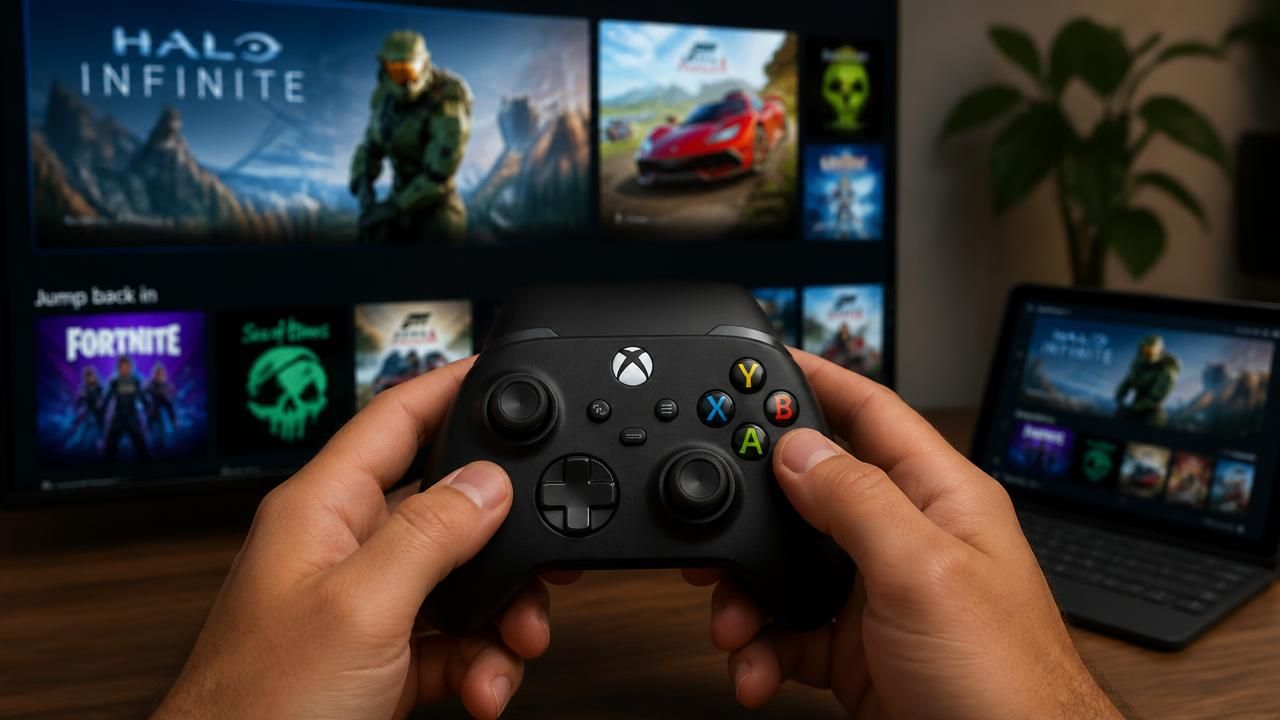
Microsoft is set to release the Xbox Nano, its smallest and cheapest controller to date, on Tuesday for $49.99 — a device the company is positioning as the entry point to a console-free future. But according to reporting from The Verge, the palm-sized gamepad carries a feature Microsoft has so far declined to advertise: the ability to connect directly to Xbox Cloud Gaming servers over Wi-Fi, bypassing the local device entirely to shave milliseconds off input latency.
A Controller Built for the Cloud
The Wi-Fi cloud-connect capability is not theoretical. The Verge reports that the feature is being privately tested on Microsoft's new Xbox Cloud Gaming website and requires users to pair the Nano over Wi-Fi to Microsoft's servers rather than to a console or phone. The approach mirrors the technology Google once built into its Stadia controllers, which famously linked directly to Stadia's data centers instead of routing inputs through a phone, TV stick, or PC.
That parallel is instructive. Stadia's direct-connection model was widely praised by engineers for reducing the input lag that makes streaming fast-paced games feel mushy — and widely ignored by consumers, who largely stayed away from the platform before Google shut it down in January 2023. Microsoft appears to be betting that the idea was sound, even if the business model that carried it was not.
"The Nano can connect directly to Xbox Cloud Gaming over Wi-Fi to improve latency. It's a feature Microsoft hasn't officially announced yet, but one I've been anticipating since the Xbox Nano leaked earlier this year." — The Verge
Smaller, Cheaper, and Broader
The Nano's second headline feature, confirmed across coverage, is Bluetooth support. Where Microsoft's standard Xbox Wireless Controller relies on a proprietary radio protocol for console connections, the Nano adds Bluetooth to the standard lineup, unlocking pairing with phones, tablets, laptops, and smart TVs without an Xbox console anywhere in the picture. Coverage from MSN framed the device precisely this way: a controller that "adds Bluetooth to Microsoft's standard lineup, unlocking console-free gaming."
The pricing is equally central to the story. At $49.99, the Nano undercuts Microsoft's standard wireless controller, which typically retails around $59.99 to $69.99 depending on color and promotions. Neowin's coverage led with both facts together — "Microsoft unveils Xbox Nano, its smallest controller ever, for just $49.99" — underscoring that size and price are the pitch, not premium features or Elite-style customization.
How the Coverage Differed
- The Verge led with the unreported technical story: a hidden Wi-Fi cloud link and its Stadia lineage, treating the launch as a latency story.
- Neowin focused on the hardware and the price tag, framing the Nano as a record-setting form factor at an aggressive $49.99.
- MSN (first item) positioned the device as purpose-built for Xbox Cloud Gaming — "perfect for Xbox Cloud Gaming" — treating streaming as the primary use case rather than a side feature.
- MSN (second item) emphasized Bluetooth and the console-free angle, framing the Nano as a broadening of Microsoft's accessory lineup rather than a niche streaming gadget.
- The Times of India covered the launch as a straightforward product milestone, headlining that Microsoft had launched "its smallest gamepad yet."
The divergence is telling. Outlets covering Microsoft's hardware beat see a small, cheap accessory. Outlets covering the cloud platform see a strategic wedge. Both are describing the same $49.99 product, but they imply different answers to the question of why Microsoft built it now.
Why a Cloud Controller, and Why Now
Microsoft has spent years arguing that gaming does not have to be tethered to a $500 box under the television. Xbox Cloud Gaming is bundled into Game Pass Ultimate, and the company's long-stated ambition is to reach players on whatever screen they already own. The bottleneck has rarely been the catalog. It has been the experience — and a meaningful share of that experience is input latency, which no amount of server capacity can fully hide when a button press travels through a phone, a Bluetooth stack, and a Wi-Fi network before reaching a data center.
A controller that talks to the cloud on its own removes at least one hop from that chain. The trade-off is a second network connection to manage and the possibility of configuration friction for casual users — precisely the kind of complexity that sank earlier direct-connect experiments. The private test on the new Xbox Cloud Gaming website suggests Microsoft is still working through that onboarding problem before it says anything publicly.
There is also a competitive dimension. Sony has pushed its own streaming ambitions through the PlayStation Portal, a handheld that streams from a PS5 rather than from the cloud directly. Microsoft's approach — a cheap controller plus a browser — is lighter, cheaper, and lower-commitment for the consumer, but it also depends on network conditions Microsoft cannot control.
The Bottom Line
The Xbox Nano launches tomorrow at $49.99 as the smallest controller Microsoft has ever shipped, with Bluetooth on board and a Wi-Fi cloud-connect feature that the company has not yet announced. For buyers, it is an inexpensive second (or third) controller that works practically anywhere. For Microsoft, it is something more consequential: a $50 bet that the next generation of Xbox players will never own an Xbox at all — and that the difference between a good streaming experience and a bad one comes down to a few dozen milliseconds.