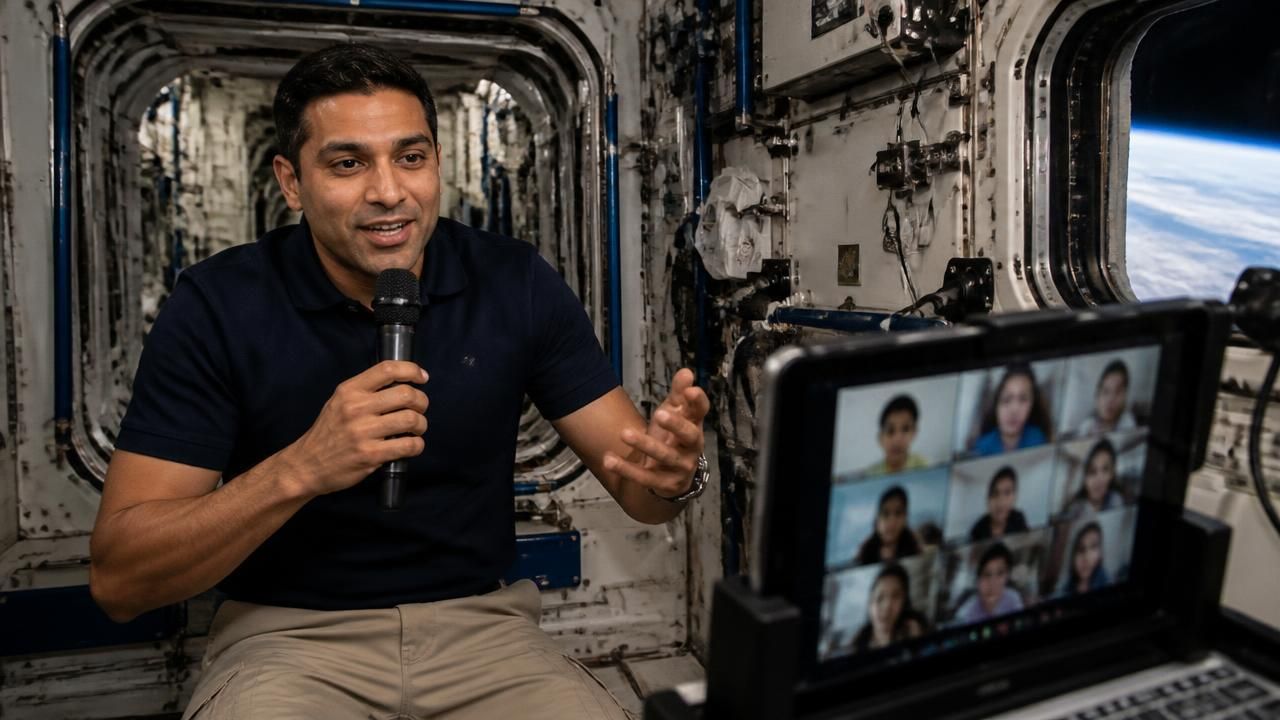
NASA is turning the International Space Station into a classroom. On Wednesday, Nov. 4, at 11 a.m. EST, NASA astronaut and Expedition 74 flight engineer Anil Menon will take questions from students across the United States during a live, interactive in-flight call timed to National STEM Day, the agency announced. Joining him from California will be Mark Rober, the former NASA engineer turned science content creator and founder of the ClassCrunchLabs Foundation.
The event, hosted by NASA's Office of STEM Engagement, will stream on the agency's flagship YouTube channel with additional engagement across its Learn With NASA platforms. According to NASA, the downlink is designed to bring "real-world science, engineering, and exploration into classrooms nationwide" — a mission statement that has become something of a mantra for the agency's education arm as it competes for students' attention in an increasingly crowded media landscape.
A live line to low Earth orbit
The format is deceptively simple: students ask questions, an astronaut answers them from roughly 250 miles above the planet. But the substance of the call spans the practical and the aspirational. Menon is expected to field queries about what it is like to live and work in microgravity, the training and education path that leads to an astronaut corps selection, and the technologies — life support, spacesuits, robotics — that make sustained human spaceflight possible.
Students will also see the station in real time as Menon demonstrates how ordinary activities, from eating to running experiments, change in weightlessness. NASA imagery from earlier in the mission shows Menon servicing a spacesuit and its components inside the station's Quest airlock, a reminder that much of an astronaut's day is closer to meticulous maintenance work than to the popular image of free-floating exploration.
"From aboard the space station, Menon will answer questions from students about living and working in microgravity, the path to becoming an astronaut, and the technologies that make human spaceflight possible." — NASA
From NASA engineer to science celebrity
Rober's presence signals NASA's recognition that reach matters as much as rigor. A former NASA JPL engineer, Rober built a massive following by engineering elaborate, often gleefully absurd demonstrations — the kind of content that reliably converts a scrolling teenager into a curious one. Through the ClassCrunchLabs Foundation, he has pushed further into formal education, funding hands-on engineering resources for classrooms.
His role in the Nov. 4 broadcast, per NASA, is to share "how curiosity, creativity, and hands-on problem-solving shaped his career from NASA engineer to STEM creator" — a narrative arc the agency hopes will resonate with students who do not see themselves in a textbook diagram. Pairing a sitting astronaut with a creator who speaks natively in the language of online video is a deliberate strategy: the astronaut supplies authority, the creator supplies attention.
Beyond the broadcast: a patchwork of local efforts
The national downlink is only the most visible strand of a much wider and more fragmented web of space-themed education outreach, much of which never makes NASA's press releases.
- North Carolina: Local coverage highlighted efforts to get students in the state excited about science and math by putting them in conversation with a NASA astronaut, framing space outreach as a tool for building enthusiasm in traditional STEM subjects.
- NC A&T State University: Regional reports described talented students at the historically Black university receiving astronaut-linked scholarships — a reminder that the pipeline extends well past K-12 into higher education, and that access and affordability remain central barriers.
- Student-designed experiments: Elsewhere, students worked alongside a retired NASA astronaut to design their own space experiments, shifting from passive audience to active investigator.
- St. Vrain Valley, Colorado: The "Space in the Community" program brought a former NASA astronaut into schools in the St. Vrain Valley district, part of a long-running local effort to weave aerospace themes into the curriculum.
Details of several of these regional programs were limited in available summaries, but the pattern is consistent: retired astronauts and agency alumni function as traveling ambassadors, converting a career's worth of operational experience into a few hours of classroom inspiration.
Two framings of the same story
The coverage itself reveals a split in emphasis. National science and space outlets tend to frame these events as spectacle and access — a rare, real-time window into orbit, with the astronaut as the main attraction. Local outlets, by contrast, frame them as workforce development: scholarships, university partnerships, district-level curriculum programs, and the question of whether a region can grow its own aerospace talent base.
Both framings are accurate, and they point to the same underlying concern. Demand for STEM workers in the United States continues to outpace supply, and interest often decays between elementary school and high school — a well-documented "leaky pipeline" that a single broadcast cannot repair. Outreach events are, by design, sparks rather than scaffolding. What determines whether the spark catches is what happens the following Monday: whether a district has a qualified physics teacher, lab equipment, and a computer science pathway that does not dead-end at an introductory course.
NASA's Office of STEM Engagement is not, and does not claim to be, a substitute for education policy. But the agency's persistent investment in these events reflects a strategic bet: that visible, charismatic role models — a flight surgeon turned astronaut, a former JPL engineer turned YouTube star — can shift what students believe is possible for them.
How to watch
The Earth-to-space call begins at 11 a.m. EST on Wednesday, Nov. 4, streaming on NASA's flagship YouTube channel, with supplementary material on the agency's Learn With NASA channels. Educators can find accompanying classroom resources through NASA's STEM engagement portals. For students who submit questions in advance, the appeal is obvious: a direct answer, delivered live, from someone currently living off the planet.