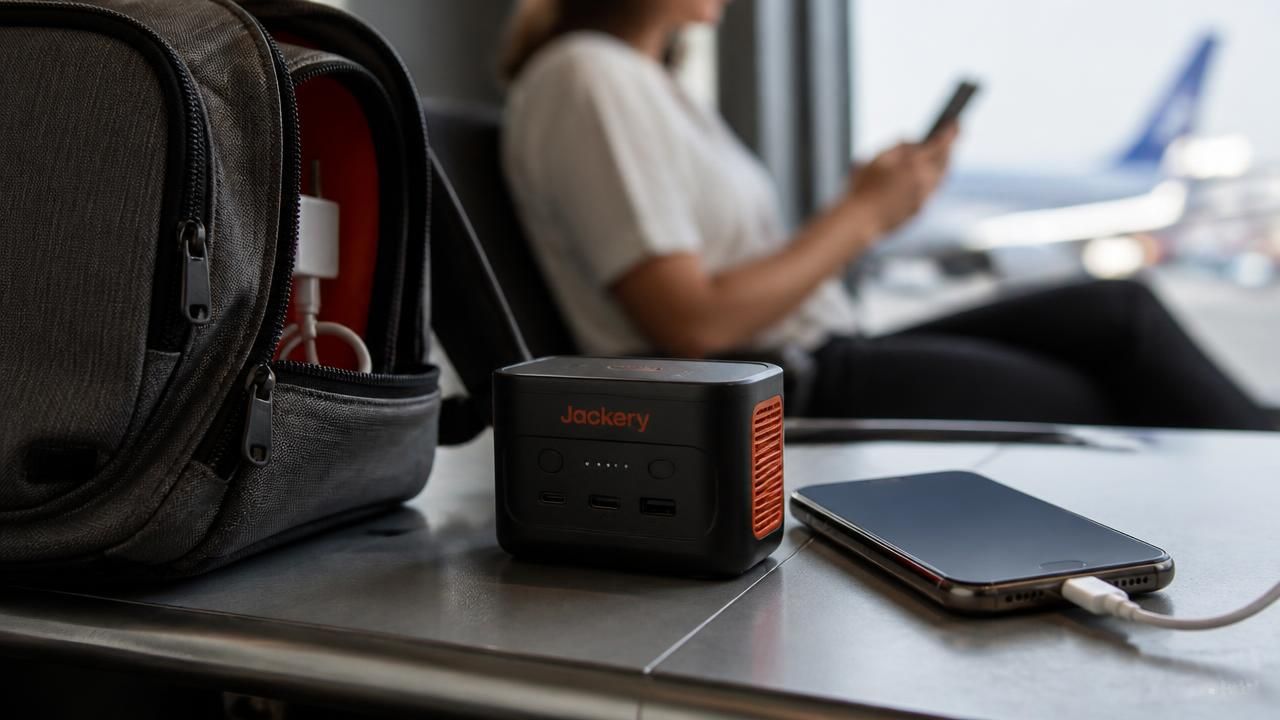
Jackery is pursuing two very different strategies at once: making its portable power stations dramatically smaller, and making the older ones dramatically cheaper. This week the company unveiled the Explorer 100D, its smallest power station to date, while simultaneously running a drumbeat of steep discounts across Amazon, Walmart and Costco in the U.S. and Canada — a two-front campaign that says a lot about where the portable energy market is heading.
A power station that fits in a carry-on
According to The Verge, the Explorer 100D measures just 4.6 by 3.4 by 3.4 inches and weighs 1.87 pounds — small enough to disappear into a backpack pocket. It carries 96Wh of capacity, or roughly 30,000mAh, which the publication notes is enough to "squeeze it into your carry-on and power multiple devices during a long flight."
That capacity figure is not accidental. Most airlines and the FAA cap lithium batteries in carry-on luggage at 100 watt-hours, meaning the 100D is engineered to sit just under the regulatory ceiling. It is a rare case of product design being driven explicitly by aviation rules rather than by raw specs.
Pricing follows the same logic. The Explorer 100D will sell for $99 starting November 15th through Walmart, and is already on shelves at Costco for buyers who don't want to wait.
The quiet shift to LFP chemistry
The more consequential detail is inside the case. The 100D uses lithium iron phosphate (LFP) batteries, a chemistry Jackery first introduced in 2023 and has been rolling across its lineup since. LFP cells trade a little energy density for meaningfully better thermal stability and far longer cycle life than the nickel-manganese-cobalt (NMC) packs that dominated early portable power stations. In a category where devices are routinely left charging unattended in tents, RVs and hallways during blackouts, that safety margin matters more than a few extra watt-hours.
"What makes the new Explorer 100D stand out is that it's Jackery's smallest power station to date." — The Verge
Solar, camping and the roundup economy
The compact hardware push extends beyond the 100D. Jackery's SolarSaga 40W Air panel has been positioned as ultra-lightweight solar for camping and off-grid use, aimed at hikers and car campers who want to top up a small station without carrying a rigid folding panel.
That puts Jackery in direct competition with Anker (and its Solix line) and Goal Zero, a three-way rivalry that now dominates buyer's-guide coverage. Mashable's 2026 roundup of the best power stations for camping pits Jackery, Anker and Goal Zero against one another, while Popular Mechanics' tested list of the eight best stations for outages and outings and The Independent's expert-tested picks for camping, home and power cuts all treat the same handful of brands as the default shortlist. For consumers, the practical effect is that the category has consolidated around a few trusted names — and that every one of those names now ships an LFP option.
Jackery has also begun segmenting by use case rather than capacity. The FridgeGuard, which Mashable reviewed as "both functional and pretty," is designed specifically to keep a refrigerator running through an outage — a single-job appliance aimed at the anxiety of spoiled food rather than at campers charging drones.
The discount engine
Alongside the product news, Jackery's promotional calendar has been relentless. The company advertised up to 65% off 4.5-star-rated power stations and solar generators for Amazon's Prime Big Deal Days, with parallel Canadian campaigns pitched squarely at the country's grid reliability. StreetInsider framed the Canadian offer around staying "prepared for Canada's grid outages," while Yahoo Finance's coverage emphasized reliable backup power "for the season ahead."
- Prime Big Deal Days: up to 65% off power stations and solar generators, in both the U.S. and Canada.
- Prime Day: individual models, including at least one Jackery station, discounted by roughly half, per WIRED.
- Prime Day Encore: MacRumors tracked Anker and Jackery promotions offering as much as $1,500 off.
- Memorial Day: up to 53% off, including editor-tested backup picks, per Popular Mechanics.
The frequency of these events is itself a signal. When a product category discounts at 50% or more several times a year, list prices become largely decorative, and the "up to" figures in press releases refer to the oldest, largest and least portable units in the catalog — not the new compact models. Shoppers comparing a $99 Explorer 100D against a 65%-off flagship should recognize they are looking at two different purchasing decisions: convenience versus whole-home backup.
Why it matters now
Portable power stations have moved from camping curiosity to household insurance. Aging grids, extreme weather and rolling outages have made backup power a mainstream purchase in North America, and the segment has responded by splitting in two directions: ever-larger home-backup units measured in kilowatt-hours, and ever-smaller personal units measured in ounces.
The Explorer 100D sits at the far end of that second curve, and its constraints are worth stating plainly. Ninety-six watt-hours will charge a phone several times over or run a laptop for a few hours, but it will not run a fridge, a space heater or a coffee maker. Solar recharging from a 40W panel is a slow trickle, not a fill-up. And a 1.87-pound device is a convenience product, not an emergency plan.
Still, the direction of travel is clear. Jackery is betting that the next wave of buyers wants power they can forget in a bag — and that the fastest way to sell it is to make the hardware smaller, the chemistry safer, and the older inventory cheaper.