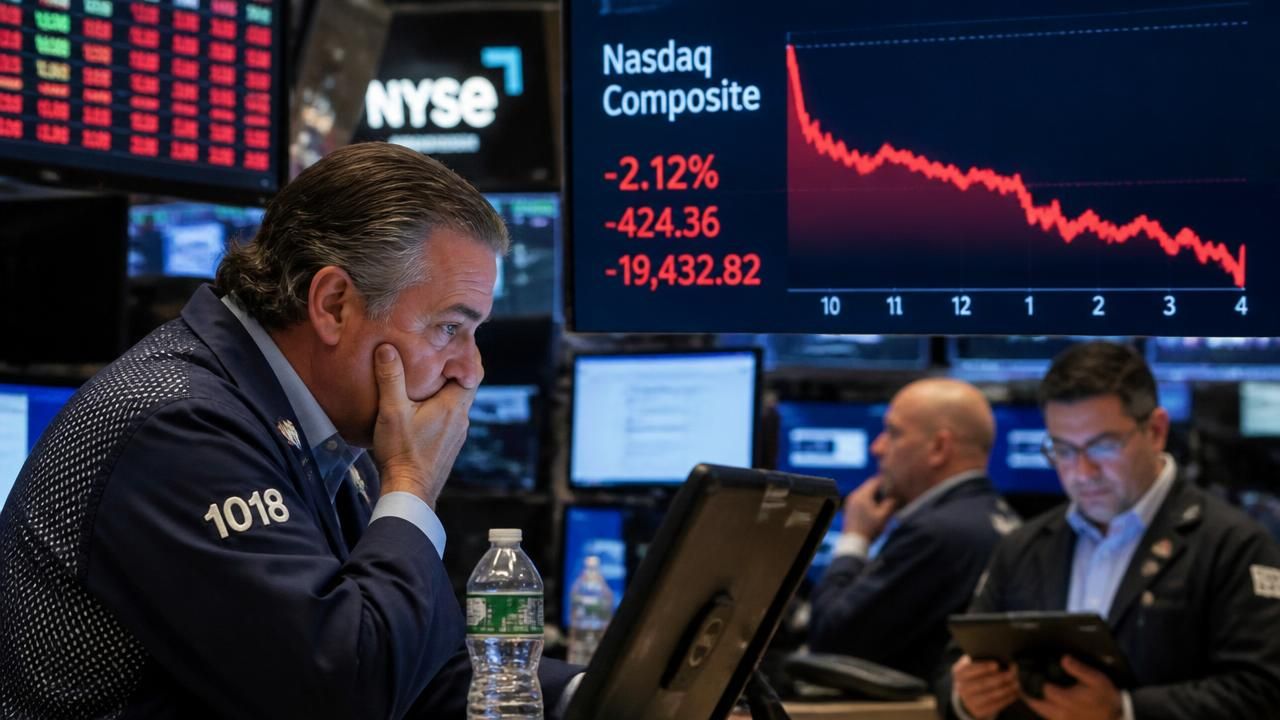
Wall Street's most crowded trade took another blow on Thursday, Oct. 29, as disappointing results from Intel and Amazon jolted investors who have spent the past two years pricing in an seemingly limitless boom in artificial intelligence spending. The Nasdaq opened roughly 2% lower and slid to its lowest level in nearly three months, while the broader market fell in sympathy — a session that one headline in The Wall Street Journal simply labeled: AI Jitters Spread.
The trigger was corporate, but the anxiety was structural. Intel sank 29% after its earnings report, a collapse of a magnitude rarely seen in a mega-cap semiconductor name and one that instantly erased tens of billions in market value. Amazon, the other half of the one-two punch, fell sharply after results and guidance that investors read as a warning sign rather than a triumph — a rare reversal for a company whose cloud and AI ambitions have been among the most powerful engines of the bull market.
A Session Defined by Two Tickers
By mid-morning, the damage was broad enough that trading desks were describing it in the language of a regime change rather than a single bad day. Bloomberg's markets coverage framed the move plainly: Stocks Fall After Amazon and Intel Deal Another Blow to AI Trade. Invezz put a number on the open — Nasdaq opens 2% lower as Amazon and Intel selloff deepens AI spending concerns — while MSN's aggregation of the session captured the threshold investors had been dreading: NASDAQ hits near three-month low.
- Nasdaq: opened about 2% lower; touched a near three-month low
- Intel: down 29% on earnings — the session's most violent single-stock move
- Amazon: fell sharply after results that failed to reassure on AI-related spending and returns
- Contagion: losses spread across chipmakers, cloud infrastructure names and AI-adjacent suppliers
Intel: A 29% Verdict
Intel's slide is the more dramatic of the two, and arguably the more telling. A 29% single-session decline reflects not merely a missed quarter but a repricing of the company's place in the AI supply chain. Intel has staked its turnaround on building a foundry business capable of competing for the advanced-node contracts that AI accelerators demand — a capital-intensive bet that requires enormous, sustained investment before it produces commensurate revenue. When results fail to show that arc bending toward profitability, investors are forced to ask how long the market will fund the gap.
“Intel Sinks 29% On Earnings—As AI Spending Fears Worsen Tech Selloff” — MSN
That framing matters. Intel's problem is partly idiosyncratic — execution, share loss, the cost of rebuilding manufacturing credibility — but the market treated it as a data point about the entire capex cycle. If the company spending the most aggressively to capture AI demand is punished this severely for an underwhelming quarter, the implied message is that investors are no longer willing to fund the buildout on faith alone.
Amazon and the Return-on-Investment Question
Amazon's decline carries a different charge. The company is not a struggling challenger but one of the defining winners of the AI era, and its cloud unit is the backbone on which much of the enterprise AI economy runs. When a bellwether of that stature disappoints, the selloff becomes a referendum on the economics of the boom: how much must be spent on data centers, chips and power, and when does that spending convert into earnings rather than depreciation?
The Journal's framing — jitters spreading — captures the mechanism precisely. This is not a sector-specific repricing but a transmission of doubt from one company's balance sheet to the next, as portfolio managers reassess the concentrated bets that have driven index returns for two years.
The Bigger Picture: Concentration Risk Meets Capex Fatigue
Thursday's session is the latest episode in a pattern that has repeated through the year: markets that are extraordinarily dependent on a handful of mega-cap technology names are also extraordinarily sensitive to any evidence that AI spending is outpacing AI revenue. Because index weighting is so concentrated, disappointment in one or two names becomes a market-wide event almost mechanically.
The deeper tension is arithmetic. Hyperscalers have committed hundreds of billions of dollars to data centers, custom silicon and energy contracts. Those commitments hit the income statement as depreciation over years, while the revenue they are meant to generate remains partly speculative — dependent on enterprise adoption curves, pricing power and use cases that are still being invented. Investors tolerated that mismatch while growth was accelerating. They are far less forgiving when it decelerates.
How the Coverage Framed It
The differences in emphasis across outlets were instructive. Bloomberg's franchise, the daily Surveillance program, positions the story as a trading-day problem — what decision-makers on Wall Street and in Washington need to know before the bell. Retail-facing coverage led with the numbers and the fear. The Wall Street Journal reached for the broader narrative, treating the selloff as evidence that AI skepticism has moved from the fringe to the mainstream of institutional thinking.
All six accounts converge on a single conclusion: this was not a rotation, a rate scare or a macro shock. It was the AI trade being marked to market on its own promises.
What to Watch Next
Attention now turns to whether the selling stabilizes or compounds. Key questions for the coming sessions:
- Whether hyperscalers reaffirm capital expenditure guidance or begin to trim it — the single most important signal for the semiconductor complex
- Whether Intel's slide attracts activist or strategic interest, or deepens into a funding question for its foundry ambitions
- Whether the AI-adjacent complex — power, cooling, networking, memory — decouples from the chipmakers or continues to trade as one bloc
- Whether volatility forces de-risking among momentum and index funds, turning a two-stock story into a mechanical one
For now, the market has delivered its verdict on the quarter: the AI trade is no longer priced on possibility. It is priced on proof.